Snap Insight: There’s no liberation from Trump’s tariffs, even after court ruling
It is unclear what happens to the deals made with trading partners now that President Donald Trump’s tariffs have been found illegal by the US Supreme Court, says Hinrich Foundation’s Deborah Elms.
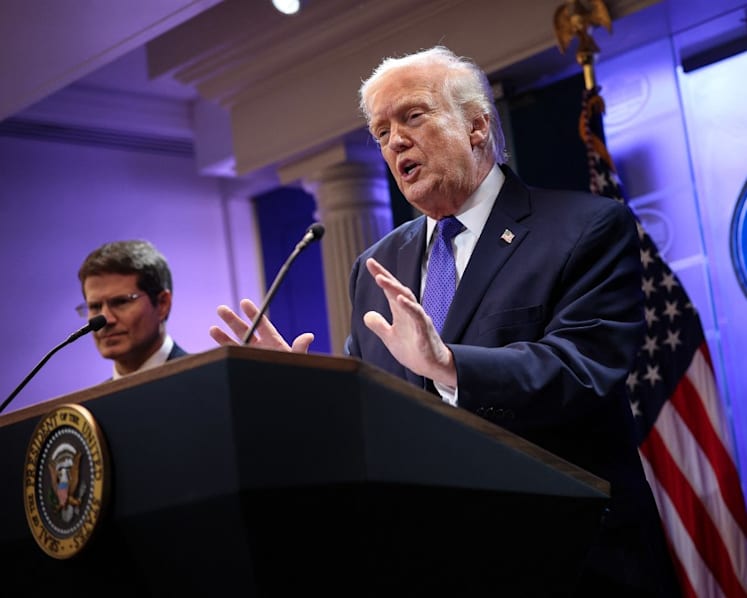
US President Donald Trump speaks during a press briefing at the White House after the Supreme Court ruled against his use of emergency powers to implement international trade tariffs on Feb 20, 2026 in Washington, DC. (Kevin Dietsch/Getty Images/AFP)

This audio is generated by an AI tool.


SINGAPORE: United States President Donald Trump’s most sweeping tariffs are going away. In a stunning rebuke of his signature policy, the US Supreme Court ruled 6-3 to find the so-called “Liberation Day” tariffs illegal.
But don’t mistake this for the end of US tariffs. “We have alternatives,” said Mr Trump in a press conference on Friday (Feb 20), ordering a new 10 per cent global tariff to be applied in the coming days.
What the highest court in the US has struck down is one method of imposing tariffs.
IT’S ABOUT THE EXTENT OF TRUMP’S EXECUTIVE POWER
The basis of the judgment was that the International Emergency Economic Powers Act (IEEPA) does not grant Mr Trump authorisation to impose tariffs.





At the start of his administration in January 2025, Mr Trump imposed tariffs against Canada, Mexico and China over what he claimed was an economic emergency caused by imports of fentanyl. He then used the same economic emergency justification in April when he tariffed the whole world over trade imbalances.
The justices in the majority were categorical in their rejection of the administration’s legal arguments. Tariffs remain the preserve of the legislative branch. Congress did not, the court ruled, intend to allow the president unlimited power to declare emergencies or to impose tariffs under IEEPA.
Not all the tariffs collected on arriving goods fall under IEEPA. Tariff duties will remain in effect for products covered by Section 232 of the Trade Expansion Act that concerns national security threats and by Section 301 of the Trade Act for unfair trade practices.
The Trump administration is likely to expand coverage of goods under these alternative legal statutes, but these are more restrictive.
The immediate response by the White House has been to issue a new Executive Order using Section 122 of the Trade Act to impose global 10 per cent tariffs starting on Feb 24. This statute, which has never been used before, allows for temporary tariffs for only 150 days and requires Congress to extend it thereafter.
During his press conference, Mr Trump claimed these alternative methods could allow him to impose higher tariffs rates and “take in more money”. He also repeatedly referenced his executive powers, saying that he was “allowed” to cut off all trade with a country or impose an embargo.
WHAT DOES THIS MEAN FOR ASIA?
The decision offers little relief to anyone, including countries that have secured trade deals with the US to lower their tariff rates or indeed any US trading partner.
Despite having a bilateral free trade agreement in place for more than two decades, Singapore exports to the United States have been charged a 10 per cent “reciprocal” tariff rate under IEEPA. This tariff will now go away, but is set to be replaced as quickly by the new global tariff.
Goods from Singapore with steel, aluminum and copper as well as vehicles and auto parts will still face tariffs under Section 232 authorisation. And threats of tariffs on additional sectors have not disappeared entirely.
At this point, it remains unclear what happens to US trade partners that have existing trade frameworks, interim trade arrangements or bilateral trade agreements with the Trump administration. This includes Indonesia (which just finalised its agreement on Thursday), Cambodia, Malaysia, Japan and South Korea.
None of these deals are fully in force and many already had ambiguous legal status. It may be that the “reciprocal” rates locked into the agreements remain in place as both parties agreed to the terms. Or it may be that the legal justification for negotiations was IEEPA. With IEEPA no longer in effect, the entire agreement could be renegotiated or voided.
NO LESS CHAOS OR UNCERTAINTY
Another question arising from the decision is how tariff revenue collected under IEEPA to date is to be handled. The amount is substantial, with Bloomberg estimating that US$170 billion may be subject to refund. The court did not provide guidance on this matter.
But it is important to note any refunds will be delivered to the importer of record, not to any foreign exporting companies.
The New York Federal Reserve published study findings last week that American businesses and consumers bore 90 per cent of the costs of Mr Trump’s tariffs, drawing the ire of the White House.
It may have lost one major battle, but the Trump administration is doubling down on tariffs. The chaos and uncertainty over US trade policy is set to continue.
Deborah Elms is Head of Trade Policy at the Hinrich Foundation.