Cathay Pacific pilots selected wrong radio frequency before NATO jets intercepted flight, investigation finds
The London-bound Cathay Pacific flight lost contact with air traffic control over Romanian airspace on Jul 4, which triggered the scrambling of two Hungarian fighter jets.
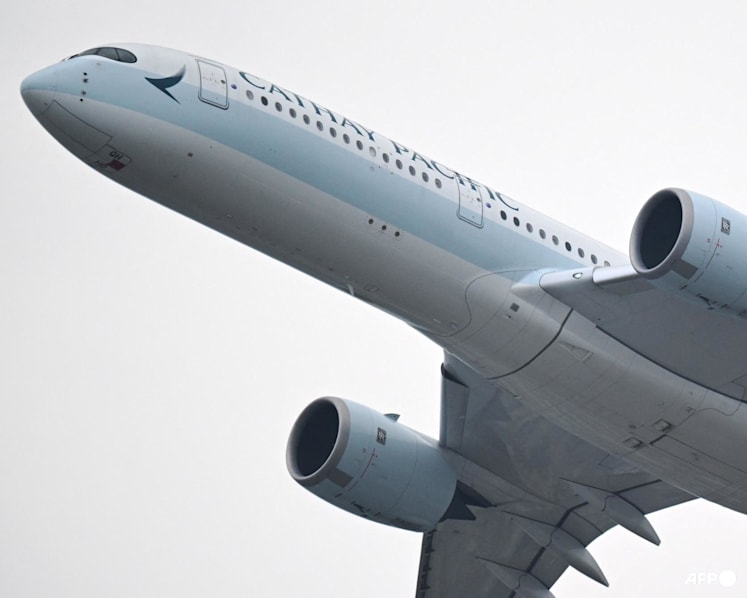
A Cathay Pacific plane takes off from Hong Kong International Airport on Mar 11, 2026. (Photo: AFP/Peter Parks)

This audio is generated by an AI tool.
HONG KONG: A Cathay Pacific flight that had been intercepted by a pair of Hungarian NATO fighter jets over Romanian airspace tuned to the wrong radio frequency after its pilots mistakenly responded to air traffic control instructions meant for another aircraft, an official investigation has revealed.
CX257, travelling from Hong Kong to London’s Heathrow Airport on Jul 4, “experienced a loss of communication” with the local air traffic control unit during its flight, Hong Kong’s Civil Aviation Department (CAD) said in a statement dated Aug 14.
“The incident involved the incorrect selection of radio frequency by the concerned flight crew due to a mistaken response to air traffic controllers’ instructions for another flight,” CAD said.
It added that the crew “did not subsequently realise the loss of communication” and the aircraft’s communication equipment had “operated normally”.






CAD previously expressed “serious concern” over the incident, which first came to light when Hungarian Minister of Defence Romulusz Ruszin-Szendi said that two fighter jets had been scrambled under NATO’s quick reaction alert.
The jets were deployed after “an A350 aircraft registered in China, operating a Hong Kong to London flight, failed to establish contact with Romanian civilian air traffic control while still in Romanian airspace”, the minister said in a post on Facebook in July.
Following the incident, Cathay Pacific implemented a host of “improvement measures”, CAD said - which included “enhancing the operational and monitoring procedures for the flight crew regarding the communication system and reminding them to be more vigilant at all times”.
It also said that it had instructed the airline to “robustly follow up on relevant improvement measures”, including “providing additional training and assessment for the concerned flight crew”.
“CAD reiterated the importance of maintaining good communications between the flight crew and air traffic controllers at all times to ensure aviation safety,” the statement said.
Cathay Pacific has since implemented the “related improvement measures” in mid-July, it added.
“CAD will continue to closely monitor the effectiveness of the measures implemented by (Cathay Pacific),” it said.
Responding to CNA's queries, a spokesperson for Cathay Pacific said that the airline takes the event “extremely seriously”.
"A number of improvement measures have been put in place so as to further reduce the likelihood of recurrence," the spokesperson said.
The aircraft had also "remained on its authorised route and altitude at all times during the event" and "at no point was there any impact to the safety of the flight".
"We will continue to work closely with regulators to support the highest standards of operational safety," the spokesperson added.