Seoul, Tokyo lead Asian plunge as tech stocks suffer fresh rout
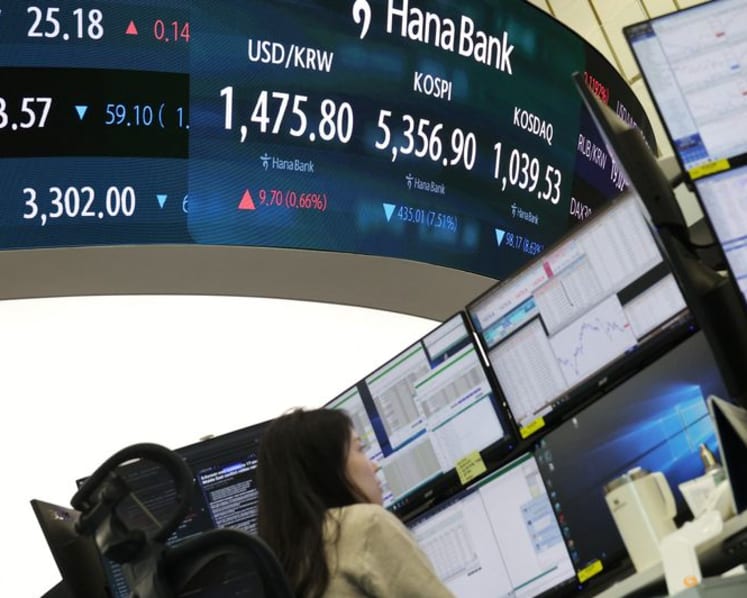
A currency dealer works as an electronic board displays the Korea Composite Stock Price Index (KOSPI) at the dealing room of a bank in Seoul, South Korea, on Mar 4, 2026. (File photo: Reuters/Kim Hong-ji)
HONG KONG: South Korea's KOSPI collapsed almost 11 per cent on Tuesday (Jul 28) as tech took a battering on another black day for Asian stock markets, with a report of a breakthrough in China's chip industry compounding worries about the longevity of the artificial intelligence boom.
The losses extended a sell-off across the industry globally following an eye-watering rally over the past two years that has sent several indexes and companies to record highs.
They also overshadowed a more upbeat outlook over the Middle East conflict as the United States and Iran paused tit-for-tat strikes for a third day and Donald Trump suggested there was a "good chance" of a deal to end hostilities.
Semiconductor firms were at the forefront of a region-wide rout on Tuesday after website The Information said China's Shanghai Yuliangsheng had started mass production of a chipmaker technology long dominated by Dutch firm ASML.





Seoul-listed SK hynix sank 14.7 per cent and Samsung more than 13 per cent, dragging the KOSPI index down 10.8 per cent.
The two firms have fallen almost 50 per cent since hitting all-time highs last month, while the KOSPI is down more than 30 per cent.
Tokyo's Nikkei tanked 4 per cent as Kioxia shed more than 18 per cent, while Advantest and Tokyo Electron dived 10 per cent and 11 per cent respectively.
Taipei was also off more than 4 per cent as market heavyweight and chip giant TSMC took a hit.
The rest of Asia was also mostly down. Shanghai, Singapore, Manila, Mumbai and Jakarta retreated, though there were gains in Hong Kong, Sydney and Wellington.
London, Paris and Frankfurt edged up.
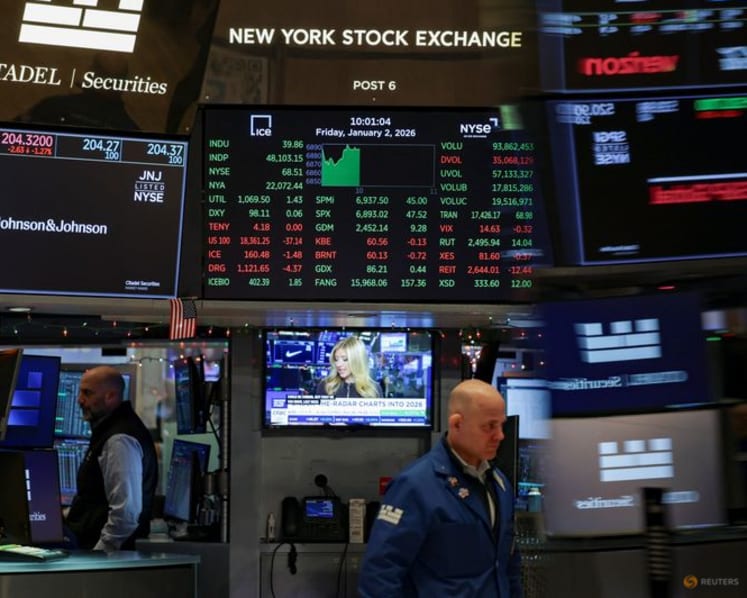
Tuesday's hammering followed a bleak day on Wall Street, where the Philadelphia Semiconductor Index dropped 2.2 per cent as Sandisk tanked 11 per cent, while Advanced Micro Devices and Nvidia gave up around 5 per cent.
ASML shed more than 8 per cent in Amsterdam.
"BEHAVING LIKE A FLYWHEEL"
The AI trade was already fracturing in recent weeks owing to worries about the vast sums that had been invested in AI, which had fuelled questions about when that would actually begin seeing a return, while extended valuations had also raised eyebrows.
"The immediate fundamentals of semiconductors have not collapsed," wrote Stephen Innes at SPI Asset Management.
"Demand for high-bandwidth memory remains strong, hyperscalers are still spending, and the largest technology companies have not yet abandoned their capital expenditure plans.
"What has changed is the market's willingness to capitalise those promises at almost any price.
"The AI trade spent the past several years behaving like a flywheel: rising equity values encouraged more spending, more spending validated higher earnings expectations, and those expectations pushed valuations higher again.
"Now that same wheel is beginning to throw investors off at speed."
Traders are awaiting earnings this week from SK hynix, Samsung and Kioxia, as well as US titans Microsoft, Meta, Apple and Amazon.
The bloodbath in tech overshadowed renewed optimism over the US-Iran crisis, with the two sides stepping back after almost two weeks of retaliatory attacks sparked by a breakdown in diplomacy over Tehran's blockade of the Strait of Hormuz.
Trump expressed hope that renewed diplomacy could bring an end to the war that began in late February.
"I have a lot of patience ... We'll see what happens," he said aboard Air Force One. "I think there is a good chance that something could happen."
Reports said Oman and Iran were trying to reach an agreement to restart shipping through Hormuz, through which about a fifth of global oil and LNG usually pass.
Hopes for a deal sent both mains sharply lower, with international benchmark Brent losing more than 8 per cent on Monday and WTI more than 7 per cent. Both were down more than 1 per cent on Tuesday.