







Tech rout batters South Korean, Taiwan equities; Singapore stocks hit record high
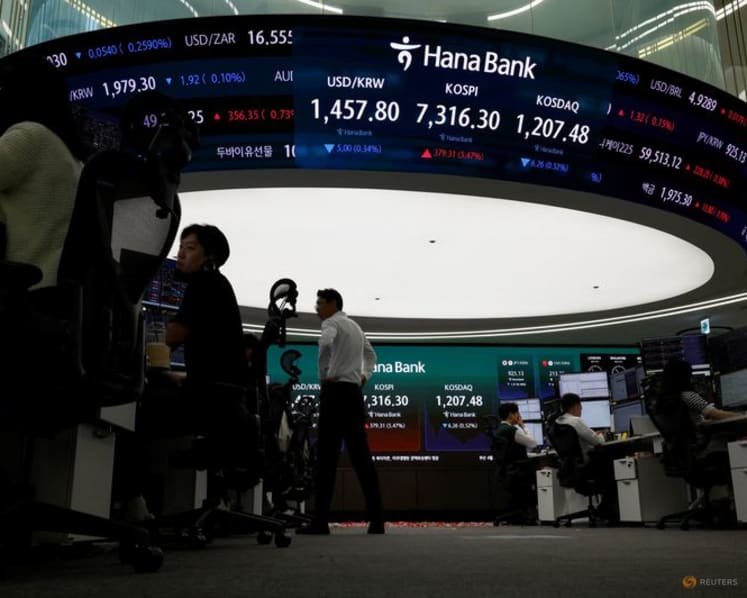
Currency dealers work as an electronic board displays the Korea Composite Stock Price Index (KOSPI) in Seoul, South Korea, on May 6, 2026. (File photo: Reuters/Kim Soo-hyeon)
SINGAPORE: Asian stocks sank on Wednesday (Jul 29), extending a vicious selloff as anxiety about artificial intelligence (AI) valuations and whether the massive spending will deliver returns rattled investors ahead of crucial earnings from big tech firms and a United States Federal Reserve policy decision.
South Korean and Taiwanese stock markets continued to be battered by AI-related worries, while Singapore equities soared to an all-time high as investors sought alternatives to the volatile tech sector.
Oil prices jumped after fresh attacks in the Middle East shattered the relative calm of recent days in the US-Iran war as investors fret about the impact of depleting supplies on prices and global rates.
Asian chipmakers have been at the epicentre of this year's AI-driven rally and, more recently, investor concerns about its staying power, sparking sharp market swings.





South Korea's KOSPI - which had more than tripled over 12 months to June – slipped as much as 12.6 per cent before paring losses to close about 6 per cent down, after dropping more than 10 per cent on Tuesday. Taiwan stocks ended 3.8 per cent lower at its weakest level since mid-May, while Japan's Nikkei slid 2.6 per cent as the rout deepened across the region.
That left MSCI's broadest index of Asia-Pacific shares outside Japan down over 2.45 per cent after shedding 3.6 per cent on Tuesday.
South Korean equities have shed more than 16 per cent over the last two sessions, bringing their June losses so far to around 33.2 per cent. This is their worst monthly performance ever.
Shares of SK Hynix fell 9 per cent as investors digested earnings that showed the chipmaker increased quarterly operating profit more than sixfold but missed lofty expectations.
"SK Hynix delivered strong results, but in today’s AI market, strong is no longer enough," said Gary Tan, portfolio manager at Allspring Global Investments.
"Investors were looking for additional catalysts, particularly around long-term agreements and shareholder returns, to support a memory sector that has become the epicentre of the AI trade," Tan added.
A 5 per cent drop in Samsung Electronics also weighed on the Seoul benchmark. This stock and SK Hynix account for more than half of KOSPI's market capitalisation.
Elsewhere, stocks in Singapore's FTSE Straits Times Index surged more than 1 per cent to a record high of 5,696.65 points, boosted by a 1 per cent to 2 per cent rise in major lenders DBS, OCBC and United Overseas Bank.
The head of Singapore's central bank said on Tuesday that the country's economic growth should remain firm in the second half of this year, although a major uncertainty is the sustainability of the AI investment boom.
The FTSE Straits Times Index has emerged as one of the best-performing markets in emerging Asia this year and is on track for its best monthly showing since November 2020.
Philippine shares rose as much as 2.1 per cent to hit a one-week high.
The move in Manila equities may partly reflect some rotation out of crowded AI-related positions into less-owned markets, considering the market has often been viewed as a potential AI disruption risk because of its large business process outsourcing sector, said Mr Tan from Allspring Global Investments.
Earnings from the Magnificent Seven members Microsoft and Meta later in the day will be a key test of the AI trade, particularly after Alphabet and Tesla spooked investors last week with negative cash flow reports.
"This round of earnings would need to prove that the huge capital expenditure has paid off, else we may see the market drag further," said Sean Teo, sales trader at Saxo in Singapore.
Teo also said investors are now getting wary of circular financing where a handful of companies are investing in each other in somewhat of a closed loop where organic demand becomes unclear.
Nasdaq futures fell 0.7 per cent in Asian hours while European futures slid 0.6 per cent as the selling appeared to spread to other regions. Hong Kong's Hang Seng index bucked the trend and was up 1.4 per cent.
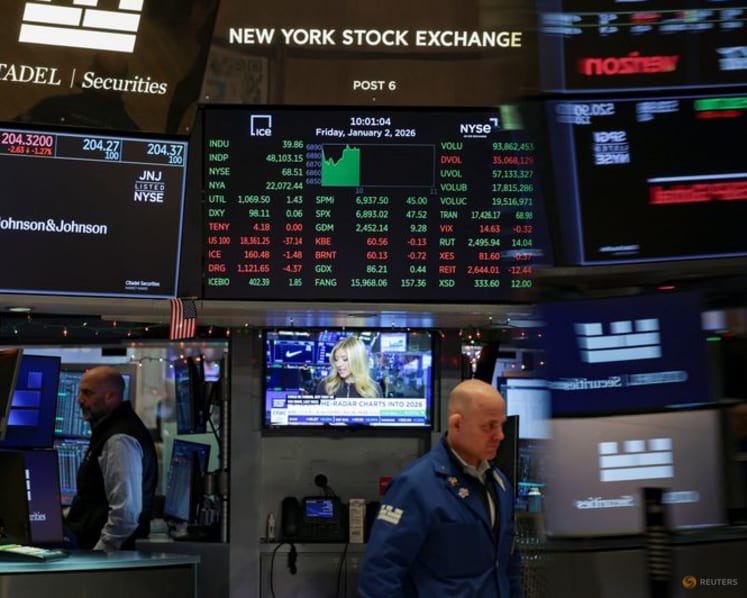
OIL JUMPS AHEAD OF FED MEETING
Brent futures jumped 3 per cent to US$87.19 per barrel while US West Texas Intermediate (WTI) crude rose more than 3 per cent to US$82.08 after US Central Command said Iran had launched multiple ballistic missiles that were successfully intercepted.
"The latest attack highlights that the two sides remain a long way from resolving the core dispute of passage through the Strait of Hormuz that caused the earlier MOU to collapse," said Tony Sycamore, market analyst at IG.
Iran effectively shut the key waterway to ships other than its own after the US and Israel launched strikes on Feb 28.
A deal last month between Washington and Tehran partially reopened it, but the agreement collapsed in early July after Iran fired on ships using a channel it had not approved.
That has again put inflation pressures in the spotlight ahead of the Federal Reserve's policy decision due later on Wednesday.
The US central bank is seen as more likely to leave interest rates steady even as a growing number of its policymakers fret openly about inflation.
The decision remains unusually hard to call under the no-guidance regime adopted by the new Fed Chair Kevin Warsh, with traders pricing in a 33 per cent chance of a hike.
The US dollar was perched near a one-month high ahead of the decision.
"We think the market may once again be underestimating the extent of the hawkish shift at the Fed, and that the (for now) moderate increase in energy prices may tip an already finely balanced meeting in favour of a hike this week," said Frank Flight, head of macro strategy at Citadel Securities.
"We acknowledge that it is a close call, but we now see a rate hike at the July meeting," Flight said.






