Crime gangs snare more than US$88 billion in scams in Asia-Pacific, UN says
Networks that once operated within specific territories or illicit trades are increasingly expanding across multiple illegal markets while using shared services, said Delphine Schantz, UNODC Regional Representative for Southeast Asia and the Pacific.
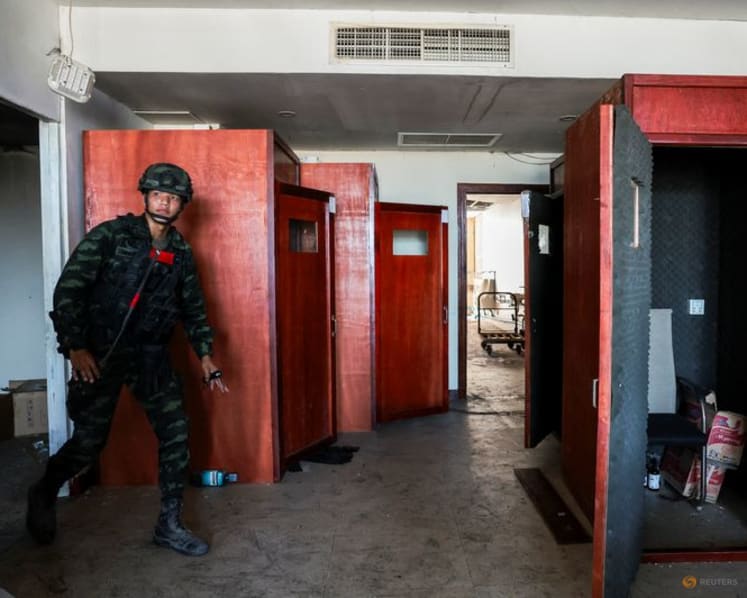
BANGKOK: Scam gangs defrauded Asia-Pacific residents of at least US$88 billion in 2025, a United Nations office said on Tuesday (Jul 21), with transnational crime groups rapidly evolving tactics to stay ahead of law enforcement.
Criminals in Southeast Asia, an epicentre for cyberfraud by mostly Chinese-origin syndicates, are outpacing crackdowns, diversifying revenue streams, exploiting corruption and harnessing artificial intelligence, the United Nations Office on Drugs and Crime (UNODC) said in a new report.
The report estimated scam losses across East Asia, Southeast Asia, Australia and New Zealand between US$88.3 billion and US$114.1 billion for 2025, a figure larger than the gross domestic product (GDP) of several of the nations in the region.
Networks that once operated within specific territories or illicit trades are increasingly expanding across multiple illegal markets while using shared services, said Delphine Schantz, UNODC Regional Representative for Southeast Asia and the Pacific.





“Their operating model looks like corporate franchising: imagine specialised departments for laundering money, trafficking people, smuggling migrants, and harvesting data, all plugged into the same, service-based interconnected network,” she said.


Scam centres in Southeast Asia run illegal online schemes that defraud people worldwide, generating billions of dollars of annual revenue. Many facilities are staffed by trafficked foreign nationals, confined in oppressive environments.
People from at least 80 countries and territories have been identified in scam compounds across the region, with recruitment networks using transit hubs in Asia, the Middle East and Africa, according to UNODC.
AGENTIC AI
Scam operators are increasingly seeking recruits from outside Asia as they expand into new markets, UNODC said.
Recruitment advertisements linked to the industry's communication channels have targeted people with German, Polish, Dutch, Spanish, Italian, French, Swedish, Norwegian and English language skills, it said.
Recent pressure from law enforcement in the region has displaced but not dismantled operations, UNODC said, with gangs relocating from countries like Myanmar and Laos to Timor Leste, Pacific Island states, and parts of Africa.


Syndicates engage in "jurisdiction shopping" to find places with weak governance and regulation, the report said, adding that corruption was the "primary enabler" of tech-driven organised crime in the region.
Beyond using generative AI to create content, criminal groups are expected to adopt agentic AI systems to more autonomously identify victims, conduct social-engineering campaigns and facilitate cryptocurrency theft and laundering, the report said.
The scam sector’s rapid growth has fuelled an ecosystem of ancillary criminal services, including money laundering, underground banking and data trading, it said.
"The scale and complexity of this expanding organised crime economy are outpacing existing responses, which were not structured to address such sophisticated criminal activity,” said Inshik Sim, a lead analyst at UNODC.