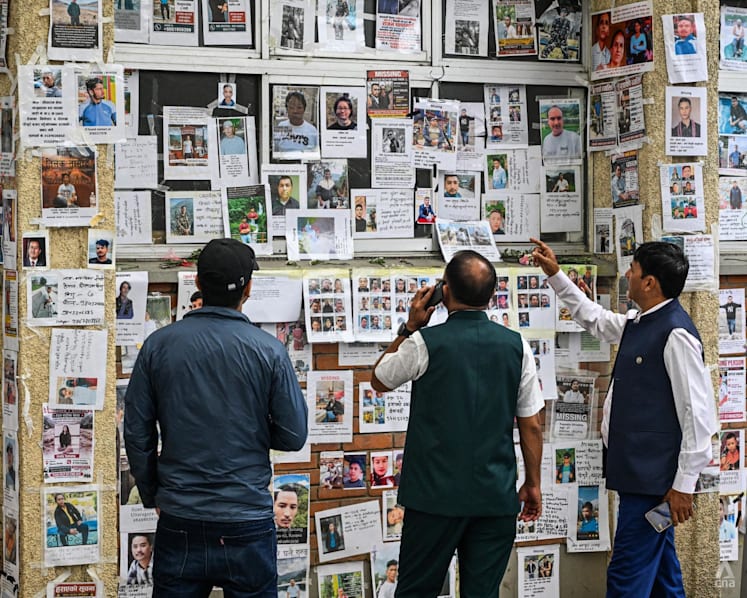
Nepal holds day of mourning as families pray missing still alive
Flags flew at half-mast as search teams race to find more than 5,500 people still missing.
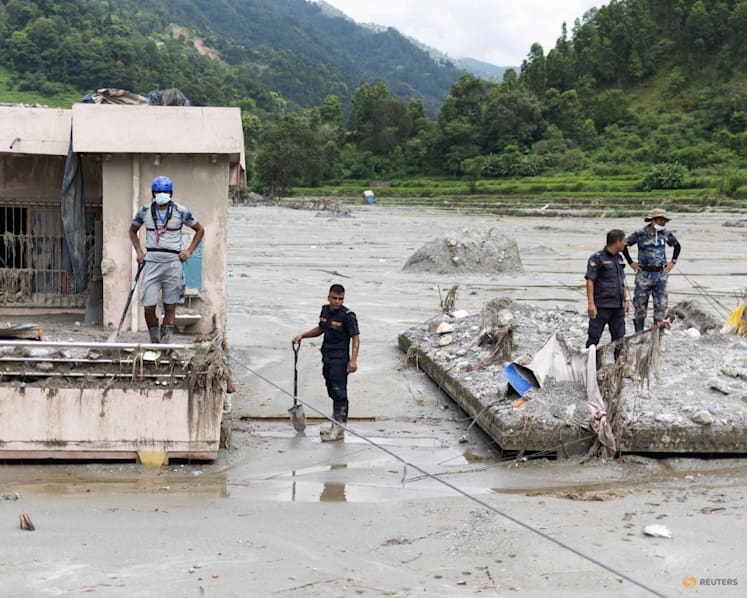
Nepal Police and Armed Police Force members search for survivors and victims of the deadly flash floods and mudslides, in Betrawati, Nuwakot district, Nepal, on Sep 6, 2026. (File photo: Reuters/Adnan Abidi)
KATHMANDU: Nepal held a national day of mourning with candlelight vigils on Monday (Sep 7) for victims of devastating glacial floods, as families of missing hydropower workers feared trapped in tunnels prayed rescuers might yet find them alive.
The Aug 26 glacial and mountain collapse on the China-Nepal border killed at least 1,399 people, with more than 5,500 missing, including around 800 foreigners.
Flags flew at half-mast and hundreds of people gathered for the vigils in the Nepali capital Kathmandu, as the nation marked the 13th day after death in line with Hindu mourning rituals.
Hundreds of hydropower workers are among the missing, but the rescue of three of them from deep inside tunnels - two Nepalis on Friday and a Chinese man on Saturday - have buoyed hopes that more could still be alive.





Nepal Army spokesman Raja Ram Basnet said rescue efforts were continuing at "the same tempo" to make sure "that no one is still stranded".
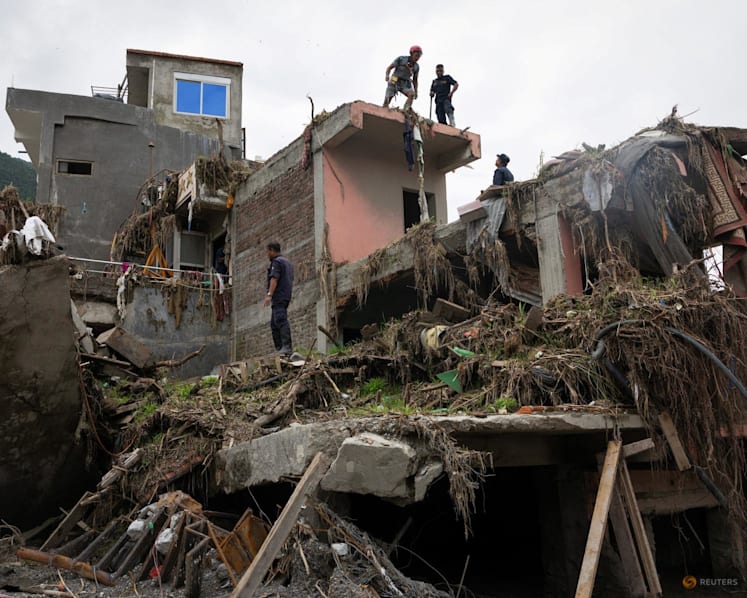
Entire communities have been swept away, with roads destroyed and homes demolished.
"HOPE"
But families of some of the missing workers who gathered in Kathmandu said the government must move faster.
"We have a lot of hope," said Reena Amatya Shrestha, whose brother is among the missing.
"They say they are doing rescue. If the rescue is there, where's the result? We need the result."
Australian tunnel rescue expert Arnold Dix, who is advising Nepali teams, said the operation presented an unprecedented challenge.
"We are facing something I have never faced before," said Dix, president of the International Tunnelling and Underground Space Association, in a post on social media.
"Not one rescue, but multiple potential rescues, unfolding at the same time, in different places, each with its own dangers, uncertainties, and lives that may still be saved."
Foreign experts, including from China, India and South Korea, are aiding Nepali teams in rescue efforts.
"We are measured not only by the lives we save, but by the lives we refuse to abandon," said Dix.
Drone pilot Adarsha Raj Bhusal recalled sinking into mud after leaping from a helicopter into the flood-ravaged Upper Trishuli-1 hydropower tunnel in Rasuwa district days after the disaster.
"The moment I landed I sank into the mud up to my waist," the 24-year-old told AFP on Monday in Nuwakot district.
"Other soldiers were there to help, but they were struggling just as much as I was. That's how bad the conditions were ... it was intense the entire way in."
"NEW LIFE"
Nepal President Ram Chandra Paudel visited relief camps in Nuwakot, speaking to those left homeless by the disaster.
"Today the entire nation is mourning this horrific disaster," he said in a statement.
"To everyone waiting for news of family members and friends, I want to assure you that search and rescue operations will continue."
With mortuaries overflowing, Nepal has buried hundreds of bodies in mass graves after taking DNA samples for future identification, according to police.
Despite the gloom, there have been remarkable tales of survival.
Chandika Shrestha, a 64-year-old Nepali woman, was pulled out alive from her mud-covered home in Bidur on Saturday.
Her family had already held a symbolic funeral ceremony, believing her dead.
"Chandika has got a new life," her neighbour Buddhi Lal Dongol told AFP. "It would be so good if the others who are missing also came back."
Several families held last-rite ceremonies in Nuwakot to mark the 13th day of mourning, while Buddhist monks held prayers for the dead.
"I have had to hold myself together a lot," 63-year-old Kula Priya Nepal, whose son was killed at a hydroelectric project, told AFP.
While the exact cause of the glacial collapse is unclear, climate change is accelerating glacial melting worldwide, increasing the risk of such disasters.
Nepal, a largely rural nation of 30 million people that has contributed little to the greenhouse gas emissions driving global warming, has said reconstruction could cost billions of dollars.
Its economy is already under pressure, with limited resources to respond to a disaster of this scale.
The disaster has come just ahead of the anniversary of last year's Sep 8-9 mass anti-corruption protests that toppled the government.
Rescuers have retrieved 1,356 bodies in Nepal, while around 4,994 people are missing, according to the disaster agency.
The toll in China stands at 43 dead and 519 missing, according to state media.
On Monday, local volunteer groups in Kathmandu packed utensils, blankets and clothes to be distributed to survivors.
"As Nepalis, we've always been told that you look after your people," volunteer Ashim GC told AFP.
"And these are our people."