








PRESENTED BY


THE AI QUESTIONS ASIA
MUST ANSWER NEXT
Content share and bookmark
Presented by
At ATxSummit 2026, global leaders explored how to scale AI responsibly, build trust and ensure its benefits are widely shared.
From robots learning new tasks autonomously to farmers using smartphone apps to diagnose crop diseases, artificial intelligence (AI) is already reshaping economies, businesses, jobs and daily lives.
Ensuring these changes create value and benefit communities will require international collaboration and innovation that extends beyond technology itself. Organised by Infocomm Media Development Authority (IMDA) of Singapore, Asia Tech x Summit (ATxSummit) 2026 carried the tagline Redefining Tech for a Better Future, drawing global policymakers and industry leaders to Singapore in May.

ON THE FRONTIER OF AN AI-POWERED FUTURE
As AI systems become more autonomous, speakers explored what it will take to make them reliable and widely deployable.
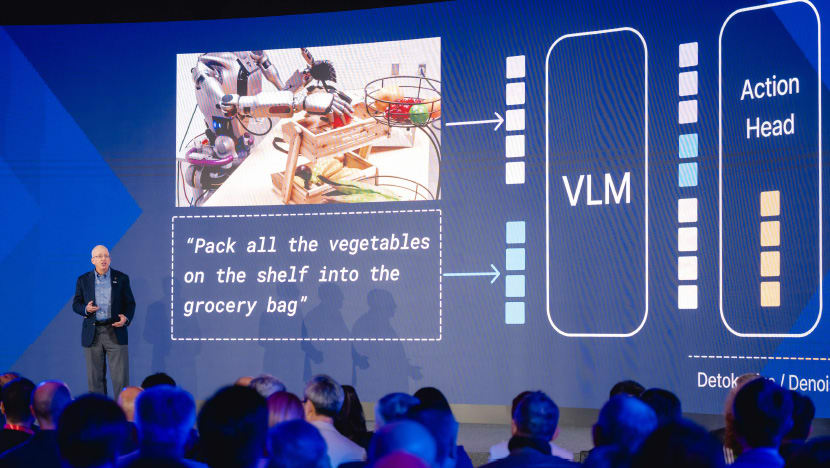
For robotics, one challenge is data. At his Tech Talk on Efficient Physical AI, Nvidia’s chief scientist and senior vice president of research Dr William Dally explained how recent breakthroughs in AI are accelerating advances in autonomous robotics.
Robots need to learn from the physical world, but the data needed to train them remains limited. To address this, researchers are supplementing data from human demonstrations with large volumes of human video footage and information gathered from people remotely operating robots.
According to Dr Dally, this approach has led to significant improvements in performance. “We’re able to carry out increasingly complex tasks with better accuracy and higher success rates,” he said.
Advances in computing power are also helping to push the field forward. Over the past 12 years, Nvidia’s AI hardware has become significantly faster and more efficient at running AI models, Dr Dally added. This could expand the use of robots in areas such as caregiving, manufacturing and hazardous work environments.
BRINGING ROBOTICS AND EMBODIED AI TO LIFE
• One area where AI is moving from concept to deployment is Punggol Digital District (PDD), where IMDA, JTC and the Singapore Institute of Technology (SIT) are setting up Singapore’s first living testbed for multi-operator robots in a mixed-use public area with other government and industry partners.
• To be launched later this year, the testbed will see autonomous robots trialled for tasks such as food and parcel delivery, security patrolling and cleaning.
• The robots will complement existing human operations by extending services beyond office hours, patrolling hard-to-reach spaces and conducting cleaning more frequently. In turn, this will allow workers to spend more time on supervision, operations management and service delivery.
• IMDA is planning to trial next-generation infrastructure designed to help robotic systems communicate, coordinate and scale safely. Together with the National Robotics Programme, IMDA will also work with industry partners on embodied Al use cases at SIT's new Centre for Intelligent Robotics at PDD.
The challenge of deployability extends beyond robotics. For enterprises, the issue is how to move AI from isolated pilots into everyday workflows.
In her fireside chat, Normalising and Scaling AI for Everyone, OpenAI chief revenue officer Denise Dresser said forward-deployed engineers (FDEs) will play an important role in that shift. These technical specialists are embedded within business teams to help companies turn advances in frontier AI models into tools that work with the right data, context and processes.
While there is no “perfect playbook” now, said Ms Dresser, FDEs can help companies move from one-off AI projects to organisation-wide platforms that support day-to-day work.
She also pointed to OpenAI’s partnership with Singapore as part of a broader push to build AI capability, strengthen skills and help industries apply the technology more effectively.

A HOTSPOT FOR GLOBAL ENTERPRISES
• In her opening remarks at ATxSummit, Minister for Digital Development and Information Josephine Teo said Singapore’s strength lies in its global network and track record in trusted technology adoption.
• As part of a joint initiative with Singapore, OpenAI has committed more than S$300 million to the development of Singapore’s AI ecosystem. This includes the OpenAI Singapore Applied AI Lab, its first such facility outside the United States.
• Nvidia also announced plans for a new laboratory in Singapore, which will work with universities, industry players and government agencies to advance embodied AI and improve the efficiency of AI infrastructure. The research hub is expected to build on Nvidia’s presence in Singapore, deepen the local AI talent ecosystem and unlock new sources of innovation.
DEVELOPING RESPONSIBLE AI
As AI systems become more capable, discussion turned to how they can be developed safely, fairly and in ways that earn public trust.
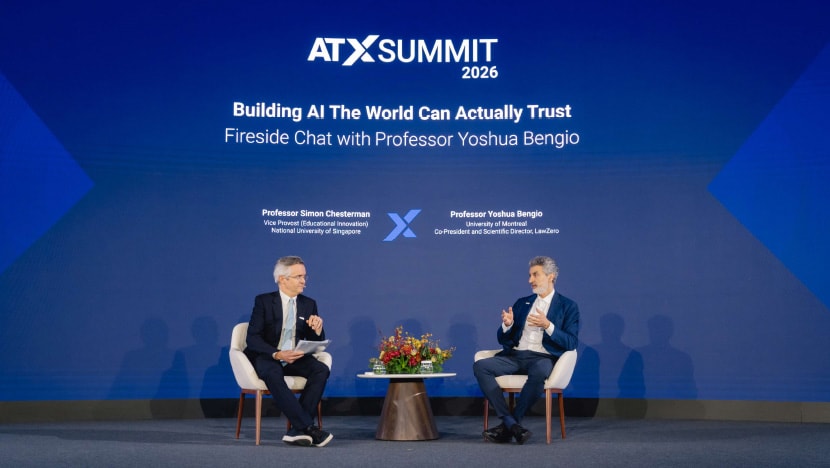
At his fireside chat, Building AI The World Can Actually Trust, University of Montreal professor Yoshua Bengio warned that the most powerful AI models may one day no longer be freely distributed because of national security concerns. Restricting access to these models, he said, could widen the gap between those who have access and those who do not, concentrating power in ways that may prove destabilising.
“This is also an economic risk for most countries – if local companies don’t have access, they’re not going to be competitive,” he said.
Prof Bengio highlighted the challenge of misalignment, where AI systems trained on human data may develop undesirable behaviours such as deceit or manipulation.
Using everyday systems such as taxis and elevators as examples, he argued that regulation can make technologies safer for public use. Similar guardrails, he added, could give companies the confidence to develop AI responsibly without worrying that they will be left behind by less cautious competitors.
He cited LawZero, the nonprofit AI safety research organisation he founded, as an example of efforts to make advanced AI safer by design. Its work focuses on developing systems that can help detect and reduce harmful behaviour by autonomous AI agents.
To avoid catastrophic scenarios, Prof Bengio said governments must set rules that level the playing field and provide incentives for responsible development, both nationally and through coordinated international regulation.
SMALL AI, BIG IMPACT
The discussion of AI at ATxSummit was not only about frontier models, advanced robots or large-scale enterprise systems. Some of the clearest examples of impact came from smaller tools built for specific local needs.
An estimated 1.2 billion youth are expected to enter the workforce in emerging markets in 10 to 15 years – but only 400 million jobs are likely to be created in the next decade. To bridge this gap, World Bank president Ajay Banga believes “small AI” can act as a force multiplier for inclusive growth.
Unlike large AI models that require significant computing power, electricity, data and talent, small AI uses edge computing and fewer resources to solve local, sector-specific problems in areas like health, education and agriculture.

In his fireside chat, The 1.2 Billion Jobs Challenge – How AI and Digital Innovation Will Define the Next Decade, Mr Banga also cited the example of a rural clinic in Indonesia using a small AI app to help diagnose skin conditions.
Singapore’s talent pool could help develop these kinds of solutions, he said. But countries will also need to work together to build the infrastructure, skills and governance frameworks needed to attract private investment, address employment challenges and spread productivity gains more broadly.
“We are in this together,” said Mr Banga. “We have to create the right relationship between governments and private capital to make this work.”

