Asian stocks stutter after rout, Fed leaves markets guessing on rates
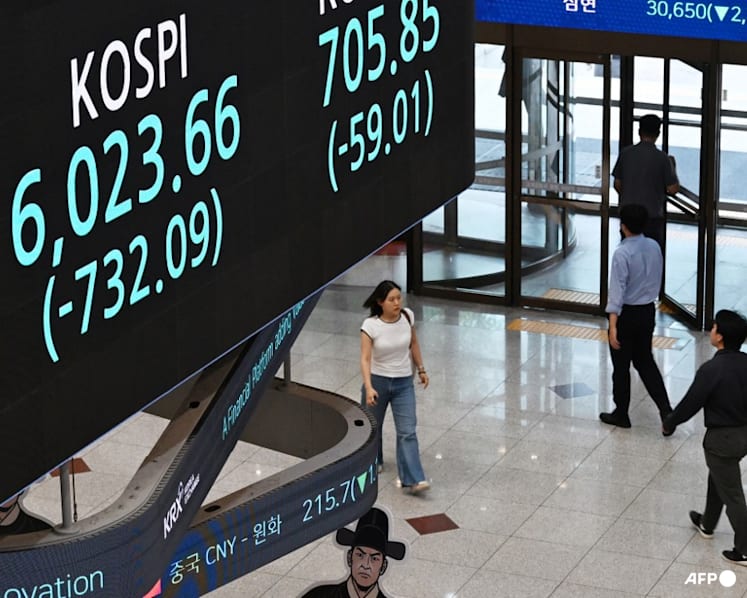
People walk below a stock index board showing South Korea's benchmark stock index (KOSPI) after the close of trading in Seoul on Jul 28, 2026. (File photo: AFP/Greg Baker)
SINGAPORE: Asian stocks struggled for direction in choppy trading on Thursday (Jul 30) after a week of market turbulence sparked by artificial intelligence jitters, as a divided Federal Reserve stood pat on rates and left bond markets uncertain about the next move.
Brent futures slipped below US$90 per barrel, after jumping over 7 per cent a day earlier as fighting in the Middle East escalated, although data showed tankers continued to make their way out of the region despite the continued strikes.
The dollar was on the defensive after the US central bank held rates steady, although the split decision left investors confused on whether the Fed will see through rate hikes to combat inflation. Yields on longer-dated US Treasuries rose to 19-year highs.
Asian chipmakers have been at the centre of attention this week after a bruising selloff in South Korean equities wiped more than US$2 trillion off market value and heightened investor anxiety over the payoff from huge AI investments.





"Uncertainty about US monetary policy, the sharp steepening of the Treasury yield curve, growing tensions in the Middle East and continued worries about the semiconductor industry and AI sector mean that markets are likely to stay volatile in the near term," said Vasu Menon, managing director of investment strategy at OCBC.
The KOSPI was down 0.6 per cent in choppy trading, on track for a 15 per cent weekly slump, a selloff that prompted Finance Minister Koo Yun-cheol to apologise for the rollout of single-stock leveraged ETFs and led authorities to unveil market-stabilisation measures.
MSCI's broadest index of Asia-Pacific shares outside Japan was flat after swinging wildly between gains and losses. Japan's Nikkei was 1.2 per cent higher, but set for a 3.7 per cent drop in the week.
"Given that the fundamental thesis remains intact, there does appear to be an irrational, panic-like element to the current selling," said Gina Kim, portfolio manager for emerging market equities at Nordea Asset Management in Singapore.
"I cannot comment on when the panic will stop as such but some indicators to look out for would be margin balances in both Taiwan and Korea for retail investors. Both are declining but we would ideally need to see some levelling off," said Kim.


Chipmaker Samsung Electronics said its operating profit jumped 19-fold to a record in the second quarter, helping lift beaten-down investor sentiment.
Earnings reports from mega caps Meta and Microsoft underscored sharply contrasting fortunes for companies racing to build AI infrastructure.
Microsoft reassured investors it would continue generating cash through fiscal 2027 despite heavy spending, sending its shares higher, while Meta's stock fell after a 91 per cent collapse in second-quarter free cash flow.
Nasdaq futures rose 0.7 per cent in Asian hours while European futures were 0.3 per cent higher.
FED LOOKING TO MARKETS FOR CUES
In a post-meeting media conference, Fed Chair Kevin Warsh vowed to contain inflation but gave no indication of the steps the central bank might take.
Warsh noted that bond yields had risen notably since the Fed's last policy meeting, reflecting market expectations of higher interest rates. He welcomed the move, while stressing that it did not oblige the Fed to validate those expectations with policy action.
"To me this is a way of saying the market has done the Fed’s job so far," said Blerina Uruci, chief US economist at T Rowe Price.
"Ultimately, Warsh’s hawkish tone will not be enough to ensure price stability. The market will learn the hard way that no forward guidance means Warsh and the FOMC will not deliver on a policy outcome just because the market has priced it."
That confusion left yields on 30-year US bonds at 5.2039 per cent, having hit their highest since June 2007 at 5.2273 per cent late in New York trading.
Fed funds futures now implied around a 60 per cent chance the Fed would lift rates at its next meeting in September and had 33 basis points of tightening priced in by year-end.
"The Fed is likely to face ongoing questions around its credibility," said Kerry Craig, global market strategist at JP Morgan Asset Management.
"The gap between the Fed’s rhetoric and its actions may pose a challenge for market pricing. A new chair faces a divided committee and a bond market that’s starting to question the central bank’s resolve."