





Indonesian stocks dive 11% as MSCI weighs market reclassification
MSCI said on Friday (Oct 16) it plans to downgrade Indonesia to "standalone" status, sparking a sell-off.
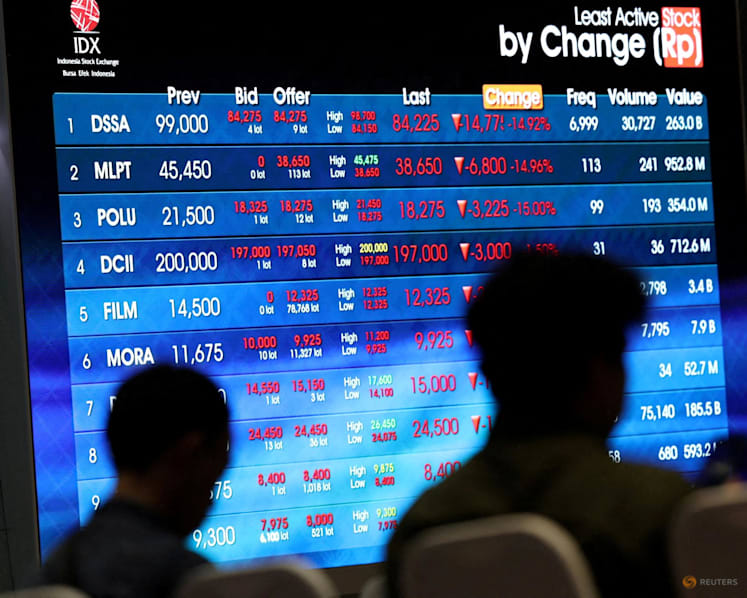
People sit near an electronic board showing stock market index at the Indonesia Stock Exchange in Jakarta, Indonesia, on Feb 2, 2026. (File photo: Reuters/Willy Kurniawan)
JAKARTA: Indonesian stocks plunged more than 11 per cent on Friday (Oct 16) as index compiler MSCI said it was "no longer appropriate" to maintain the country's emerging-market status, fuelling fears of an exodus of foreign investment.
Indonesian equities have struggled since January when MSCI froze Indonesia in its indexes and threatened a downgrade to "frontier" status because of opacity in ownership and trading behaviour.
On Friday, MSCI said reforms to address those problems have not made sufficient progress and that even a downgrade to frontier wouldn't reflect the severity of issues.
"Significant concerns remain around market dysfunction," MSCI said. "Accordingly, MSCI considers Indonesia's continued classification as an emerging market no longer appropriate," it said in a statement.





Instead, it proposed a downgrade to "standalone" status, which would exclude Indonesian stocks from global indexes tracked by billions of dollars in passive investment, forcing funds that follow or are ranked against the indexes to sell.
Argentina, Lebanon and Palestine are among the markets with the designation, with none in Asia, according to Bloomberg.
UBS estimated a removal by MSCI could trigger about US$4 billion of passive outflows from Indonesia, with active investors potentially adding a further US$15 billion in outflow.
Coming a month ahead of a scheduled review, MSCI's change of tack stunned investors and irked Jakarta officials.
Indonesia's senior economic minister Airlangga Hartarto said there was "a big question mark" over why MSCI did not discuss downgrading the country to "standalone" status during a meeting this week in Bangkok.
He made the comment ahead of a meeting of the country's top officials, including the finance minister, the governor of the central bank and other related officials to discuss MSCI's announcement.
The Indonesia Stock Exchange said it has taken concrete steps to enhance transparency and integrity in the country's capital market, and CEO Jeffrey Hendrik said he would request further clarification on the basis for the announcement.
"We also need to emphasise that this MSCI announcement is still part of the consultation process, with input being accepted until Apr 30, 2027, and does not constitute a final decision," said the Indonesia Stock Exchange.
Angus Mackintosh, an ASEAN specialist at Aletheia Capital in Singapore, said the move did not reflect the health of the vast majority of listed companies or indeed the Indonesian economy, and "grouping Indonesia with Lebanon, Palestine, and Argentina does not make sense".
New York-based MSCI produces international indexes used by investors as a benchmark to balance their portfolios.
It has a significant impact on investment decisions through its flagship emerging markets index, which contains 1,200 companies with a market capitalisation more than US$10 trillion.
Fund managers worldwide keep a close eye on what countries are included or excluded in MSCI's indexes, as that can trigger adjustments to their portfolios.
The Jakarta Composite Index collapsed 8 per cent at the open, sparking a trading halt. When trading resumed, it was down 11.1 per cent, its heaviest fall since early 1998 and sitting at its lowest level since 2020.
The index has now fallen more than 40 per cent since the start of the year.
The rupiah slid 0.6 per cent to 18,070 per US dollar, its weakest level since late July.
Erwin Gunawan Hutapea, the Indonesian central bank's head of monetary management and securities, said the bank would take action to ensure stability of the rupiah, which had already tumbled around 8 per cent this year to a record low.
"Amid rising global risk-off sentiment, which has driven US dollar strengthening and put pressure on domestic financial markets, capital outflows from domestic portfolio assets are expected to continue.
"Bank Indonesia is committed to maintaining a presence in the market to uphold rupiah exchange rate stability in line with its fundamentals and to ensure that market mechanisms function properly."
The central bank had carried out several rate hikes earlier in the year to shore up the rupiah, after it came under pressure over the state of Southeast Asia's biggest economy.
The bank is due to hold its next monetary policy meeting on Wednesday.
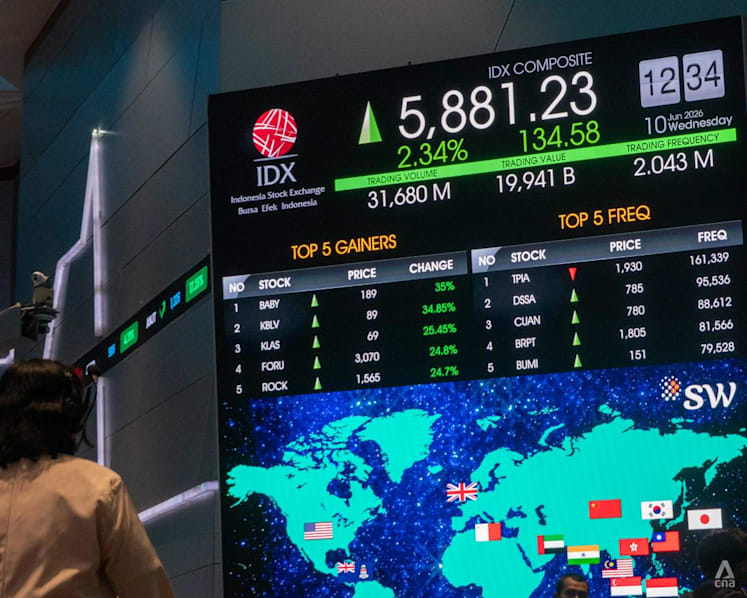

MSCI SCRUTINY RAISES MORE QUESTIONS
MSCI's announcement piles pressure on the government under President Prabowo Subianto. Indonesia has faced a series of setbacks this year, with Moody's and Fitch cutting their sovereign rating outlooks to negative, citing reduced policymaking credibility.
"The proposal highlights MSCI's dissatisfaction with the pace of reforms and raises further questions about the investability of the market," said Tan Altundag, investment manager for emerging equities at Pictet Asset Management.
"The investment implications could be significant," said Altundag, who has no holdings in Indonesia.
The office of finance minister Suahasil Nazara, who chairs the country's financial stability board, did not reply to a request for comment.
"It's the first time this has ever happened in my 20 years in the stock market," said Liza Camelia Suryanata, head of research at stockbroker Kiwoom Sekuritas Indonesia.
MSCI's move seemed heavy-handed given the steps Indonesia has taken to address issues around market transparency and increase the free-float requirement for listed firms, Mackintosh said.
"The only way for Indonesia to remedy this situation would be to impose severe sanctions and fines on those involved in concerted share manipulation," he said.