Oil settles down more 3% after US-Iran talks signal easing supply risks
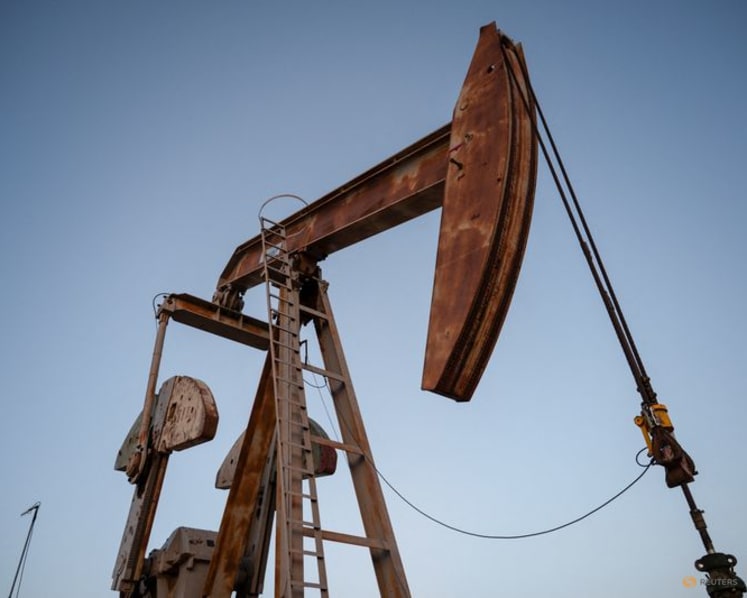
A pump jack operates outside of Midland, Texas, U.S. June 11, 2025. REUTERS/Eli Hartman
HOUSTON, June 22 : Oil prices settled more than 3 per cent lower on Monday, as supply concerns eased after U.S. Vice President JD Vance said progress has been made in talks with Iran and the Strait of Hormuz was open.
Brent crude settled down $2.67, or 3.31 per cent, at $77.90 a barrel. In early trading, prices had climbed to $82.30 because of threats by U.S. President Donald Trump to restart the Iran war, and Tehran's announcement that it had again closed the strait.
U.S. West Texas Intermediate crude futures expired on Monday and settled at $74.82 a barrel, down $1.78 or 2.32 per cent. The more-active August contract lost $1.99 and settled at $73.86 a barrel.
High-ranking U.S. and Iranian officials wrapped up their first round of talks in Switzerland on Monday, mediators said.





The discussions began on Sunday under the terms of a memorandum of understanding reached last week to extend a tenuous ceasefire from April for at least another 60 days.
The United States authorized Iranian oil sales on Monday. The general license, announced by the Treasury Department, allows the sale of crude oil and petrochemical and petroleum products of Iranian origin through August 21.
Meanwhile, Iran did not negotiate on its nuclear program and did not accept any new commitments in Sunday's talks with the U.S. in Switzerland, Foreign Ministry spokesperson Esmaeil Baghaei told the official IRNA news agency.
Crude inventories in the U.S. government's emergency stash fell by 9.05 million barrels last week, the third steepest draw on record. The drawdowns are a part of a U.S. agreement to release 172 million barrels from the facility to help push down fuel prices.
SUPPLY RECOVERY REMAINS CHALLENGING
Iran has resumed exports of its oil, which were blocked earlier this month due to the U.S. naval blockade, UBS analyst Giovanni Staunovo said.
"The 'release' of those barrels is additional supply for the market," Staunovo added.
Two crude tankers with just under 2 million barrels of oil sailed through the Strait of Hormuz on Monday, ship tracking data showed, in a sign that traffic was picking up following weaker flows on Sunday due to concerns over passage through the waterway.
The United Arab Emirates, Kuwait and Iraq have offered more oil to customers in the past week.
Crude oil exports from Saudi Arabia fell for a second straight month in April and hit a record low of 3.99 million barrels per day, compared with 4.974 million bpd in March, according to Joint Organizations Data Initiative (JODI) data.
Iraq plans to restore crude production gradually to between 4.2 million and 4.3 million barrels per day, its deputy oil minister for upstream affairs said on Sunday.
ANZ expects around 2 million to 3 million barrels per day to be restored in the first four weeks.
Recovery will remain challenging, it said, with a further 2 million to 3.5 million bpd potentially recoverable in the third quarter of 2026 subject to stability, while 1 million to 2 million bpd of supply could be permanently or semi-permanently lost.
"Early gains will be driven by logistics (shipping) rather than production," ANZ added. "Later gains will depend on upstream and refinery recovery. Full restoration is unlikely this year."