







Brent settles at lowest since before start of Iran war as more tankers exit Hormuz
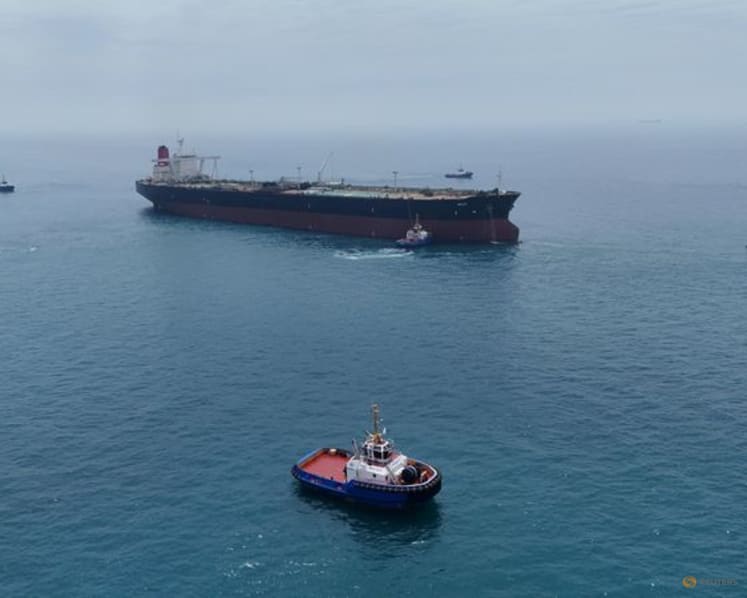
FILE PHOTO: Drone view of oil tanker HELGA berthed at one of Iraq's southern offshore oil terminals near Basra as it prepares to load crude oil, becoming the second vessel to arrive since the closure of the Strait of Hormuz, April 24, 2026. REUTERS/Mohammed Aty/File Photo
HOUSTON, June 24 : The benchmark global oil price declined more than $3 on Wednesday to settle at its lowest level since before the start of the Iran war as supply concerns eased with more stranded oil tankers exiting the Strait of Hormuz.
Brent crude futures closed $3.34, or 4.3 per cent, lower at $73.74 a barrel, while U.S. West Texas Intermediate settled $2.87, or 3.9 per cent, lower at $70.34 a barrel.
Brent touched a low of $73.12, its weakest since February 27, the day before U.S.-Israeli strikes on Iran, while U.S. crude futures slipped below $70 a barrel for the first time since March 2.
Crude oil flows through the Strait of Hormuz are similar to what they were before the start of the Iran war, as tankers exit the key waterway with the help of military escorts, U.S. Energy Secretary Chris Wright said.





Around 20 million barrels of crude oil have exited the Strait of Hormuz in the last 24 hours, Wright said while speaking at the Reuters Global Energy Forum in New York, adding that a return to normal navigation was delayed due to Iranian mines in the strait.
Iran will not have the ability to block the strait going forward, Wright said, adding the U.S. will ensure flows even without a deal with Tehran.
Three stranded tankers carrying 5 million barrels of crude oil were exiting the strait on Wednesday, with two heading to Asia, shipping data showed, as the interim deal between Iran and the U.S. unlocks more supply stuck in the Gulf.
PRICE PRESSURE
Physical crude oil cargoes were selling at discounts across the globe, changing trade flows as markets come under pressure from fast-rising Middle Eastern supply with Iran set to boost sales following a temporary reprieve from U.S. sanctions.
Prices for Brent crude for second-month delivery were also trading higher than prices for prompt delivery for the first time since the war, a sign of increased near-term supply.
"Positive signals from the Persian Gulf are fuelling optimism about oil flows through the Strait of Hormuz. Vessel crossings increased in recent days, although they remain well below pre-war levels," ING analysts wrote in a note.
The U.S. also authorized Iranian oil sales this week, easing decades-old sanctions as it pushes toward a final peace deal with Tehran in return for commitments on nuclear inspections and free transit through the Strait of Hormuz.
"If sanctions are eased, Iranian production and exports could ramp up relatively quickly given the substantial amount stored on tankers — we are likely talking weeks rather than months," said Tim Waterer, chief market analyst at KCM Trade.
Oman said it would keep the strait open to shipping without imposing tolls and had designated two temporary routes north and south of the existing shipping lane to facilitate the safe passage of vessels leaving the region.
Uncertainty remains over the durability of the U.S.-Iran accord, however. U.S. President Donald Trump said on Tuesday that Iran had agreed to nuclear inspections into "infinity," although Tehran said it had made no such concession.
However, U.S. inventories remained tight on strong refining demand and amid a release of oil from the government's emergency stash. U.S. crude stocks, including commercial and those in the Strategic Petroleum Reserve, fell by 15.1 million barrels to 743.3 million barrels in the week ended June 19, the EIA said, the lowest level since 1984.
J.P. Morgan on Wednesday lowered its second-half 2026 Brent crude oil price forecast due to lower-than-expected OECD commercial inventory draws and softer demand for oil. The bank sees Brent averaging $86 per barrel in the third quarter and $80 in the last quarter.
Elsewhere, Moscow's oil refinery will be offline for at least six months after suffering extensive damage in Ukrainian drone attacks, two industry sources said on Wednesday.





