







Oil prices fall 1% to 4-month lows as progress in US-Iran talks cools supply concerns
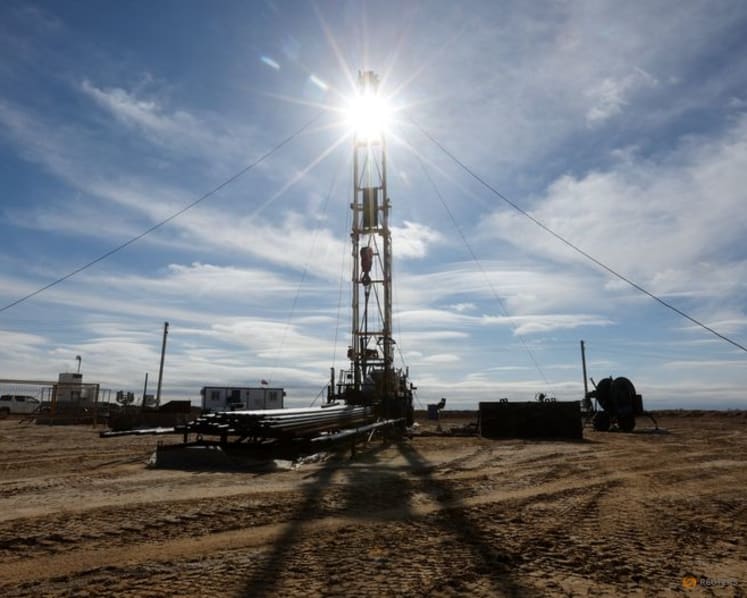
FILE PHOTO: Sunlight shines through a drilling rig at the Airankol oil field operated by Caspiy Neft in the Atyrau region, Kazakhstan, April 21, 2026. REUTERS/Pavel Mikheyev/File Photo
NEW YORK, July 1 : Oil prices fell more than 1 per cent on Wednesday to their lowest levels since March as optimism over U.S.-Iran talks allayed supply concerns after U.S. President Donald Trump said talks in Qatar had gone well.
Brent futures settled down $1.38, or 1.89 per cent, to $71.57 a barrel, while U.S. West Texas Intermediate crude lost 92 cents, or 1.32 per cent, at $68.58 a barrel. Both benchmarks closed at their lowest levels in four months.
"The negotiations that are currently taking place in Qatar are perceived as being positive (and) that has allowed prices to drift further," Saxo Bank analyst Ole Hansen said. "There is a chance that we could see even lower prices."
Trump said on Wednesday the U.S. was getting along very well with Iran and that recent meetings in Qatar went well.





The U.S. and Iran held technical talks in Doha as they seek to agree on the flow of shipping through the Strait of Hormuz and secure a lasting ceasefire, a source with direct knowledge of the talks and an Iranian official said. The U.S. and Iran have sparred publicly over the meaning of the interim pact, exchanging military strikes over the past week.
"There's more optimism as more oil goes through the Strait of Hormuz," said Phil Flynn, senior analyst for Price Futures Group. "The market is signalling that once we get past this, the gloves are going to come off and we're going to probably produce more oil in the world than we ever have."
Tanker traffic through the strait has started to recover, with U.S. Vice President JD Vance saying oil flows through the waterway had returned to pre-war levels, without citing figures.
OIL PRICE FORECASTS CUT
In the U.S., crude inventories fell by 3.8 million barrels to 408.4 million barrels last week, the lowest level since September 2018, as domestic refinery demand rose ahead of the July 4 holiday weekend, the Energy Information Administration said on Wednesday. The draw, however, was smaller than analysts' expectations in a Reuters poll for a drop of 4.5 million barrels.
Following five straight monthly increases, analysts have cut their 2026 oil price forecasts for the first time since the Iran war began, as the reopening of the Strait of Hormuz eased concerns over prolonged supply disruptions, a Reuters poll showed.
Brent fell by around $45 a barrel in the second quarter of this year, its largest quarterly drop since the global financial crisis in 2008. U.S. crude futures, meanwhile, fell by around $31 a barrel, their largest quarterly decline since 2020, when the COVID-19 pandemic crushed global oil demand.
The declines followed progress towards ending the Middle East conflict, after sharp gains in March triggered by the U.S.-Israeli attack on Iran.
Meanwhile, OPEC+ oil-producing countries will likely agree on a further hike in their output targets from August when they meet on Sunday, three sources said on Wednesday.





