







Nasdaq hits record high as chipmakers fuel stock gains
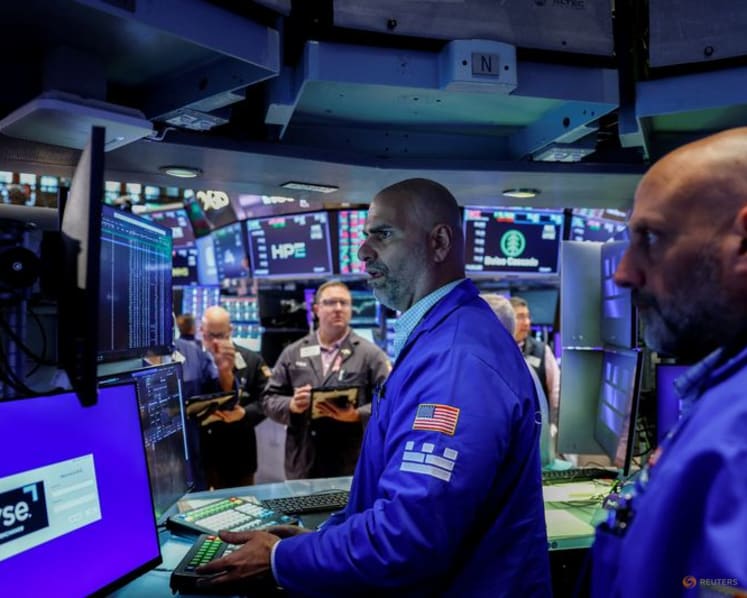
Traders work on the floor of the New York Stock Exchange (NYSE) in New York City, U.S., September 16, 2026. REUTERS/Jeenah Moon
NEW YORK, Sept 21 : The Nasdaq hit a record closing high on Monday, lifted by gains in Advanced Micro Devices and other AI heavyweights, while falling oil prices and long-dated Treasury yields also boosted risk sentiment.
Chip stocks rallied, with Intel and Arm Holdings surging over 12 per cent, and the PHLX semiconductor index jumping 4.3 per cent.
Advanced Micro Devices closed 10 per cent higher to reach a market capitalization of $1 trillion for the first time.
Investors pointed to signs that suggest spending on AI is still expanding, despite recent safety warnings from leaders of AI giants a week ago that triggered a global tech selloff.





The Nasdaq Composite rose 2.26 per cent and posted a record closing high for the first time since June 2, while the S&P 500 gained 1.49 per cent, just shy of its record. The Dow Jones Industrial Average ended up 0.71 per cent.
MSCI's All-World index rose 1.31 per cent, while shares in Europe rallied 1.02 per cent.
Risk appetite remains strong despite growing expectations of further global rate hikes.
“While synchronized rate hikes have raised concerns about risk assets, equities remain near record highs, supported by strong earnings growth,” said Seema Shah, chief global strategist at Principal Asset Management.
“Importantly, central banks are raising rates to address inflation rather than to slow economic activity, suggesting tightening will be gradual and limited. While higher rates may hinder further multiple expansion, they are unlikely to materially pressure earnings or derail the broader bull market,” Shah said.
SHORT-DATED YIELDS RISE
Interest-rate-sensitive two-year US Treasury yields rose 0.75 of a basis point to 4.751 per cent and earlier reached 4.772 per cent, the highest since July 2024. Benchmark 10-year yields fell 4.5 basis points to 4.951 per cent.
Central banks in most major economies are expected to raise rates again this year. Hawkish guidance from the Federal Reserve last week has futures wagering on a 55 per cent chance it will hike rates again in October, with 91 per cent odds of a hike by year-end.
Concern about the impact of inflation, as well as over governments' long-term finances, hit French debt on Friday, sending its risk premium to the highest since the 2012 euro zone debt crisis.
But yields fell on Monday alongside the drop in oil, leaving German 10-year yields down 6 basis points at 3.462 per cent and French 10-year yields 9 bps lower at 4.474 per cent.
OIL RETREATS, FOR NOW
Oil futures prices eased even as Iran and the United States exchanged new threats and after the Houthis attacked Saudi Arabia's capital.
US crude fell 4.86 per cent to $95.43 a barrel and Brent fell to $100.11 per barrel, down 3.62 per cent on the day.
“Profit-taking after recent gains, together with hopes for constructive discussions at this week's UN General Assembly (UNGA) and the upcoming Trump-Xi meeting, helped improve market sentiment,” said ING commodities strategists Ewa Manthey and Warren Patterson in a note.
US President Donald Trump will attend the United Nations General Assembly this week, ahead of a meeting with Chinese President Xi Jinping on Thursday.
There were also reports that Saudi producers were aiming to quickly restart some flows through the country's main east-to-west pipeline after it was damaged in attacks last week, though details were lacking and analysts harboured doubts.
Data from analytics firm Kpler showed exports from Saudi Arabia had recovered to just over 4 million barrels per day so far in September after slumping to 2.4 million bpd in August, the lowest since at least 2013.
In foreign exchange, the dollar gained 0.35 per cent against the yen to 157.42, with investors wary in case the Bank of Japan took advantage of the lack of liquidity during the country's three-day Silver Week holiday to step in to buy the currency.
The yen jumped on Friday after Japanese authorities conducted rate checks in the currency market, the Nikkei newspaper reported.





