





Commentary: Microsoft discovers AI can’t keep the email going
The outages of Outlook, Teams, Copilot and more than a dozen services are a bad look for the tech giant and its AI layoffs, says Mark Gongloff for Bloomberg Opinion.
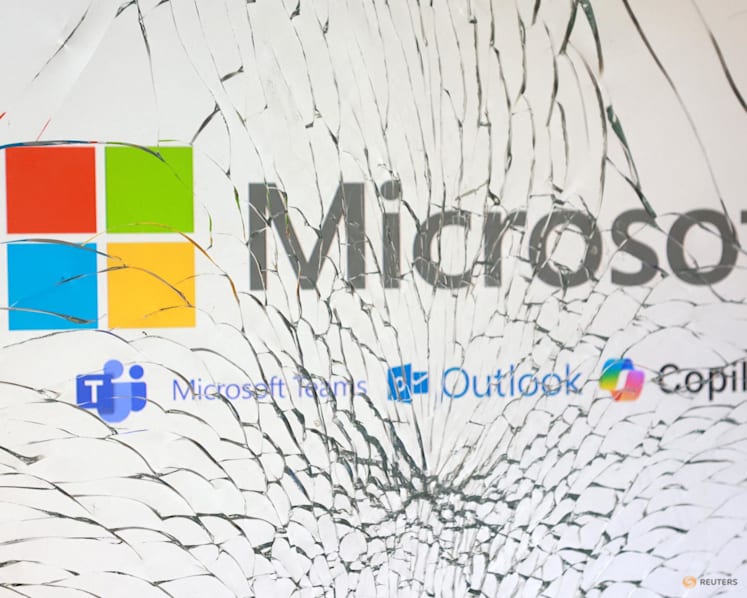
Microsoft, Teams, Outlook and Copilot logos are seen through broken glass in this illustration taken on Nov 13, 2026. (Photo: Reuters/Dado Ruvic)

This audio is generated by an AI tool.
NEW YORK: We’ve all been there: Your WiFi is down and you need a human to fix it, but first you have to run the gauntlet of the cable company’s dimwitted AI robots to access one.
Now imagine you’re a US$4 trillion company and the entire planet needs your computer problems fixed, like, yesterday, but you’ve sacrificed a third of your human employees to AI.
As of Friday morning (Nov 13, US time), Microsoft had still not completely repaired outages of its Outlook, Teams, AI assistant Copilot and more than a dozen other services that began nearly a day earlier. The outage wasn’t caused by Russian or North Korean hackers but by plain old bad code, “a core process” that apparently got performance anxiety and curled up into a ball, sobbing, on the server room floor. Other code collapsed in sympathy, and the company’s engineers hadn’t yet fully coaxed them back to health.
Eighteen hours later, the best this massive company, supposedly near the pointy end of the AI spear, could say was that things were looking up. Unless you were in Asia, where there were merely “encouraging recovery signals.” That will be slim comfort to the governments of Japan, Australia, the Philippines and several other countries who were still unable to serve their citizens because they could not get into their Outlook.





COULD LAID OFF EMPLOYEES HAVE HELPED AVOID THE OUTAGE?
About 450 million customers around the world pay good money for Microsoft 365 subscriptions, including governments, public services and other massive corporations. Many of their employees have spent the past day celebrating a forced vacation from Outlook, Teams and other unloved work tools and reflecting on the positives of competitors such as Slack and Zoom.
Microsoft 365 customers also include the AI companies, such as Anthropic and OpenAI, upon which the global economy depends these days.
That’s ironic, because Microsoft’s involvement in the AI revolution has inspired a series of major layoffs of human beings this year. To help cover its US$175 billion in AI spending in 2026, the company offered buyouts to 7 per cent of its workforce in May, cut another 2 per cent in July and then offered still more buyouts to a massive 27 per cent just last month.
Could the presence of those missing employees have helped quickly end or even avoid the Great 365 Crisis of 2026? It’s impossible to say at this moment, but we do know that at least 30 per cent of Microsoft’s new code is now written by AI, as CEO Satya Nadella has bragged.
And the internet quickly noticed that 30 per cent isn’t far from the percentage of employees the company has sent packing this year. Memes abounded.


GETTING ANTSY ABOUT AI BOOM
Nor is this Microsoft’s first such debacle this year. Another software bug in July cut off its West US Azure data centre from the rest of its network and caused hours-long outages across North America.
None of this has been a problem for Microsoft’s stock price. Investors have celebrated every layoff and AI spending announcement, as revenue from its AI-focused Azure cloud service has soared, taking the company’s shares to an all-time high earlier this month.
But investors are starting to get antsy about the AI boom, questioning the wisdom of the massive capital spending involved and seeing signs of the top in everything from the US midterm results to Jensen Huang’s love life.
Microsoft may be racking up Azure customers, but its service record even for those VIPs hasn’t been spotless. If and when the AI tide rolls out, then Microsoft could well regret treating the rest of its customers so badly in the process.