Commentary: Why Deliveroo’s exit from Singapore isn’t quite a surprise
Given its small market share, Deliveroo’s exit is unlikely to materially affect consumers or riders but it may have strategic implications for F&B businesses, says Momentum Works’ Li Jianggan.
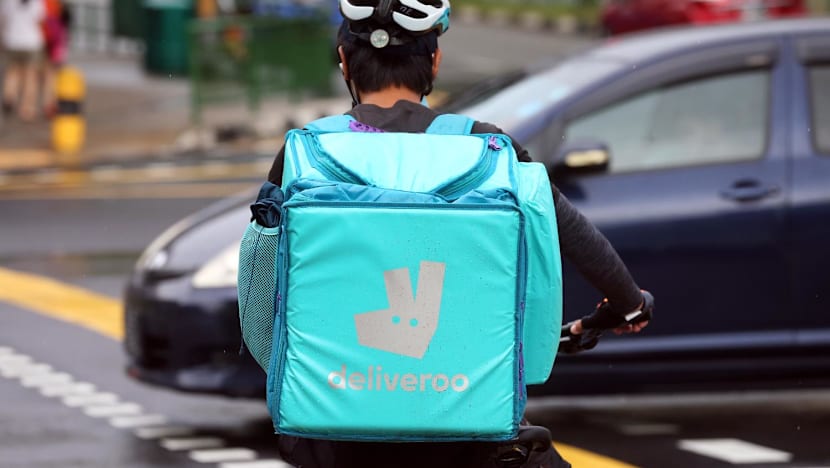
File photo of a Deliveroo rider making deliveries. (Photo: CNA/Ooi Boon Keong)

This audio is generated by an AI tool.


SINGAPORE: Deliveroo’s decision to wind up operations in Singapore may have some people wondering - is Singapore falling out of love with food delivery?
After all, the United Kingdom-based firm, with its signature teal-coloured logo, has been one of the longest-running players in Singapore since its entry in 2015.
But the short answer is no. Deliveroo’s decision to cease operations here may feel abrupt to consumers, but in a scale-driven and increasingly consolidating industry, it is not surprising.
Since the second half of 2022, Deliveroo’s market share here has remained firmly in the single digits.
According to our tracking at Momentum Works, its share declined from roughly 24 per cent in 2020 to about 7 per cent last year. Over the same period, the market consolidated around two players - Grab and Foodpanda which hold 69 per cent and 24 per cent of market share, respectively.
STATE OF THE SINGAPORE MARKET
In food delivery, scale is not a vanity metric. It determines whether a platform can achieve delivery density, optimise rider allocation and amortise fixed costs across a larger order base.
A generalist food delivery platform requires three things to be structurally competitive in the long term: volume, density and operational efficiency. Without sufficient order density in each zone, batching – defined as one rider delivering multiple nearby orders in a single trip – becomes harder, rider utilisation drops and delivery costs per order rise. These disadvantages compound over time.
Deliveroo repositioned itself in recent years towards premium restaurants and higher-income users, rather than competing aggressively in the mass market. While that strategy preserved brand identity, it limited scale expansion in a small and highly penetrated market like Singapore.
The strategic question for Deliveroo eventually became straightforward – invest further to regain share or focus resources on its core European markets, especially after the company was acquired by US delivery giant DoorDash last year.
In that context, Deliveroo’s pull-out from Singapore is a capital allocation decision rather than a demand collapse story.


Certainly, growth in the local market has moderated from pandemic highs, but penetration remains among the highest in Southeast Asia.
Based on our research, Singapore ordered about US$2.9 billion worth of food deliveries in 2025. For perspective, that is 44 per cent of Indonesia’s total value despite Indonesia having a population 46 times larger.
That said, local user behaviour has changed. Order frequency has stabilised. Consumers are more price-sensitive given the choices of delivery, self-pick-up and dine-out. Promotional intensity too has normalised from pandemic-era highs.
In such an environment, the third platform player – in this case, Deliveroo – struggled.
CONSOLIDATION IS THE NEW GLOBAL NORM
It is worth noting that the food delivery industry’s consolidation trend is not unique to Singapore. Food delivery markets in many developed cities have moved toward two-player structures, as investors become less tolerant of sub-scale operations in saturated markets. Profitability discipline has replaced growth-at-all-costs.
In Southeast Asia, for instance, Grab is the dominant player with market shares of 46 per cent to 69 per cent across the six markets that we track. Vietnam is the sole exception, where its share of the market is on par with ShopeeFood at 48 per cent each.
Foodpanda is the second-biggest player in three regional markets – Singapore, Malaysia and the Philippines – while Line Man holds the second position in Thailand.
Smaller players hardly saw any breakthrough in 2025.


CONSUMERS AND RIDERS NEED NOT OVERREACT
A logical concern is whether industry consolidation will lead to higher prices for consumers, lower rider earnings or steeper merchant commissions.
Given Deliveroo’s relatively small share, the transition is unlikely to materially affect consumers or riders.
In addition, Singapore remains one of the most transparent and competitive markets in the region. Consumers can compare prices easily, and platforms still compete vigorously on service quality and subscriptions such as GrabUnlimited or PandaPro.
In fact, scale can - and should - improve efficiency rather than reduce consumer value. Larger platforms stand to benefit from wider merchant selection, stronger subscription ecosystems, and higher order density that enables more efficient fleet allocation and batching.
Importantly, maintaining the scale-efficiency model is key for platform businesses. If prices rise too aggressively, order volumes fall, density weakens and the efficiency advantage erodes. Even dominant platforms have strong incentives to keep optimising.
For riders, fewer platforms could reduce arbitrage opportunities across apps – a term describing how riders switch between different platforms to maximise earnings at any given time.
But earnings are primarily tied to order density. If the remaining players absorb Deliveroo’s volume efficiently, rider utilisation and productivity - defined as how much of a rider's available working time is spent completing orders and how many orders they complete in a given time period, respectively – may in fact improve in certain zones, which means that earnings may still be supported.
F&B MERCHANTS FACE THE REAL ADJUSTMENT
The bigger implications are likely to fall on the food and beverage businesses. In particular, the smaller outlets may feel the heat of reduced bargaining power with one fewer platform option.
But the issue goes beyond that.


Singapore’s F&B sector is becoming structurally more competitive. While there were 3,074 closures last year, 4,103 new F&B businesses were registered in the same period. In fact, F&B openings have far outpaced closures over the last 3 years.
In this environment, delivery platforms are no longer just incremental sales channels. For many F&B operators, one or two platforms might eventually end up contributing 40 per cent to 50 per cent of total revenue. At that level of dependency, the choice of a food delivery platform becomes a more strategic consideration.
Some premium merchants previously chose exclusivity with Deliveroo to avoid competition on larger platforms. Being listed on larger platforms typically means more competition on pricing, ratings, delivery time and promotional mechanics with merchants ranging from premium to mass market.
That option has now narrowed and will require F&B businesses to come up with clearer channel strategy, sharper cost discipline and better understanding of platform dynamics in an already cut-throat F&B market.
Over the past decade, Deliveroo helped build the food delivery ecosystem in Singapore and its exit is not about disappearing demand. It is about the economics of scale asserting themselves in a fully penetrated market, and in delivery, scale almost always wins.
Jianggan Li is founder and CEO of Momentum Works, a Singapore-based venture outfit.