Commentary: Famous players like Honda excite, but that’s not enough for the Singapore Premier League
New players like ex-Japan star Keisuke Honda bring buzz, but that will be short-lived without a real vision for our professional league, says former sports commentator Edwin Yeo.
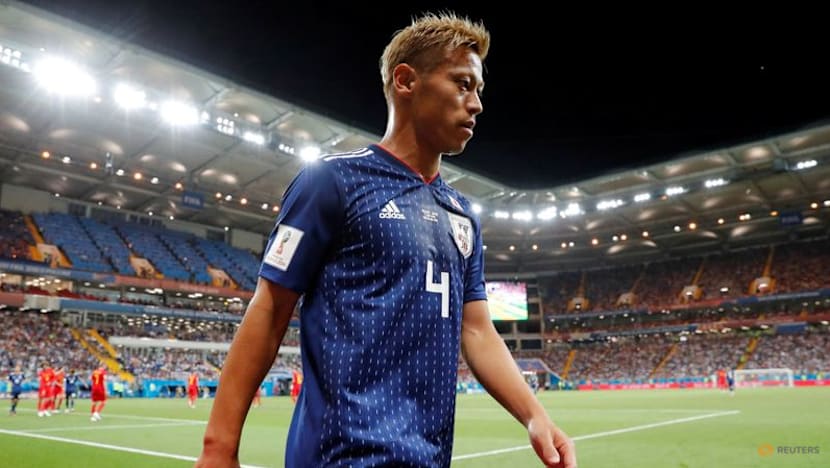
Japan's Keisuke Honda after Belgium vs Japan in the round of 16 at the World Cup, Rostov Arena, Rostov-on-Don, Russia, Jul 2, 2018 . (File photo: REUTERS/Jorge Silva)

This audio is generated by an AI tool.


SINGAPORE: It’s been some year for Singapore football. The men’s national team made history in November 2025 by qualifying for the Asian Cup on merit for the first time.
Now, two new signings could breathe new life into the Singapore Premier League (SPL) next season. First, former Japan international and AC Milan midfielder Keisuke Honda will play for Albirex Niigata Singapore, which won the league six times in the last decade and will be renamed FC Jurong.
Days after Honda’s move, the Young Lions announced the signing of Kai Whitmore, the young Welsh midfielder with Singaporean heritage. He played most recently with Newport County in England’s League Two, which is three tiers below the Premier League.
Though Honda will be 40 years old by the time he dons the White Swans’ jersey, he brings World Cup experience having played in three tournaments. Whitmore is in his prime at 25 and a good stint could help his chances of getting the Singapore passport to fulfil his expressed desire to represent the country.





Both signings inject some optimism for a league that has diminished in fan interest over the years. Yet, there is a sense of deja vu.
A HOME FOR PROFESSIONALS PAST THEIR PRIME?
Such excitement could pack the stands next season, even though Honda isn’t the biggest name to have played in our league.
That honour would go to Jermaine Pennant, former Arsenal and Liverpool winger who was 33 during his short stint with Tampines Rovers in 2016. The SPL also saw the likes of Japanese internationals such as Kazuyuki Toda play for now-defunct Warriors FC in 2013 at the age of 36, and Tadanari Lee for Albirex at 37.
Such signings might make the SPL seem like a home for professional footballers past their prime – and no doubt, some use this to lament the state of the league. But that wouldn’t entirely be fair.
The league also counts among its luminaries the likes of Grant Holt, who played for Sengkang Marine in 2001 at 20 years old, before heading off to a fairly successful career in England including time in the Premier League with Norwich and Aston Villa. And who can forget Iranian legends Mohammad Khakpour and Hamid Reza Estili, who played for Geylang United in 1996 before making their marks in the 1998 World Cup finals?
The SPL can at least claim that it played some part in those players’ development as footballers.


EXCITEMENT MIGHT BE SHORT-LIVED
But excitement will be short-lived if Singapore football misses the opportunity to be bolder.
The Football Association of Singapore’s (FAS) new leadership has been in place for a year now. While there have been some positives at the senior level of the national team, there has been little to suggest that our professional league is heading for a massive upgrade.
There are fewer teams and games this season compared to last. The Singapore clubs’ journey towards a coveted AFC Champions League Two title ended earlier this season than last.
There have been some changes in the current season – a larger prize pool, the possibility of fielding seven foreign players, up from six, the requirement to have at least four local players in the starting line-up. But the SPL has made such incremental changes before, and these are not enough to improve both the quality of competition and fan engagement.
For too long, spikes in excitement have been dependent on the clubs themselves somehow finding the funds to bring in players that can put bums on seats. That’s surely not a sustainable strategy, given how few resources the clubs have to be able to sign big names, apart from perhaps Lion City Sailors which is owned by Sea Group, the parent company of retail platform Shopee and gaming platform Garena.


Perhaps it is an unsolvable problem, and we are too stubborn to admit that Singapore is just too small to sustain a professional football league. Or perhaps we don’t know how to build a vibrant professional football league – and to be fair, not many countries do.
If Singapore is serious about a vibrant professional league, then there needs to be a real short, mid, and long-term strategy for turning what is fundamentally a taxpayer-supported league into one that attracts not only the fans, but also more corporate dollars.
WHY HAVE A PROFESSIONAL LEAGUE
The first thing the FAS needs to think about is the role of the SPL.
Yes, it should be a key component of football development in Singapore. But that’s really not the key reason for having a professional football league.
There are other pathways of development that have shown a degree of international success, none more so than Iceland which reached the quarter-finals of Euro 2016 and the 2018 World Cup finals when their domestic league was a semi-professional one.
Small countries like Luxembourg and Cape Verde also use their semi-professional league as a springboard for their players to hone their craft in top-tier European leagues such as France and Germany. So a professional league is not actually vital if player development is the main objective.
It is better to have one, of course. But that would also require the professional league to be successful in its own right, and that requires vision and commitment.
LEARNING FROM JAPAN
It can be done. Japan has been the gold standard of football management, where a committed development of the J-League has worked in tandem with its national footballing goals.
Their league, upon inception, was immediately adopted by corporations as a source of pride for companies, and consistent policies over the years to increase fan engagement kept the corporations committed as well.
Today, Japan isn’t just satisfied with qualifying for the World Cup finals: Their goal is to win it. Given their commitment and professional ecosystem, few would bet against them being the first Asian country to win the World Cup.
Honda’s and Whitmore’s signings now present a window of opportunity for the FAS. It is a chance for the new leadership team to outline their vision for the league, how they can get fans and corporations interested, and how this connects to a broader national footballing ambition for Singapore as a country.
Qualifying for the Asian Cup and a S$50 million injection from Sea Group founder and FAS president Forrest Li is great, but it’s time for the FAS to move away from short-term public relations wins to really showing the country how they will build an ecosystem that can rival the best in Asia.
Edwin Yeo, a former football commentator, leads the Singapore office of SPRG, a regional integrated communications agency.