Commentary: Thailand must reckon with reform or face irrelevance
Thailand’s urgent challenge is to lift the country out of economic stagnation and dwindling geopolitical relevance, says former foreign correspondent Nirmal Ghosh.
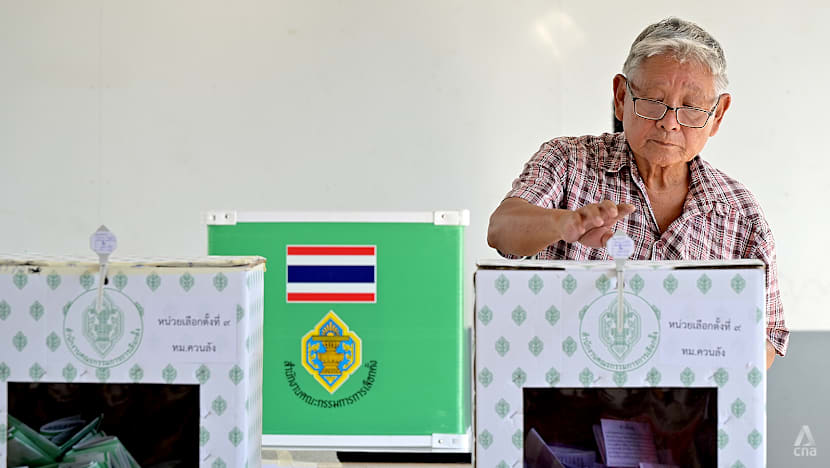
A man casts his ballot at a polling station at Hat Yai, Thailand, during the Thai general election on May 14, 2023. (File photo: CNA/Danang Wisanggeni)

This audio is generated by an AI tool.


SINGAPORE: Whatever the shape of the government that emerges out of Thailand’s Feb 8 election, its most urgent challenge will be to lift the country out of economic stagnation and dwindling geopolitical relevance – or else be stuck in a middle-income trap with a population increasingly frustrated at lack of opportunities.
But given the volatile nature of Thai politics, there is a growing chorus of worry from top economists and analysts that short-term, populist “quick win” stimuli will be applied, instead of the structural reform necessary to address core issues like declining industrial competitiveness, an ageing population, and transparency and corruption.
The upcoming election comes at a difficult time for Thailand’s credibility following renewed political uncertainty.
It is also happening in a global environment in which Thailand is increasingly sandwiched between two superpowers, China and the United States - both of whom it depends on. In such a world, Thailand’s relevance increasingly hinges on agile and opportunistic economic diplomacy.
In March 2025, when parts of Thailand were rocked by a powerful earthquake in Myanmar, an under-construction government building in Bangkok collapsed, killing at least 95 workers and exposing irregularities and potential corruption.
Last year also saw tensions with Cambodia erupting into border armed conflict and in August, then Prime Minister Paetongtarn Shinawatra was dismissed from office by a Thai court for ethical misconduct over her handling of the tension with Cambodia.
This was followed by a massive flood in the southern city of Hat Yai in November 2025, which appeared to catch the then interim administration unprepared.
As if to underscore the problems the new government will face, the start of the new year has seen a spate of attacks in Thailand’s three Muslim-majority southern provinces - long beset by an on-again, off-again separatist insurgency - and two fatal construction crane collapses.
RISK OF INCOHERENT POLICY
Yet the risk is not crisis, but incoherent policy, a senior Thai government official told me.
“The priority should be credible medium-term fiscal planning and revenue reform, to revive productivity and investment, not rely on stimulus,” the official said.
To be sure, Thailand’s economy has been somewhat resilient. Exports grew last year, with imports growing even faster. Tourism dipped slightly but remains substantial; Bangkok was the world’s most-visited city in 2025 with 30.3 million foreign visitors, ahead of Hong Kong, London and Paris.
But exports are expected to contract in 2026. Foreign tourist arrivals look set to grow this year, but not by much as the Thai baht remains strong and geopolitical uncertainty casts a pall globally. Besides, tourism is at best a short-term fix; it cannot drive long-term growth.
Gross domestic product growth in 2025 was a humdrum 2 per cent, and is expected to be an even lower 1.5 to 1.7 per cent in 2026 – the lowest in some 25 years and well below the regional average of around 4 per cent.
Household debt remains high; in the second quarter of 2025, Thailand's household debt-to-GDP ratio was 86.8 per cent – a factor that makes short-term fiscal stimuli in the form of handouts more attractive for voters and political parties alike.

REGAINING LEADERSHIP
Thai economists like to contrast the country’s performance with Vietnam, whose GDP is expected to surpass Thailand by the end of 2026.
Vietnam is also emerging as a leader in Southeast Asia – a position long occupied by Thailand – underlining the danger of Thailand’s declining relevance. Since the military coup of 2014, Thailand has been “essentially absent from the ASEAN table”, a former senior diplomat from the region told me. ASEAN is the 11-member Association of Southeast Asian Nations.
But regaining its traditional leadership role is arguably contingent on Thailand restoring and maintaining both internal political stability and economic dynamism.
“Political uncertainty is an economic drag, it undermines confidence,” the Thai government official told me. “Investors care less about ideology than predictability and execution.”
Structural changes inevitably impact existing interests and diminish state power to pave the way for free competition, and therefore face resistance, Chairman of Thailand’s National Economic and Social Development Council Supavud Saicheua told the Thai publication Prachachat this month. But the choice is between merely muddling through or accepting the short-term pain, he said.
Days of horse trading and coalition arithmetic are expected to follow Thailand’s Feb 8 election. A best-case scenario will be a free and fair poll without post-election subversion, with a new administration in place around March, empowered to make policy changes that address core issues and lift growth or risk growing popular disenchantment.
This, in turn, would rebuild Thailand’s regional and global standing. The challenge for the next government is not choosing sides internationally, but convincing partners that Thailand remains a reliable, forward-looking player in a rapidly shifting regional order, says Professor Pavin Chachavalpongpun, Professor at Kyoto University’s Centre for Southeast Asian Studies.
“Rebuilding confidence will require demonstrating political stability, policy coherence and a clearer strategic voice, particularly within ASEAN at a time of heightened great-power rivalry,” he told me.
The most consequential issue to watch will be whether recent political patterns of polls, protests, and military and judicial interventions, give way to a compromise between the old guard clinging on to vested interests and a new generation clamouring for reform and change, Thitinan Pongsudhirak, professor and senior fellow of the Institute of Security and International Studies at Chulalongkorn University, wrote in the Bangkok Post last month.
It is probably inevitable that, whichever party wins outright or more likely forms a ruling coalition, there will be a strong element of quick-fix cash handouts to appease voters, and accommodation of entrenched corporate and political elites favouring the status quo.
But that will not address the fact that business as usual – tourism, incentives for foreign investment, and an export-led growth model in a world turning against globalised free trade – is no longer good enough for Thailand.
The good news is there is an obvious consensus on this; whether Thailand’s power elites act on it, remains to be seen.
Nirmal Ghosh, a former foreign correspondent, is an author and independent writer based in Singapore. He writes a monthly column for CNA, published every third Friday.