Commentary: Three things Asia will be watching when Trump meets Xi in Beijing
The question is whether the US and China can compete without destabilising Asia - and at what cost if they cannot, says Patricia M Kim from the Brookings Institution.
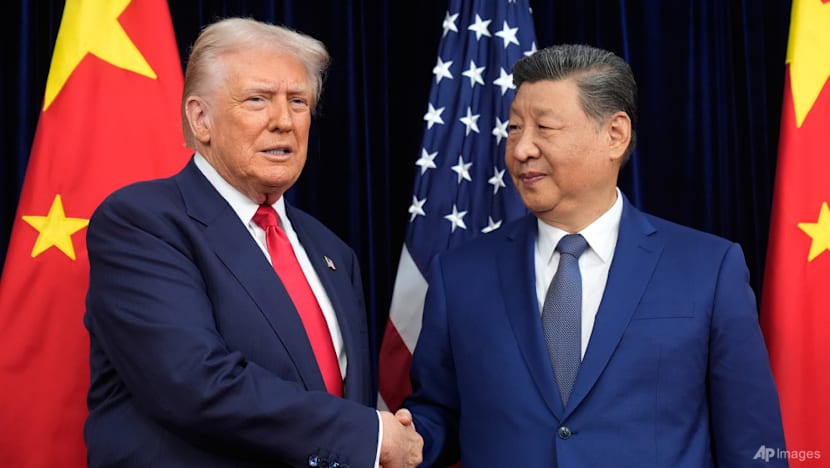
US President Donald Trump and Chinese President Xi Jinping shake hands before their meeting at Gimhae International Airport in Busan, South Korea, on Oct 30, 2025. (File photo: AP/Mark Schiefelbein)

This audio is generated by an AI tool.


WASHINGTON DC: The economic detente between Washington and Beijing has proved more durable than many expected. But since President Donald Trump and President Xi Jinping agreed to a one-year trade truce at their Busan summit last October, global conditions have become far less stable.
The two leaders are preparing to meet in Beijing this week, in the middle of the worst global energy shock in decades. Asia will be watching more closely than any other region to see whether the stability in the US-China relationship can endure.
Since Busan, US and Israeli military strikes on Iran and the resulting crisis in the Strait of Hormuz, a vital artery for global energy flows, have sent shockwaves through global markets. Nowhere is this more acutely felt than in Asia, where economies depend heavily on the Middle East for oil, gas and industrial inputs.
Against this backdrop, the relative steadiness of US-China relations is striking. The meeting in Beijing, then, is not just another summit.





WHY NEITHER SIDE WANTS ESCALATION
Predictions that the Iran crisis would derail the bilateral relationship have yet to materialise. This is despite US accusations that China may have shipped shoulder-fired missiles to Iran, continues to sell it dual-use goods and to buy Iranian oil in defiance of US sanctions.
Instead, both sides appear to have reached a tacit understanding: For now, stability serves their interests better than escalation.
That calculation reflects a deeper reality. Despite years of decoupling rhetoric, the US and China remain bound by mutual vulnerabilities.
Washington understands that Beijing still dominates the rare earth supply chain, with these elements essential to everything from electric vehicles to advanced defence systems. China, for its part, continues to depend on access to US technology - especially high-end semiconductors - where American export controls retain the power to cripple key Chinese firms.
Until both sides reduce these dependencies, a managed truce may be the least risky path forward. And what emerges from the Beijing summit will matter for Asia at large.


THE BIG TRADE QUESTIONS
First, on trade. How the US and China manage their economic ties will have profound implications for a region that relies on trade with both.
In Southeast Asia, countries such as Vietnam and Malaysia have become key manufacturing hubs, importing Chinese raw materials and inputs while assembling and exporting goods to the US. These economies have already been navigating pressure from both sides and are particularly exposed to shifts in policy.
If tensions re-escalate, they could face increased pressure from Washington to limit reliance on Chinese inputs in exports bound for the United States, or higher tariffs if Washington decides to widen and intensify the enforcement of “transhipment” rules. Beijing has made clear it would oppose such moves and retaliate against countries it sees as acting at its expense.
The squeeze would be different but no less consequential in Northeast Asia. Economies such as South Korea, Japan and Taiwan sit at the centre of high-tech supply chains and are already under pressure to align with US technological and export control regimes. A renewed trade confrontation would sharpen those demands, with Washington likely pushing for further restrictions on exports to China in strategically sensitive sectors like semiconductors.
A particularly sensitive question is whether any US-China trade truce extends beyond bilateral arrangements to include third parties. In recent months, Beijing has signalled a continued willingness to use its rare earth exports as leverage, including to exert pressure on Japan following their diplomatic spat over Taiwan.
The Trump administration has so far been reluctant to confront China on behalf of partners, raising concerns across the region. If Washington secures assurances for its own rare earth supply while leaving partners exposed, it would send a troubling signal about the reliability of US economic leadership - and risk further undermining US alliances and partnerships in Asia.
NUANCES IN RHETORIC ABOUT TAIWAN
Second, Taiwan. For Beijing, this remains the central issue in the relationship, and Mr Xi is likely to use the summit to press for greater clarity - or concessions - from Washington.
China has long sought an explicit US statement opposing Taiwanese independence, going beyond not supporting independence which is the longstanding American position.
The risk is not necessarily a formal shift in policy this time, but something less predictable - perhaps an off-the-cuff remark by Mr Trump, that seems to align US-Taiwan policy more closely with Beijing’s position, at Taipei’s expense.
This would shake confidence not just in Taiwan, but also US allies and partners across Asia, reinforcing concerns that they are viewed less as strategic stakeholders than as bargaining chips in Washington’s transactional diplomacy with China.

WHO WILL PROVIDE STABILITY AMID TURBULENCE?
Third, the broader security environment. Asian governments will be listening closely for any signals on how Washington and Beijing intend to navigate ongoing crises, particularly the war with Iran. With the conflict driving up costs and complicating supply chains, the stakes for the region are high.
So far, China’s response has been limited to calls for de-escalation and a focus on protecting its economic interests.
While some have looked to Beijing to play a more active diplomatic role, it has shown little appetite to step in as a crisis manager. At the same time, Beijing has been sharpening its legal tools to counter US sanctions or what Beijing calls "long-arm jurisdiction" imposed on Chinese entities that facilitate its oil trade with Iran.
On the other hand, Washington shows little sign of compromise or a clear diplomatic off-ramp in its approach to the conflict.
How the United States and China respond - whether they coordinate or operate at cross purposes - will shape Asia’s perceptions of their willingness to provide stability in a turbulent moment and help contain the fallout.

DON’T EXPECT A BREAKTHROUGH
Just like the Busan summit, the Beijing summit may be less about breakthroughs than about shaping the general trajectory of the US-China bilateral relationship.
The most likely outcome is a continuation of the status quo: an extension of the trade truce, a mutual effort to avoid escalation and a shared understanding that neither side is ready for a more ambitious agenda.
For many in Asia, that may be enough.
But that stability is not guaranteed. If either side concludes that the other is violating the terms of their understanding - or if new crises disrupt that balance - the détente could unravel quickly.
For Asia, the question is not whether the United States and China will compete, but whether they can do so without destabilising the region - and at what cost if they cannot.
Patricia M Kim is a Senior Fellow with a joint appointment to the John L Thornton China Center and the Center for Asia Policy Studies at the Brookings Institution.