Commentary: US and Iran may now fear escalation more than compromise
Despite the contradictory messaging from the US and Iran, there appears to be real momentum toward a deal, says international security professor Stefan Wolff.
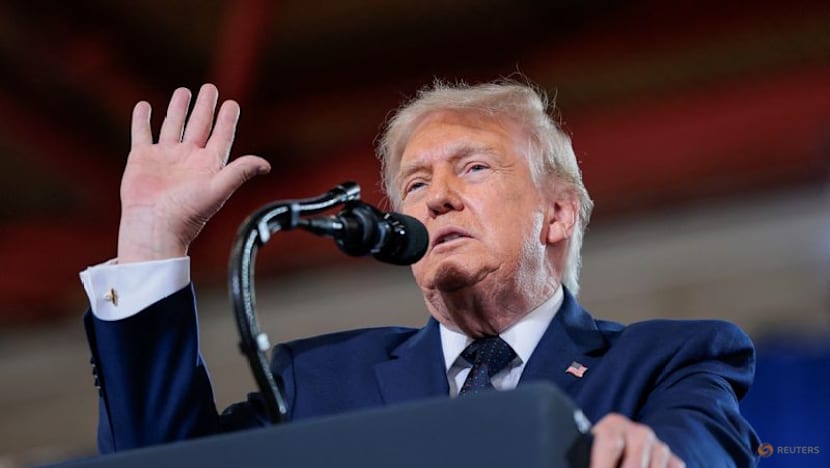
U.S. President Donald Trump delivers remarks at Rockland Community College in Suffern, New York, U.S., May 22, 2026. REUTERS/Kylie Cooper

This audio is generated by an AI tool.


BIRMINGHAM: The United States and Iran are finally behaving like the cost of a return to all-out war is too much to ignore.
A deal has been “largely negotiated”, said United States President Donald Trump on Saturday (May 23), but Iranian media quickly declared his claims “inconsistent with reality”. Then on Sunday, Mr Trump tempered expectations by saying the US will not "rush into a deal". Yet despite the contradictory messaging, there appears to be real momentum towards an agreement.
Brinkmanship appeared to be reaching a dangerous peak over the past week.
Mr Trump said he called off a military attack – one that would have broken the fragile ceasefire in place since Apr 8 – after an intervention by Gulf allies but warned that the US was ready for “a full, large-scale assault … on a moment’s notice”. Iran responded by threatening that the war would “extend beyond the region” in the event of renewed US strikes.
Over the past year, both sides have demonstrated enough capacity and willingness to show that these are not empty threats.
What has likely changed is the recognition that a miscalculation could lead to escalation beyond either side’s control. For the regime in Tehran, the potential consequences are existential; for the Trump administration, a prolonged war could be politically costly in the November mid-term elections.
Together, these create incentives for a deal despite the lack of trust.

THE GULF SEES A NARROW OPENING
This shift is reflected in intensifying mediation efforts led by Pakistan, which sent its powerful army chief Asim Munir to Tehran on Friday. More strikingly, Qatar also sent a negotiating team to Tehran.
Doha has traditionally had a role as a mediator, but it stepped away after coming under Iranian attack at the start of the war.
Qatar’s return to the mediation process indicates that the Arab Gulf states sense that a deal might be possible, and they want to be able to shape it as much as possible. That Doha is willing to take the diplomatic risk underscores both the urgency Gulf states feel to prevent renewed escalation and the narrow window of opportunity they currently see to achieve it.


Europe, too, appears to be preparing for the possibility of a deal.
On Friday, the Council of the European Union extended its sanctions framework against Iran, specifically targeting those deemed to undermine freedom of navigation in the Middle East. Yet, no specific individual or entity was named, which adds pressure on Iranian negotiators but preserves room to reach a deal on reopening the Strait of Hormuz.
This move positions the EU for a potential role in implementing any new arrangements to uphold freedom of navigation in the strait, similar to the role it already plays in the Red Sea with its Operation Aspides. It also adds to the bloc’s independent diplomatic leverage: The EU can impose sanctions but also remove them in exchange for a deal, and can do so independently of the US.
REOPENING STRAIT OF HORMUZ IS THE EASIER PART
All of these developments, however, also expose two long-term structural vulnerabilities.
The immediate priority for current diplomatic efforts is clear: prevent a return to all-out war and reopen the Strait of Hormuz. This may be possible as a temporary agreement.
But the more fundamental disputes remain unresolved, namely Iran’s nuclear enrichment capabilities, its ballistic missiles programme and its support for regional proxies. These are issues over which sustainable agreement has eluded negotiators for a long time and the stated positions on both sides make any compromise extremely difficult to achieve.
The mistrust between Tehran and Washington runs deep. Any eventual new regime for the Strait of Hormuz will be tested by even the most minor of incidents.
Whatever deal might be achieved now on the Strait of Hormuz, therefore, will not remove the risk of escalation later. At worst, it simply postpones the resumption of hostilities until one side perceives a road to victory.
THE BIGGER OBSTACLE
There is an important wild card in all of this: Israel.
Israel’s strategic preferences are fundamentally not aligned with those of the US, Arab Gulf states and Europe. It see Iran as an existential threat and wants to comprehensively neuter Iranian nuclear, ballistic missile and regional proxy capabilities.
The US under Trump seems to have settled for a narrower transactional framework, one that trades re-opening of the Strait of Hormuz for a longer-term commitment to curbing Iran’s ability to acquire nuclear weapons (not unlike the 2015 nuclear deal which Trump abandoned in 2018). The Arab Gulf states and Europe are similarly keen on rapid de-escalation and more strongly committed to long-term stabilisation, especially with an eye to secure energy flows from the region.

The divergence creates incentives for Israeli Prime Minister Benjamin Netanyahu to torpedo any short-term deal he sees leaving Iran strategically intact and capable.
Tehran could walk away from negotiations, if Netanyahu were to launch unilateral strikes on targets in Iran or escalate his war against Hezbollah in Lebanon. Israel has already shown it was willing to continue striking Lebanon despite the US-Iran and the Israel-Lebanon ceasefires in force. Importantly, these are threats that Israel can also wield in the longer term, heightening the risk to subsequent talks under a US-Iran framework deal.
For now, fear of an uncontrolled escalation may be enough to get the US and Iran to make a deal. Lasting peace will require tackling far more difficult questions.
Stefan Wolff is Professor of International Security at the University of Birmingham.