Commentary: Is Texas election upset a 'wake-up call' for Trump and the Republicans?
Despite the headwinds ahead of the US midterm elections, President Donald Trump and his Republican party appear to be sticking, rather than twisting, says RSIS’ Adrian Ang.
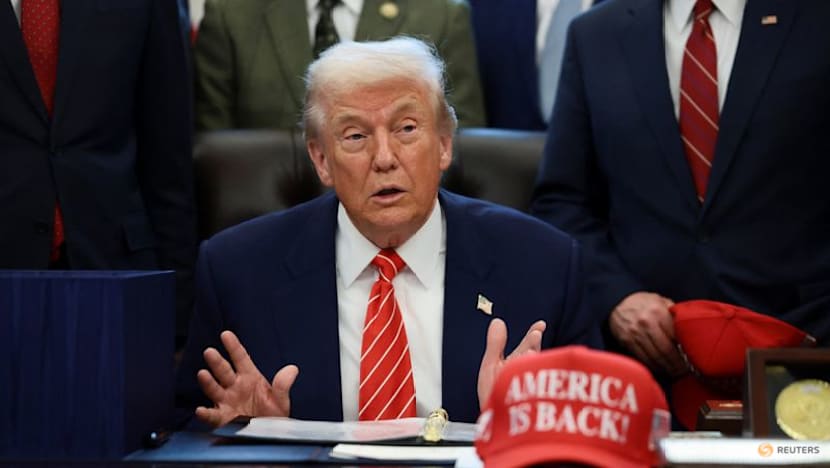
US President Donald Trump sits at his desk, behind a hat that reads "America is back" at the White House in Washington, DC, Feb 3, 2026. REUTERS/Evelyn Hockstein

This audio is generated by an AI tool.


SINGAPORE: After retaking the White House and securing a governing “trifecta” in November 2024, US President Donald Trump and the Republican Party now face the grim prospect of losing not one, but both houses of the US Congress in the upcoming midterm elections.
Historically, the president’s party almost always loses seats in the midterms where voters elect members of the House of Representatives and the Senate, which together are called Congress.
Only three times in the past century has the party of a sitting US president gained seats: in 1932 during the depths of the Great Depression; in 1998 amid perceived Republican overreach in the impeachment of then President Bill Clinton; and in 2002 in the aftermath of the 9/11 attacks.
Ahead of the midterm elections set for November, the recent win by a Democratic candidate in a Texas state senate district – a reliable Republican district that Mr Trump won in 2024 – has set off alarm bells, with nervous Republicans calling it a “warning” and a “wake-up call”.
The Democratic win in Texas was not a one-off, but rather the latest in a string of victories nationwide and at all levels of government – from headline gubernatorial wins in New Jersey and Virginia to breaking the Republican supermajority in the Mississippi Senate, despite some polls suggesting that Democrats continue to struggle with voter confidence.
DONALD TRUMP’S UNPOPULARITY
Scepticism towards the Democrats, however, must be juxtaposed against the president’s own unpopularity and voters’ disapproval of his handling of key issues, including jobs and inflation.
The latter is posing real jeopardy to the Republicans. In December, Mr Trump made a primetime address defending his economic record but voters were unconvinced. A January poll by Harvard University and Harris Poll found that a slight majority of respondents believe that former President Joe Biden was more effective than Mr Trump.
At the same time, immigration enforcement actions in Minneapolis, including two fatal shootings by US Immigration and Customs Enforcement (ICE) agents, have squandered what had hitherto been a Republican asset – the party’s “ownership” of the immigration issue in the minds of voters.

A year ago, a majority of Americans approved of Mr Trump’s handling of immigration and favoured his deportation plan. But he is now seven points underwater on the issue and more Americans support, rather than oppose, abolishing ICE.
Further, private Republican polls indicated falling support for the administration’s aggressive tactics, especially among independent, moderate, and minority voters, who will play a crucial role in determining if Republicans retain their congressional majorities.
This backlash has prompted the administration to try de-escalating the situation. Last week, White House border czar Tom Homan announced the withdrawal of 700 ICE agents from Minneapolis, with the possibility of further drawdowns.
However, while Mr Trump conceded that enforcement measures “could use a little bit of a softer touch”, he insisted that they were “totally focused on criminals”. This suggests that the partial drawdown of ICE agents could be a tactical adjustment to manage the public fallout, and not a recalibration of policy.


Similar behaviour can be observed in Mr Trump’s approach to trade and foreign policy. For example, the president may have renegotiated tariff rates down with India but he is unlikely to jettison his signature tariff policy even as the toll on the economy is becoming evident, as seen by the recent tariff threats directed at South Korea.
Meanwhile, the Republicans recognise that the US faces an affordability crisis but remain too divided to come up with solutions. So, they are instead backing the president’s initiative to “safeguard” elections from alleged voter fraud. Mr Trump, who remains convinced that the 2020 US presidential election was rigged against him, has ramped up attacks on the electoral system. His latest idea is to take responsibility for organising elections away from some US states and hand it to the federal government instead.
Despite the electoral headwinds, Mr Trump and the Republicans appear to be sticking, rather than twisting.
UNCERTAINTIES REMAIN
Lessons from the past suggest that Mr Trump and his Republican Party are unlikely to buck the historical trend at this year’s US midterms. Rather, we are likely to witness a replay of his first midterm election in 2018 when Democrats regained control of the House.
Currently, Democrats have a five-point advantage in a generic ballot among registered voters. The party is unlikely to yield the net gain of 40 seats like it did in 2018 but flipping half that number of seats would suffice to regain control of the House.
That said, nothing in politics is set in stone.
For the Democrats, the 2022 midterm elections should be a cautionary tale. Then, many indicators pointed to large Republican gains, but poor candidate selection and the issue of abortion rights helped blunt the election as a referendum on Mr Biden and the anticipated “red wave” never materialised.
Tariffs, Turmoil and Trump: One year into his return to power
This year’s midterm is also being conducted amidst a wave of unprecedented mid-cycle redrawing of congressional boundaries. The Supreme Court has given the green light to Texas and California’s redistricting plans, but legal wrangling continues over the plans of Florida, Maryland, Virginia, New York, Utah and Louisiana. These redistricting battles could prove decisive in determining control of the House in November.
The biggest “wildcard”, however, is likely to be Mr Trump, who has every incentive to forestall a Democratic House victory. The latter will likely subject his administration to aggressive oversight and might even push to impeach him again.
Mr Trump has thus far amassed a formidable US$375 million election war chest that makes him a potent political force.
More ominous are the president’s attacks on the election system. With the FBI and even the Director of National Intelligence now involved in pursuing Mr Trump’s false claims of widespread voter fraud in his 2020 defeat, it is not beyond the realm of the imagination that he will refuse to accept midterm results that do not go in his favour.
One thing is clear: Unpredictability is likely to be the defining feature of what lies ahead in US politics.
Adrian Ang U-Jin is a Research Fellow and Coordinator of the United States Programme at the S Rajaratnam School of International Studies (RSIS), Nanyang Technological University.