China's Xi says AI should not be dominated by one country
"We should jointly oppose overstretching the national security concept in the field of AI or placing one country's security over that of others," said China's President Xi Jinping.
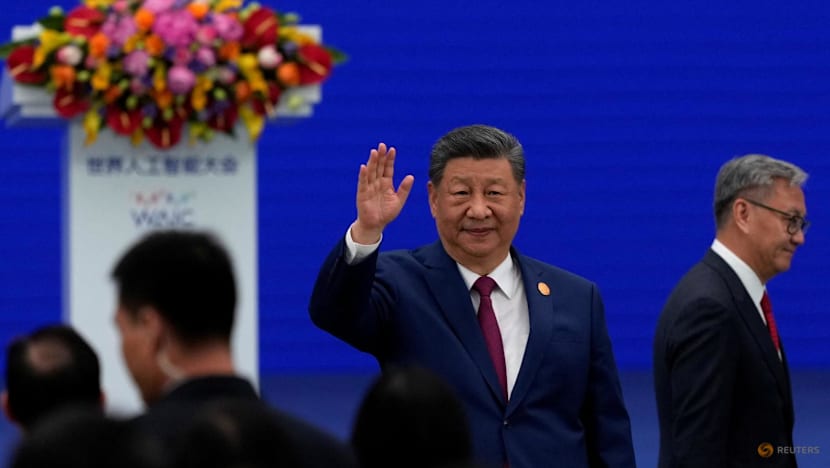
Chinese President Xi Jinping waves as he arrives at the opening ceremony for the World AI Conference in Shanghai, China, on Jul 17, 2026. (Photo: Reuters/Ng Han Guan)
SHANGHAI: Artificial intelligence should not be dominated by a single country, China's President Xi Jinping said on Friday (Jul 17) at a major technology conference in Shanghai, urging international cooperation on its development.
Chinese AI models are catching up to the most powerful US offerings and attracting global users with lower costs.
But how to govern the sector has become a key question, as concerns grow over military AI deployment or its use by hackers and terrorists.
"AI development should not be a solo performance by a single country, but a symphony of international cooperation," Xi said at the opening of the World Artificial Intelligence Conference.





"We should jointly oppose overstretching the national security concept in the field of AI or placing one country's security over that of others," Xi added.
The United States and European Union restrict tech exports to China over national security concerns, while tussles between Washington and American AI labs have raised the issue of who controls top technologies.
"China is trying to lead not only in terms of the technology development, but also in terms of AI governance," said Shengyun Lu, AI entrepreneur and founder of Shanghai consultancy Praxis Advisory.
Lu told AFP that in his view, AI should be regulated "like we regulate nuclear power".


"UNDER HUMAN CONTROL"
The four-day WAIC gathers more than 1,000 of China's tech firms, officials, researchers and industry figures.
Around 3,000 products are on display, from powerful semiconductor systems for AI computing to a smartphone that can autonomously operate apps.
But eyes were first on Xi's vision of how the world should handle the potential impacts of AI.
"We should put in place laws and regulations, technological monitoring, early warning, and emergency response systems, in order to... ensure AI is always under human control," Xi told the conference, calling for a "people-centric" approach.
On Thursday, foreign minister Wang Yi and representatives from 29 countries including Russia, Pakistan and Indonesia agreed to establish an intergovernmental AI cooperation group.
The World Artificial Intelligence Cooperation Organization, headquartered in Shanghai, aims to ensure the "healthy and orderly" development of AI, state media reported.
"I can understand Western countries are absent from this initiative, because Europe already has its own AI act and the United States is already defining their regulations," Lu said.
New York University business and technology professor Arun Sundararajan said "small glimmers of recent cooperation between Presidents Xi and Trump" were encouraging, but it was "hard to imagine there being a single approach to AI governance globally".
MEGA AI CONSUMPTION
Leaders including UN chief Antonio Guterres, Cambodia's Hun Manet and Thailand's Anutin Charnvirakul are attending WAIC, which showcases the cutting edge of Chinese tech.
Early Friday, the Beijing-based startup Moonshot AI released a powerful new flagship model, Kimi K3, which it said "demonstrated frontier-level performance".
Other highlights this year include MiniMax's M3 model and Huawei's Atlas 950 "supernode", an AI architecture for learning and reasoning.
"The main theme will be the transition from AI models to systems that can be deployed at scale" in everyday life, Poe Zhao of analysis publication Hello China Tech said.
Daily consumption in China of "tokens" - the industry unit of AI usage - has increased a thousandfold over the past two years, according to state media citing officials.
A growing number of companies abroad, like Siemens, are adopting Chinese open-source AI models, attracted by their performance, lower cost and ability to customise, in contrast to the closed systems of US giants such as OpenAI and Anthropic.
Both those US firms had to temporarily withhold the release of their latest AI models because of government concerns that they could help hackers break into critical online infrastructure.
"Models these days are controlled by very few," so more cooperative governance could expand access to them, 34-year-old Mike Luan, who works for an AI research lab, told AFP outside the WAIC venue.