analysis East Asia
Europe's race to arm Ukraine exposes how hard it is to build drones without China
Kyiv has reportedly secured a European Union exemption to purchase drone components from China, highlighting Beijing’s deeply embedded role in the supply chain and the strategic influence that position affords, say analysts.

This audio is generated by an AI tool.


BEIJING: As Ukraine burns through drones in its war with Russia, Europe’s race to keep Kyiv supplied is exposing just how difficult it remains to build enough of them without Chinese-made parts.
This reality has come into sharper focus after the European Commission in April approved an exception allowing Ukraine to use a portion of a multibillion European Union (EU) defence loan to procure drones with a higher share of components from outside the EU’s approved supplier countries.
While European officials did not identify China, the Financial Times (FT) reported on Jul 15, citing people familiar with the decision, that Kyiv had obtained a “carve-out” to “purchase drone components from China”.
Analysts told CNA the decision reflects a broader reality: Europe may have the technical expertise to manufacture drone parts, but it has yet to match China's ability to produce them quickly, cheaply and at scale.





China's advantage lies not in any one component but in its overall manufacturing ecosystem built over decades, said Hao Nan, a Nuclear Futures fellow with Ploughshares Fund and Horizon 2045, which support research on nuclear security and strategic risk.
"Those commercial foundations have since acquired strategic value by giving China greater capacity to scale production, accelerate iteration and influence supply chains that other economies cannot quickly replace, especially at wartime."
While China's position does not amount to absolute leverage, it gives Beijing the potential to influence supply chains that Europe cannot quickly replace, even as governments accelerate efforts to reduce their dependence, said analysts.
WHEN RULES MEET WARTIME REALITY
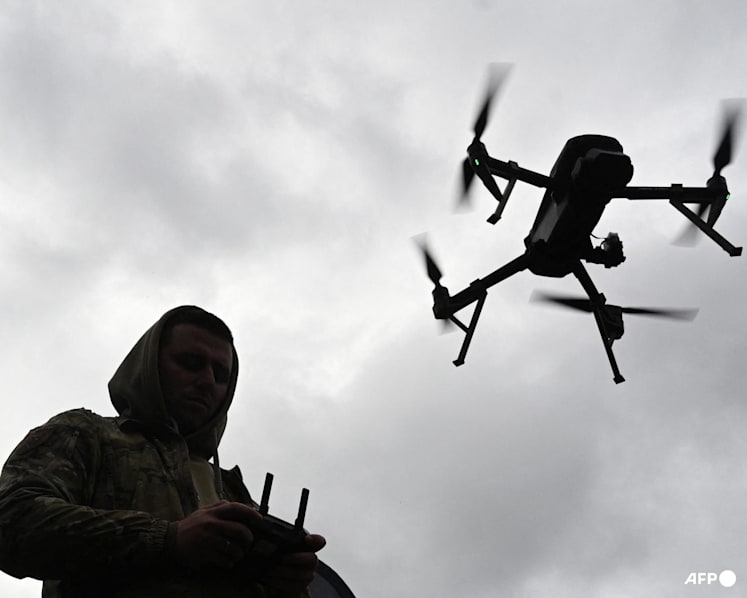
More than four years into Russia's full-scale invasion of Ukraine, drones have become a battlefield staple for both sides, used in huge numbers for reconnaissance and attacks.
They are also being lost, replaced and modified at a pace that conventional defence procurement was never designed to support, a challenge the European Commission highlighted on Jun 30 when it said Ukraine's military edge depended on obtaining critical products "in the required quantities and within very short timeframes".
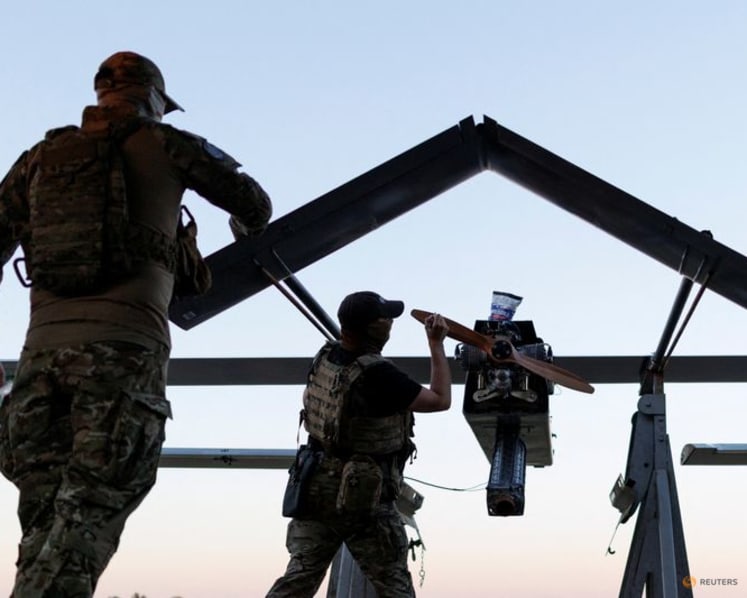
The European Commission described drones as "a key capability" enabling Ukraine to withstand Russia's war when it announced the first 3.9 billion euro (US$4.6 billion) payment on Jun 30 under a drone procurement package worth about 6 billion euros.
To help sustain that effort, the EU in February established a 90 billion euro Ukraine Support Loan, including about 60 billion euros for defence procurement. The roughly 6 billion euros drone package was the first tranche under that defence allocation.
The scheme is intended to strengthen Ukraine's defence industry and Europe's industrial base by sourcing equipment primarily from Ukraine, EU member states and approved partner countries.
But on Apr 1, the European Commission approved Ukraine's request for an exception to those sourcing rules, allowing drones purchased under the programme to contain more than 35 per cent by value of components originating outside those countries.
It said the conditions for granting the exemption were met because Kyiv provided information showing that Ukrainian and European manufacturers could not supply the required products in sufficient quantities or within the required timeframe.
The Jul 15 FT report said the decision “allowed Kyiv to buy certain Chinese components that are not sufficiently available in Europe”, citing people familiar with the decision.
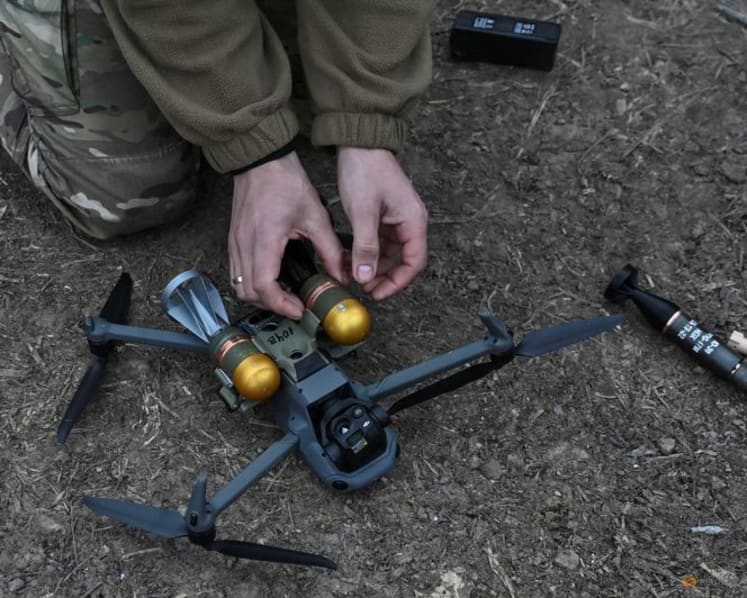
Neither the Financial Times nor the European Commission identified the specific Chinese-made components involved, and Brussels has not disclosed how much EU funding could ultimately be used to procure them.
Still, the episode essentially highlights how eligible European and Ukrainian suppliers still cannot produce enough drone components to meet Kyiv’s wartime needs, even as production is ramped up, said analysts.
CHINA'S EDGE IN THE SUPPLY CHAIN
It also highlights China’s entrenched position in this space, analysts noted.
“Every drone involved in the war in Ukraine depends on China,” reads a commentary published last December by the Center for Strategic and International Studies (CSIS).
“From palm-sized quadcopters guiding artillery to long-range loitering munitions, nearly every unmanned system on both sides contains materials and components that originate in Chinese factories and refineries.”
China's advantage lies not in a single technology or government programme, but in a manufacturing ecosystem that has developed over decades, said Andrii Tyndyk, CEO and co-founder of Ukrainian drone motor manufacturer AeroMotors.
"In Shenzhen and similar manufacturing centres, a company can source motors, electronic speed controllers, connectors, cameras, batteries, antennas, flight controllers and tooling from suppliers located within the same industrial ecosystem,” he told CNA.
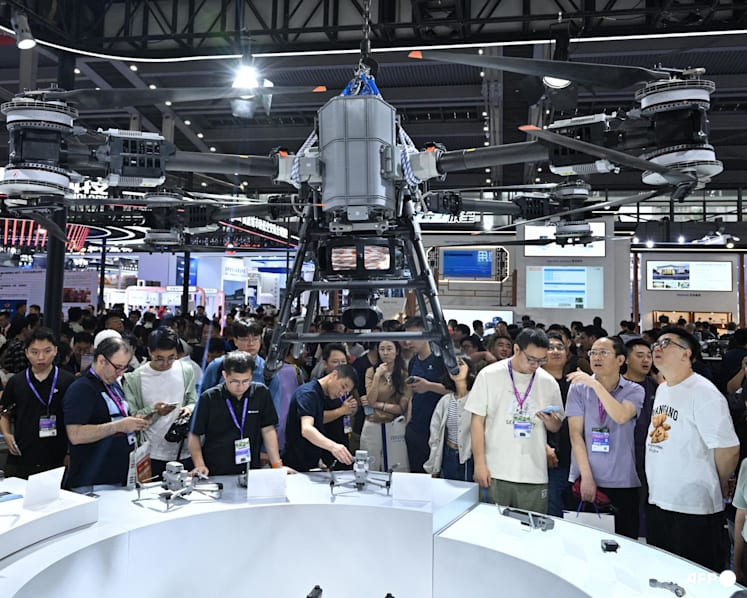
Europe's suppliers, by comparison, are more fragmented, generally operate at lower volumes and lack the certainty of long-term defence demand, Tyndyk noted.
AeroMotors' customers include Ukrainian drone makers. The company said in December 2025 that it had a production capacity of about 10,000 drone motors a month and, amid increased demand, was targeting 60,000 following investment from Swedish venture capital firm Front Ventures.
Hao of Ploughshares Fund noted how individual components may not be “technologically exceptional” for Europe.
“But China's integrated ecosystem - from materials and parts to assembly and logistics - can deliver reliable products at low cost, high volume and fast pace,” he said.
Those capabilities were built on decades of civilian demand, dense electronics clusters, industrial policy, competition and economies of scale, rather than a deliberately designed military supply-chain strategy, Hao said.
That manufacturing depth has become increasingly important as the war in Ukraine has transformed how drones are developed and used, said Bryce Barros, a defence innovation and dual-use technology strategist and associate fellow at GLOBSEC, a Europe-based think tank.
"The technologies are changing so quickly that what becomes more important is having an ecosystem that can support that fast iteration rather than focusing on developing that single product or platform,” he told CNA.
LEVERAGE, BUT NOT A FREE HAND
China's deeply embedded position in the drone supply chain gives Beijing an advantage that is "primarily structural rather than transactional", said Hao from Ploughshares Fund.
"China wants neither Europe to view China as enabling Russia nor Moscow to view it as arming Ukraine."
The balancing act comes as Brussels has repeatedly accused Beijing of helping sustain Russia's war effort by supplying dual-use goods and technologies to Moscow's military-industrial base, allegations China has consistently rejected. The EU has sanctioned more than 100 Chinese companies and individuals over alleged support for Russia's military capabilities.
Beijing says it has maintained an objective and impartial position on the Ukraine conflict, promoted peace talks and opposed unilateral sanctions against Chinese companies.
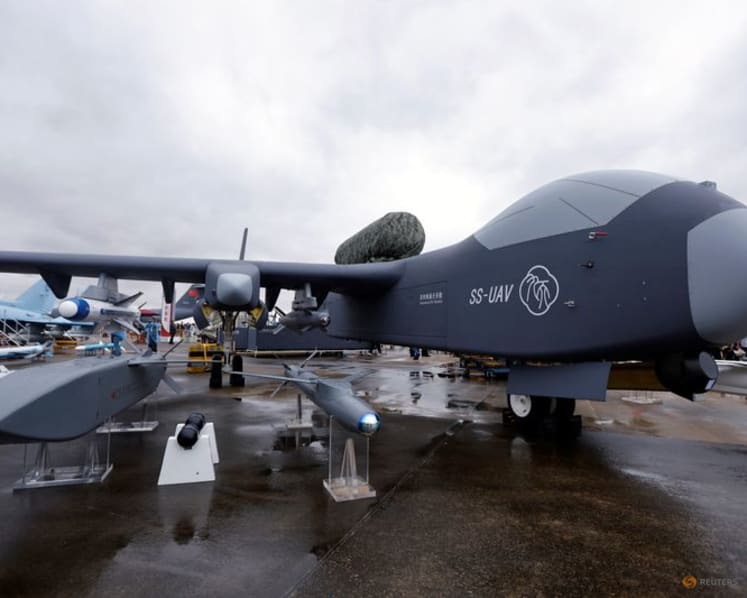
The current landscape is different from a straightforward geopolitical bargaining chip, Hao said.
China's manufacturing network is vast and highly dispersed, with components moving through commercial supply chains that Beijing cannot fully control.
Even so, EU-funded purchases could reinforce the position of Chinese suppliers through larger orders, economies of scale and what Hao described as a potential "supplier lock-in effect", making it more difficult for European manufacturers to shift to alternative suppliers.
That could also leave Beijing with the option of tightening export licences or disrupting access to selected dual-use products should political tensions escalate, he added.
Beijing has already shown its willingness to tighten controls over drone-related exports.
On Wednesday (Aug 5), it announced restrictions on drone exports to the United States and blacklisted six companies, in response to recent trade sanctions by Washington.
Yet how much leverage such a position ultimately affords Beijing is less clear, analysts noted.
"Europe does not have to worry too much about its dependence on China turning into a critical vulnerability,” Sun Yun, director of the China programme at the Stimson Center, a Washington-based foreign policy think tank, told CNA, noting that both sides were unlikely to face each other in a direct conflict.
“However, the dependence will translate into vulnerability and give China the ability to influence its agenda and freedom of action,” she said.
Hao described any effort to weaponise that dependence as "self-limiting". Restrictions imposed by Beijing could prompt Europe to tighten local-content rules, introduce stronger trade measures and accelerate investment in alternative suppliers, he said.
Rather than a complete break with Chinese suppliers, Hao expects the market to move towards what he called a "segmented supply chain".
More sensitive and networked military systems would increasingly use components from Europe or trusted partners, he said, while cheaper Chinese inputs could retain a role in expendable drones manufactured and lost in large numbers.
"Chinese firms may retain a durable commercial role, but the current dependence will also accelerate European investment in domestic and Ukrainian production,” Hao said.
BUILDING ALTERNATIVES WILL TAKE YEARS
Reducing European dependence on Chinese drone parts suppliers is likely to be measured in years rather than months, manufacturers and analysts said.
With sufficient investment and guaranteed demand, Ukraine and Europe could expand production across almost every stage of drone manufacturing, including final assembly, testing, balancing, quality-control systems and ground equipment, said Aeromotors’ Tyndyk.
But governments and defence customers would first need to give manufacturers the confidence to invest through advance funding, multi-year orders and guarantees.
"We cannot build an independent drone industry by financing hundreds of final assemblers while leaving the component manufacturers undercapitalised."
Some of the greatest challenges lie not in assembling finished components, but in producing the specialised materials that go into them. Permanent magnets - a key part of many electric drone motors - are one example, Tyndyk said.
"Possessing rare-earth deposits does not automatically create a magnet industry.”
Producing high-performance permanent magnets also requires an industrial chain stretching from refining rare-earth materials and producing metals to manufacturing and testing specialised magnets, Tyndyk said.
"The most technically demanding and strategically important stages are refining, metal production and high-performance magnet manufacturing."
Those facilities require long-term demand, significant capital, technical expertise and years of investment before they can operate at scale, he said.
Batteries present a similar challenge, with Barros from GLOBSEC describing it as “one of the biggest industrial and technological hurdles” facing the supply chain for drone parts.
Even where batteries are manufactured outside China, many producers remain dependent on Chinese-controlled critical minerals or processing capacity further upstream, he said.
"There is (no) clear-cut answer on how to get around this."
For now, the pace of diversification will depend heavily on the course of the war, said Hao from Ploughshares Fund.
"Sustained high-tempo operations would force Ukraine to prioritise immediate volume, affordability and delivery over supply-chain autonomy,” he said.
Meanwhile, a lower-intensity conflict would give European and Ukrainian manufacturers more time to qualify suppliers, redesign systems around alternative components and expand production, although that would still require sustained investment and long-term procurement commitments, he said.
Sun from the Stimson Center said there is no silver bullet for Europe.
"The calculus is simple. If Europe wants to avoid vulnerability, it will have to build its own supply chain, or a supply chain that it can depend on,” she said.
"But it will be of higher cost, and will not be bulletproof, given China also produces some of the raw materials that go into the supply chain. There is no perfect answer."