







CNA Explains: Why are Singapore bank shares falling after a record run?
Singapore bank stocks tumbled for the second day in a row after a Citi report downgraded OCBC to a “sell” rating, saying it expected the bank's third-quarter earnings to be flat from a year earlier.
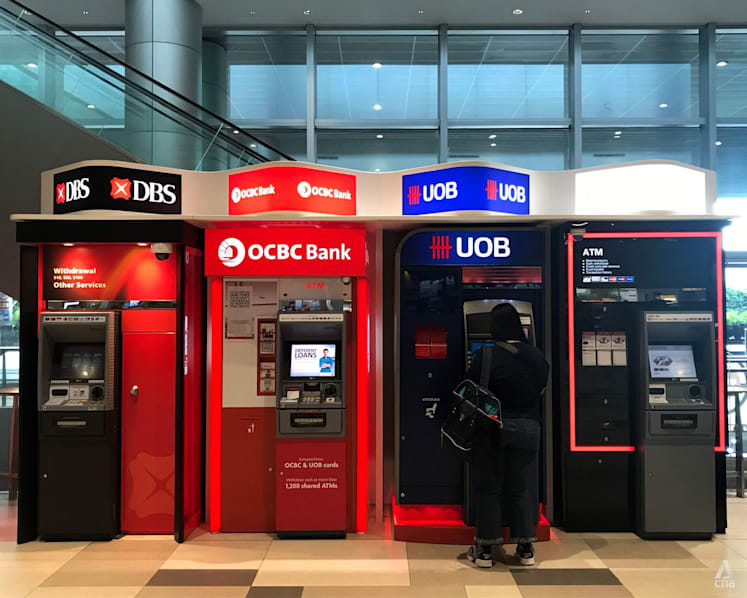
A row of ATMs in Singapore. (File photo: CNA/Jeremy Long)

This audio is generated by an AI tool.


SINGAPORE: Singapore bank stocks tumbled for the second straight day on Thursday (Oct 8), extending a sell-off sparked by a Citi downgrade of OCBC.
The Citi report cut its rating on OCBC to “sell” from a “neutral”, saying it expected the bank's third-quarter earnings to be flat from a year earlier.
Shares of OCBC fell 4.29 per cent or S$1.30 to S$29 on Thursday. This followed a decline of more than 5 per cent the previous day, which wiped more than S$8 billion off the bank’s market capitalisation.
UOB also fell on Thursday, declining 5.16 per cent or S$2.19 to S$40.25. DBS slid 4.7 per cent or S$3.64 to S$73.85.





The declines come after the share prices of all three banks hit fresh record highs this year.
So why are investors turning cautious even after the banks’ record run, and what could determine how the sector performs going into next year?
Why are investors pulling back?
Analysts attributed this week’s pullback to a combination of profit-taking by investors after the sector’s strong performance, rising bond yields, as well as concerns about the potentially higher funding costs banks may face due to rising interest rates.
Investors may be selling bank stocks this week to rake in profits while they can after the banks’ fresh record prices this year, Macquarie Equity Research’s head of ASEAN equity research Jayden Vantarakis told CNA, noting that investors are becoming more risk averse.
Similarly, Jefferies’ ASEAN research analyst Joanna Cheah noted that Singapore banks had been trading at historically elevated valuations. OCBC in particular had an exceptionally strong second quarter this year, she pointed out.
Investors are now questioning whether that performance can be repeated, she told CNA.
With OCBC priced for good news after gaining about 60 per cent this year, there was little room for disappointment, said Glenn Thum, research manager at Phillip Securities Research.
Citi’s forecast that OCBC's third-quarter profit would be flat from a year earlier – after growing 22 per cent in the second quarter – challenged the growth story that had helped drive the stock higher.
Higher interest rates would typically be positive for banks, allowing them to earn more from lending. But analysts said the benefit could take time to materialise, while banks face higher funding costs in the near term.
As interest rates rise, banks may have to pay more to attract deposits, increasing the cost of funding their loans.
Mr Thum said banks are already competing for fixed deposits. Loans also take time to reprice at higher rates, meaning margins could remain under pressure for another quarter or two before improving.
In its report, Citi also said the market could be overestimating how much OCBC would benefit from higher interest rates and stronger loan growth.
CGS International research analyst Tay Wee Kuang similarly said higher funding costs could temper expectations for improvements in banks’ net interest margins.
Competition for quality loans could also limit how much banks can charge borrowers, making higher asset yields unlikely in the near term, he said.
Why are analysts divided?
Analysts have markedly different calls on the three Singapore banks, reflecting differing views on their valuations and how much they stand to benefit from the changing interest-rate environment.
Citi downgraded OCBC from “neutral” to “sell” with a target price of S$27.50. It maintained its “buy” rating on DBS and reiterated its “sell” rating on UOB, although it still preferred UOB over OCBC due to relative valuations and positioning.
Other brokerages were more bullish.
In an Oct 1 report, Macquarie Equity Research’s Vantarakis said that while all three banks would benefit from higher Singapore rates, UOB had the most to gain.
About 43 per cent of UOB’s loans are denominated in Singapore dollars, compared with 37 per cent to 38 per cent for DBS and OCBC. UOB also has a higher proportion of revenue coming from net interest income, at 66 per cent, compared to about 58 per cent for its two peers, he said.
RHB took a more bullish view of the sector. In its Oct 7 report, the brokerage gave a “buy” rating to all three banks, naming OCBC as its top pick and giving the bank a target price of S$33.70.
“OCBC is our sector top pick on all-round balance sheet strength and earnings momentum,” RHB said.
The brokerage ranked UOB as its second pick, followed by DBS.
Rising rates may boost Singapore banks’ growth, with OCBC and UOB likely to benefit more, RHB said, although DBS remained a core pick for dividend safety and yields.
“The rising benchmark rates may provide the operating income of the Singapore banks … with another leg for growth, which has predominantly been carried by non-interest income in recent quarters,” it added.
Who should investors believe?
Rather than focusing solely on analysts’ “buy” or “sell” calls, investors should assess the key drivers of the banks’ earnings, experts said.
“Analysts largely agree on the fundamentals and differ mainly on how much to pay for them, so investors should look at the reasoning behind each call and not just the rating,” said Mr Thum.
One factor to watch is the Singapore Overnight Rate Average (SORA), and whether it continues to rise alongside US interest rates.
Investors should also consider the economic outlook and what it could mean for loan growth and borrowers’ ability to repay their debts, Mr Tay said.
Another question is whether continued inflows into wealth management can sustain the banks’ growth in fee income.
Taken together, these factors help determine whether the banks can generate enough earnings growth to justify their valuations.
For long-term investors, a dividend yield of about 4 per cent backed by strong balance sheets would still make the banks worth holding, said Mr Thum.



What is the outlook for Singapore banks?
Despite the recent sell-off, analysts generally remain positive on the banking sector and expect earnings to continue growing next year, supported by factors that include improving margins, loan growth and fee income.
“We expect earnings to keep growing in 2027, albeit at a slower pace than this year's strong rebound,” said Mr Thum.
Jefferies’ Ms Cheah also said the brokerage remained constructive on the banking sector in 2027, supported by various drivers such as healthy loan growth, continued wealth-management expansion and resilient asset quality.
“While stabilising margins should support net interest income, the more important structural driver in our view is the growing contribution from wealth and recurring fee income, which improves both earnings diversification and quality,” she said.
Singapore banks have also demonstrated their ability to generate attractive returns while maintaining exceptionally low credit losses through economic cycles, Ms Cheah said.
Still, risks remain.
Mr Thum pointed to higher credit costs and rising bond yields, which could weigh on banks’ capital.
Mr Tay, meanwhile, said a weaker economic outlook in 2027 could revive asset-quality concerns and offset some of the benefit from higher net interest income.
Want an issue or topic explained? Email us at digitalnews [at] mediacorp.com.sg. Your question might become a story on our site.





