Singapore to invest S$800 million in decarbonisation over next five years
Another S$800 million will be invested to establish a Research, Innovation and Enterprise flagship in semiconductors.
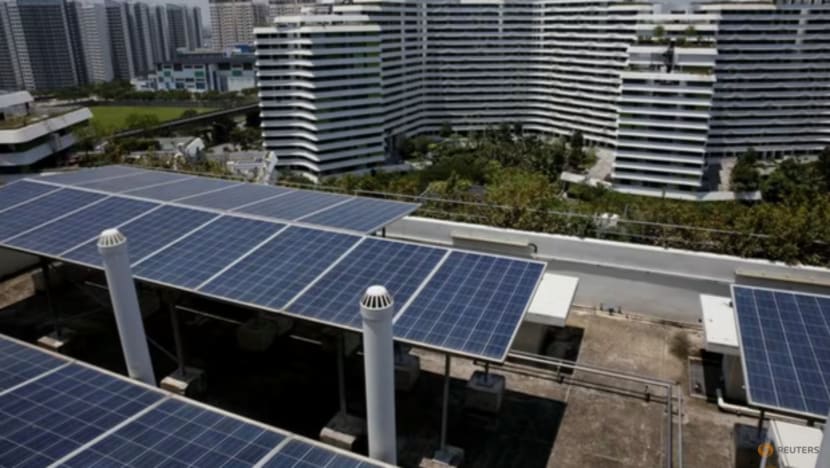
Solar panels on the roof of a public housing block in Punggol. (File photo: Reuters)

This audio is generated by an AI tool.


SINGAPORE: Singapore will pump S$800 million (US$631 million) into decarbonisation over the next five years, as it steps up efforts to meet its 2035 abatement target and 2050 net-zero ambition.
“Building on past efforts, we are significantly increasing investments in promising solutions to reduce power sector and industry emissions, and at the same time, to ensure a reliable and resilient power system,” said Minister-in-charge of Energy and Science and Technology Tan See Leng in parliament on Monday (Mar 2).
The funding is one of two “grand challenges” – large-scale research and translation programmes that advance national strategic priorities – under the national Research, Innovation and Enterprise (RIE) 2030 plan.
Industrial processes and power generation together account for more than 80 per cent of Singapore’s greenhouse gas emissions. The Ministry of Trade and Industry said the investment will focus on technologies that can decarbonise these two sectors at scale.
Examples include solar power, hydrogen and its derivatives, energy efficiency, energy storage, carbon capture and utilisation and grid modernisation.
Funding will support both early-stage laboratory research and the piloting of more mature solutions.
Dr Tan also announced the launch of a new programme called Singapore Pilots for Energy and Enterprise Decarbonisation to support local research, development and demonstration activities and attract private investments.
The programme will bring together facility owners, investors and government agencies to pilot and support the development of promising innovations.
INVESTMENT IN SEMICONDUCTORS
Dr Tan also announced an additional S$800 million investment to establish the RIE Flagship in semiconductors, focusing on high-impact technology areas such as advanced packaging and advanced photonics.
“The flagship will translate research into products and encourage more advanced R&D and manufacturing activities, creating good jobs in Singapore,” he said.
Semiconductors contribute close to 7 per cent of Singapore’s gross domestic product, and global demand for chips continues to grow. The flagship aims to position Singapore as a strategically important node for semiconductor research and development.
According to the Agency for Science, Technology and Research (A*STAR), the programme will take a coordinated, portfolio-based approach to bring together Singapore’s publicly funded semiconductor R&D efforts under a shared strategic direction.