




Singapore startup opens plant to recover lithium from EV batteries, raises US$7.6 million
NEU Battery Materials says its Tuas plant can process 1,300 tonnes of battery materials a year but will not run at full capacity for now.
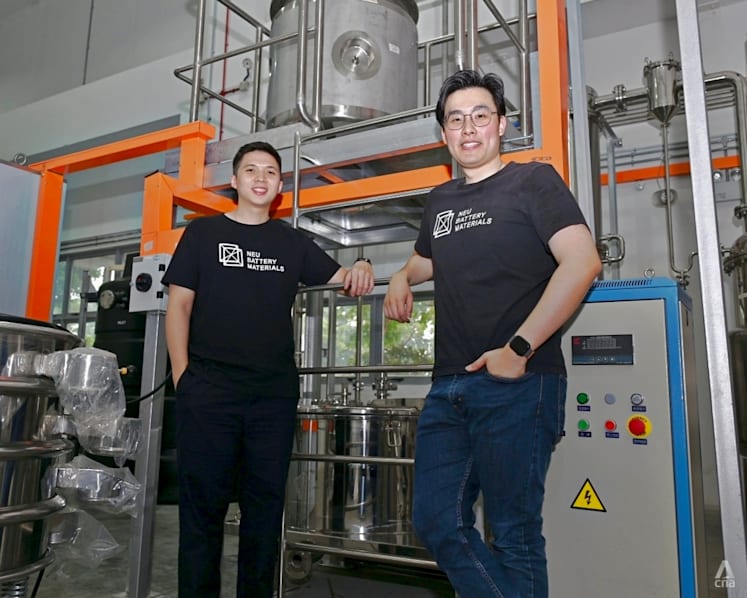
NEU Battery Materials' co-founders, chief technology officer Kenneth Palmer (left) and CEO Bryan Oh, at the firm's new plant in Tuas on Oct 12, 2026. (Photo: CNA/Raydza Rahman)

This audio is generated by an AI tool.


SINGAPORE: A Singapore startup has opened its first plant to scale up a process it says could make recovering lithium from certain electric vehicle (EV) batteries commercially viable.
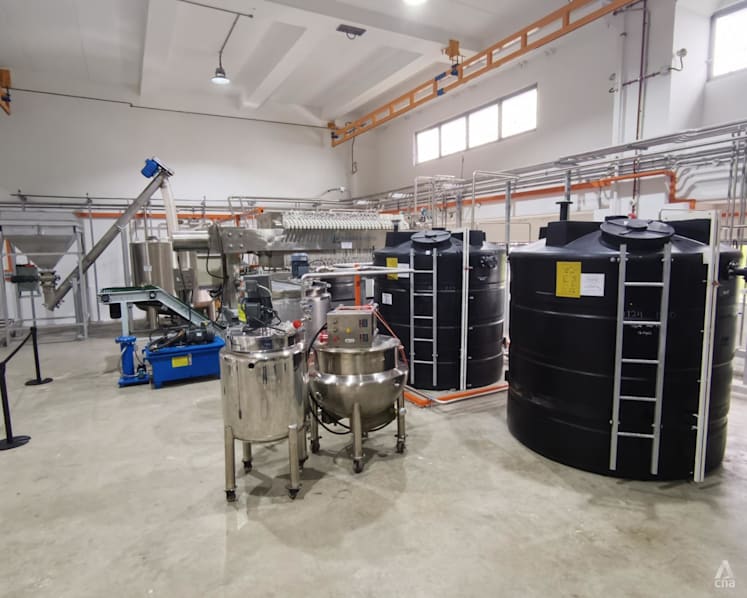
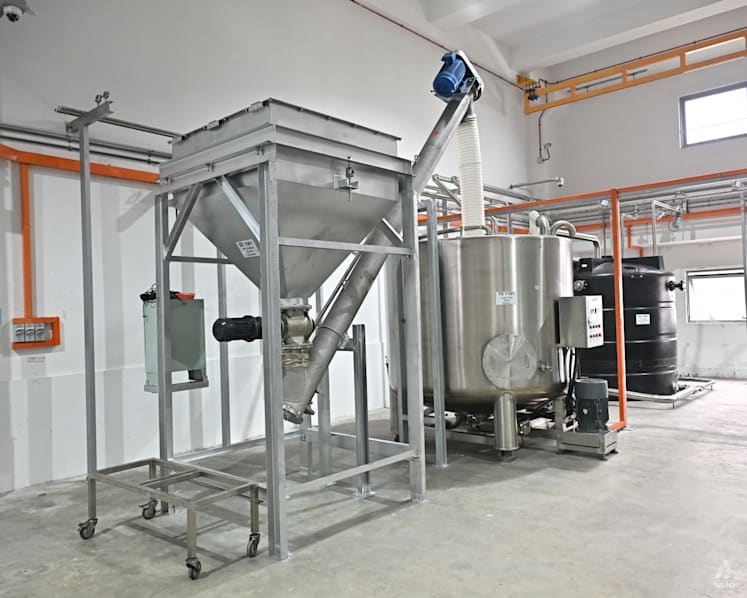
NEU Battery Materials marked the opening of the 12,000 sq ft facility in Tuas on Tuesday (Oct 13). The plant can process 1,300 tonnes of battery materials a year.
The company also announced the close of an oversubscribed US$7.6 million (S$9.7 million) funding round.
Co-founder and chief executive Bryan Oh told CNA the money will go towards running the plant, developing the technology and expanding overseas, which the firm is targeting next year. It is eyeing Europe and the United States, where it hopes to build larger facilities alongside battery manufacturers.





Mr Oh said NEU does not intend to run the Singapore plant at full capacity for now.
“The purpose is to run tests and then improve (the process) so that we can create the final blueprint to replicate for really big scale,” he said.
WHAT THE COMPANY DOES
NEU specialises in recovering lithium from lithium iron phosphate battery materials. These batteries are increasingly used in EVs as an alternative to nickel manganese cobalt batteries.
Lithium iron phosphate batteries accounted for more than 55 per cent of EV batteries deployed globally in 2025, up from nearly 50 per cent the year before, according to the International Energy Agency. Deployment was heavily concentrated in China.
Unlike nickel manganese cobalt batteries, they do not contain valuable metals such as nickel and cobalt, leaving recyclers with less high-value material to sell. Lithium makes up a small proportion of the material, making it difficult to recover enough value to cover processing costs.
"We have 50 per cent global market share in the world using lithium iron phosphate, but not many people can actually make money recycling (this). So this presents a very difficult problem," Mr Oh said.
"If you cannot recycle lithium iron phosphate, then all these will just go into the landfill."
NEU has developed a patented electrochemical redox process that uses electricity and water. Conventional hydrometallurgical processes consume chemicals to extract metals, but NEU's process reuses its proprietary chemical, Mr Oh said.
This lowers processing costs and could make lithium recovery commercially viable at scale, he said.
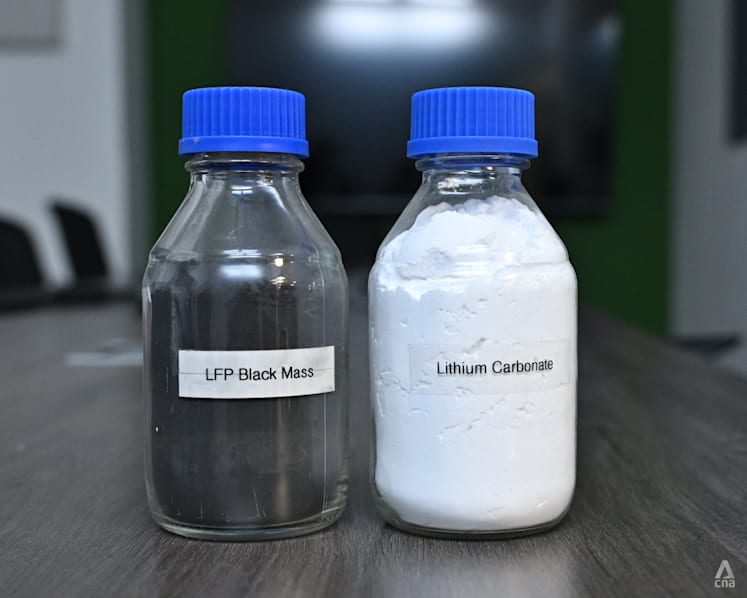
The system takes production scrap or black mass, a powder produced after end-of-life batteries are shredded, and extracts lithium hydroxide. This is then processed into battery-grade lithium, which can be used to make new lithium iron phosphate batteries.
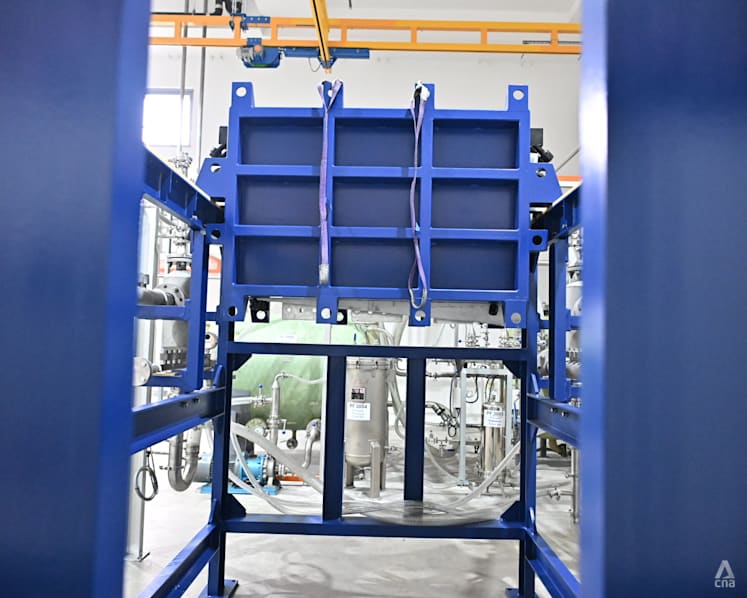
About 85 per cent of NEU’s current feedstock is production scrap, which is waste generated during battery manufacturing. Mr Oh said the waste generated can be substantial.
"So what we want to do today at the early wave of the battery and EV industry is to recycle this, sell back the lithium to them, so that they can continue the (circular) journey."
NEU also processes black mass from end-of-life batteries, but volumes are smaller, partly because the batteries entered the market more recently.
Mr Oh said the company holds about 40 to 50 tonnes of material – mostly from overseas battery manufacturers – at its Singapore facility. This is enough for about six months of operations.
SELLING LITHIUM TO BATTERY MAKERS
NEU plans to supply the lithium carbonate to battery manufacturers for use in new batteries.
Mr Oh said the company is working with manufacturers to validate the quality and consistency of the recovered lithium, sending progressively larger quantities for testing. Some of these manufacturers supplied the production scrap.
The lithium carbonate could also be sold to buyers in China, where lithium iron phosphate batteries accounted for more than 80 per cent of EV battery sales in 2025, according to the International Energy Agency.
If successful, the technology could help address a growing challenge as more of these batteries reach the end of their lives in the coming years.
NEU is prepared to scale up the Singapore facility if more end-of-life batteries become available locally, Mr Oh said. Existing equipment can accommodate about double the current processing capacity, while going beyond that would require additional equipment.
For now, the company's priority is still to use the facility as a testbed to refine its technology and establish the engineering blueprint for its larger plants overseas, he said.