




Singapore's economy grows 5.4% in Q3, down from 6.2% in previous quarter: Advance estimates
On a quarter-on-quarter seasonally adjusted basis, Singapore's economy grew 1.1 per cent, compared to the 1.5 per cent growth in Q2.
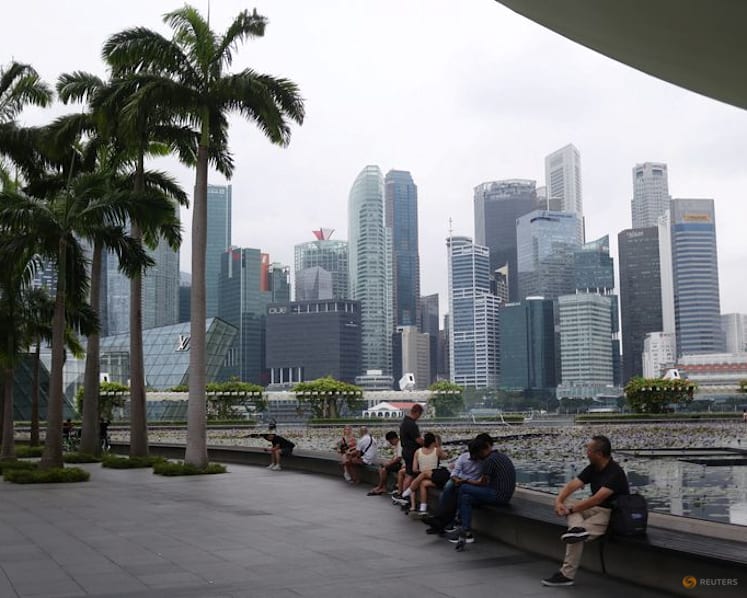
A view of Singapore's central business district on Apr 8, 2025. (File photo: Reuters/Edgar Su)

This audio is generated by an AI tool.


SINGAPORE: Singapore’s economy grew 5.4 per cent in the third quarter of 2026, slightly slower than the 6.2 per cent reported in the second quarter of the year, according to advance estimates from the Ministry of Energy, Trade and Industry (METI) on Wednesday (Oct 14).
The manufacturing sector grew 7.5 per cent, slowing down from a 12.9 per cent expansion in Q2.
On a quarter-on-quarter seasonally adjusted basis, Singapore’s economy grew 1.1 per cent, compared to the 1.5 per cent growth in Q2.
Advance estimates are largely computed from data in the first two months of the quarter, July and August in this case. They are intended as an early indicator and may be revised later when more data is available.





Growth in the manufacturing sector was driven by output expansions in the electronics, precision engineering, transport engineering and general manufacturing clusters, said METI in a media release on Wednesday.
This outweighed declines in output in the chemicals and biomedical manufacturing clusters, it added.
On a quarter-on-quarter seasonally adjusted basis, the manufacturing sector contracted 0.9 per cent, compared with the 6.3 per cent growth in Q2.
The construction sector grew 8.8 per cent, the best-performing of all sectors in the third quarter. This was faster than the 6.1 per cent growth reported in Q2, as both public and private sector construction output increased, figures from METI showed.
On a quarter-on-quarter seasonally adjusted basis, the sector grew 3.4 per cent, turning around from the 2.7 per cent contraction in the previous quarter.
SERVICES INDUSTRIES
The wholesale and retail trade, and transportation and storage industry grew 8 per cent, up from 6.9 per cent in the previous quarter.
All sectors across the industry grew, except for the retail trade sector, METI said in the press release.
Growth in the wholesale trade sector was driven by the machinery, equipment and supplies segment, in line with the strong growth in electronics exports over the same period, it added.
Water and air transport led growth in the transportation and storage sector.
On a quarter-on-quarter seasonally adjusted basis, the wholesale and retail trade, and transportation and storage sectors grew 2.2 per cent as a group, improving from the flat growth in the second quarter.
Together, the information and communications, finance and insurance, and professional services sectors grew by 4.3 per cent in the third quarter, easing from the 5.1 per cent growth in Q2.
All sectors in the group grew in the quarter – IT and information services drove growth in the information and communications sector, while the architectural and engineering, technical and analysis services segment supported the professional services sector.
Fund management and banking services led growth in the finance and insurance sector, METI said.
On a quarter-on-quarter seasonally adjusted basis, this group of sectors grew by 0.4 per cent, slowing from the 2.8 per cent growth reported in the second quarter.
For the remaining services sectors – accommodation and food services, real estate, administrative and support services, and other services industries – growth came in at 2.1 per cent in the third quarter, easing from 2.4 per cent in Q2.
All sectors in this group grew except for food and beverage services. The accommodation sector grew due to an increase in gross lettings in the higher value-added hotel segments, METI said.
On a quarter-on-quarter, seasonally adjusted basis, this group grew by 0.6 per cent, slightly slower than the 0.8 per cent in Q2.
UPGRADED 2026 FORECASTS
HSBC’s senior ASEAN economist Yun Liu said the bank is upgrading its 2026 growth forecast from 5.1 per cent to 5.8 per cent, given the upside surprise in the third quarter.
This exceeds the government’s current growth forecast of 4.5 per cent to 5.5 per cent. In August, the ministry raised Singapore’s economic growth forecast from the previous forecast of 2 per cent to 4 per cent.
This also means Singapore is likely to be ASEAN’s second-fastest growing economy in 2026 after Vietnam, said Ms Liu.
Ms Sheana Yue, a senior economist at Oxford Economics, agreed that this year’s GDP growth is likely to come in higher than initially expected, maybe closer to 6 per cent.
On Wednesday, she told CNA's Asia First that AI-related demand or AI-related influence will continue to be "a pretty strong driver going into next year" for Singapore's economy.
At the same time, she warned of AI becoming a key risk going into 2027, if a pullback on comes "prematurely".
Analysts are also monitoring how global conditions will affect Singapore’s economy, said Ms Yue. With the US Federal Reserve already hiking rates, she is expecting several other global central banks to do the same for the next few quarters.
“That will probably weigh quite heavily on global consumers and therefore Singapore’s export demand.”
OCBC’s chief economist Selena Ling said the Q3 advance estimates fell short of the bank’s forecast of 5.7 per cent.
“The sectoral data nevertheless indicate that growth momentum is being turbo-charged by AI- and electronics-related activity, trade and transportation services, and construction and infrastructure,” she said.
Highlighting that the first three quarters of growth have already averaged at 6 per cent, OCBC has upgraded its full-year growth forecast from 5.2 per cent to 5.5 per cent, she added.
Businesses linked to construction, trade and advanced electronics may continue to benefit from strong demand while consumer-oriented sectors face a more challenging environment, especially with tightening financial conditions, said Ms Ling.
This divergence creates a dual-speed expansion, she added, where one sector grows at a much more rapid rate than another.