Singapore's economy grew 5.7% in Q2, easing from 6.3% in previous quarter: Advance estimates
The manufacturing sector grew 12.2 per cent in the April to June period, compared with the same months a year ago.
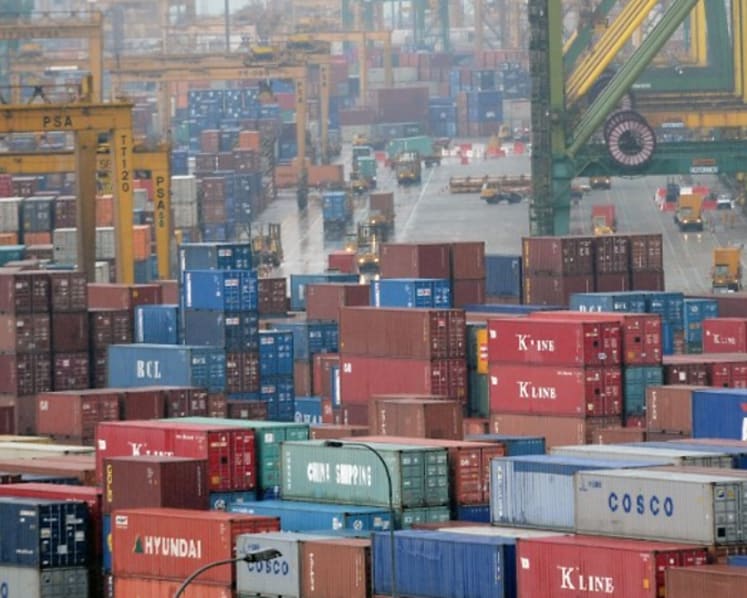
Stacks of containers at the Keppel terminal in Singapore. (File photo: AFP/Roslan Rahman)

This audio is generated by an AI tool.


SINGAPORE: Singapore's economy grew 5.7 per cent in the second quarter of 2026, slightly slower than the 6.3 per cent growth reported in the first three months of the year, according to advance estimates from the Ministry of Trade and Industry (MTI) on Tuesday (Jul 14).
The manufacturing sector grew 12.2 per cent, accelerating from an 8 per cent expansion in the previous quarter.
On a quarter-on-quarter seasonally adjusted basis, Singapore's economy grew 1.1 per cent, extending the 1.3 per cent growth in the first quarter of the year.
Advance estimates are largely computed from data in the first two months of the quarter, April and May in this case. They are intended as an early indicator and may be revised later when more data is available.





Growth in the manufacturing sector was largely driven by output increases in the electronics and precision engineering clusters due to strong artificial-intelligence-related demand for semiconductors and semiconductor manufacturing equipment, said MTI.
However, the chemicals cluster contracted due to feedstock disruptions from the Middle East conflict. The biomedical manufacturing cluster also shrank.
On a quarter-on-quarter seasonally adjusted basis, the manufacturing sector grew 5.3 per cent, compared with a 2.2 per cent contraction in the first quarter.
The construction sector grew 6.2 per cent in the second quarter, significantly slower than the 12.9 per cent growth reported in the first quarter.
Growth was supported by an increase in public and private-sector construction output. On a quarter-on-quarter seasonally adjusted basis, the sector contracted 2.1 per cent, compared with a 7.4 per cent expansion in the previous quarter.
SERVICES INDUSTRIES
On the services side, the wholesale and retail trade, and transportation and storage sectors grew 6.3 per cent in the second quarter, compared with 9.3 per cent growth in the previous quarter.
All sectors within the group expanded, with growth in the wholesale trade sector driven by the machinery, equipment and supplies segment, which grew in line with strong growth in electronics exports.
The water transport segment led growth in the transportation and storage sector.
On a quarter-on-quarter seasonally adjusted basis, the wholesale and retail trade, and transportation and storage sectors shrank 0.3 per cent as a group, reversing the 3.5 per cent growth in the first quarter.
The group of sectors comprising the information and communications, finance and insurance and professional services sectors expanded by 3.9 per cent in the second quarter, extending the 4.5 per cent growth in the first quarter.
All sectors in the group grew, with growth in the information and communications sector boosted by continued strong demand for IT and digital solutions. The professional services sector was supported by the architectural and engineering, and technical testing and analysis services segment.
Growth in the finance and insurance sector was largely driven by the banking and insurance segments.
On a quarter-on-quarter seasonally adjusted basis, this group of sectors grew by 1.7 per cent, compared with the 3.5 per cent contraction reported in the first quarter.
For the remaining services sectors – accommodation and food services, real estate, administrative and support services and other services industries – growth came in at 2.7 per cent in the second quarter, easing from 3.2 per cent in the previous quarter.
Besides the food and beverage services sector, all other sectors in the group registered growth. The real estate sector expanded on the back of steady growth in developer activities, while health and social services and education remained resilient.
On a quarter-on-quarter seasonally adjusted basis, the sectors in the group collectively expanded by 1.2 per cent, slightly faster than the 1 per cent growth reported in the first quarter.
AI-DRIVEN GROWTH
The economic expansion in the second quarter was driven by robust AI-related demand, said Mr Edward Lee, ASEAN and South Asia chief economist at Standard Chartered Bank.
He said manufacturing added 2.5 percentage points to growth and the boost was largely due to the semiconductors segment.
"This segment of the economy may continue to ... drive economic activity in the coming quarters," he said.
Mr Lee added that the economic growth for the first quarter was upgraded from 6 per cent to 6.3 per cent due to revisions in the services and construction sector.
Market analyst at eToro Zavier Wong said Singapore's economy is "currently being carried by one export-facing cluster" and that growth in Singapore is now "almost entirely a proxy for global AI capex", adding that there are questions over the sustainability of these AI investments.
"If chip demand can continue to hold strong, the second half looks fine. If it doesn't, though, it raises concerns that Singapore has very little underneath to absorb the hit," said Mr Wong.
However, DBS senior economist Chua Han Teng said the second half of the year is likely to be resilient. Besides continued support from the AI boom, he said construction and financial services could help drive the economy as well.
"For the full year, we are expecting 4.3 per cent, and I think that is pretty much intact given the strong numbers that we've seen in the first half," he said.
Standard Chartered's Mr Lee said the advance estimates today pose "some upside risk" to MTI's forecast of 2 to 4 per cent growth for 2026, since the first half's growth stands at 6 per cent.
"Any potential revision is expected in August when the final Q2 GDP is released," he said, adding that the government usually narrows the forecasted range. He said the expectation may be upgraded to 3.5 to 4.5 per cent.