







Singapore haze: Air quality in west and central hits unhealthy range as PM2.5 readings rise islandwide
The National Environment Agency warned on Friday morning that the risk of severe transboundary haze remained, with widespread hotspots detected in southern Kalimantan and Sumatra.

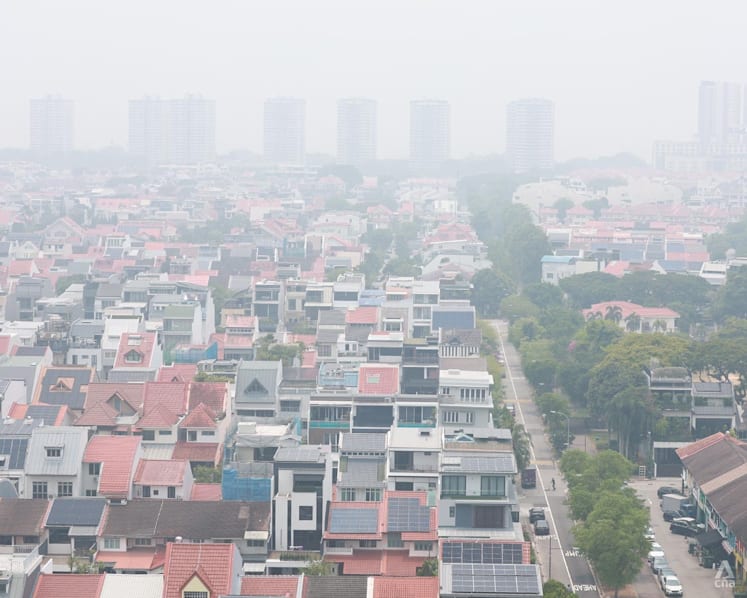
A view of the haze from Chinatown on the afternoon of Oct 23, 2026. (Photo: CNA/Ooi Boon Keong)

This audio is generated by an AI tool.
SINGAPORE: Air quality in western and central Singapore entered the unhealthy range on Friday (Oct 23), as hourly PM2.5 readings rose across the island.
The 24-hour Pollutant Standards Index (PSI) in the west reached 103 at 4pm, crossing into the unhealthy band, before rising to 108 two hours later.
The central region crossed into the range at 6pm, with a reading of 102.
Readings in the other three regions remained in the moderate range, with PSI readings ranging from 85 to 89 at 6pm.





Hourly PM2.5 readings were also elevated in all five regions, ranging from 70 to 98 at 6pm.
The west was the first region to record elevated PM2.5 levels at 10am, followed by the central and southern regions at 11am, the east at noon and the north at 1pm.
The deterioration came a day after air quality across Singapore returned to the good to moderate range on Thursday, when the PSI in the west fell out of the unhealthy band at 3pm.
CONTINUED RISK OF HAZE
The National Environment Agency (NEA) warned on Friday morning that the risk of severe transboundary haze remained, with widespread hotspots detected in southern Kalimantan and Sumatra.
Moderate to dense smoke haze was observed over parts of Kalimantan, Singapore, southern Peninsular Malaysia, southern and central Sumatra, and western Sarawak.
Hotspot activity remained low in the northern ASEAN region.
"While showers may bring some improvement, the hotspot and smoke haze situation is expected to remain elevated, especially over areas experiencing prolonged dry conditions, with a continued risk of severe transboundary haze occurrence," NEA said.
It added that the prevailing winds over the southern ASEAN region are likely to blow generally from the southeast to the southwest, except over Peninsular Malaysia and the northern parts of Sumatra, where the winds are likely to blow from the west to northwest.
In its evening advisory the agency said the 24-hour PSI was forecast to be in the moderate to unhealthy range, with readings from 90 to 140.
"From Sunday onwards, the winds are expected to blow from the southwest or west, which may reduce the smoke haze transported to Singapore," said NEA.
"Showers over Singapore and the vicinity could also help with the haze situation."
ADVICE FOR VULNERABLE GROUPS
When the 24-hour PSI is in the unhealthy range, NEA advises the elderly, pregnant women and children to minimise prolonged or strenuous outdoor physical exertion.
People with chronic diseases, including heart or lung conditions, should avoid such activities.
For decisions on mask use and immediate outdoor activities, the public should refer to the one-hour PM2.5 readings instead.
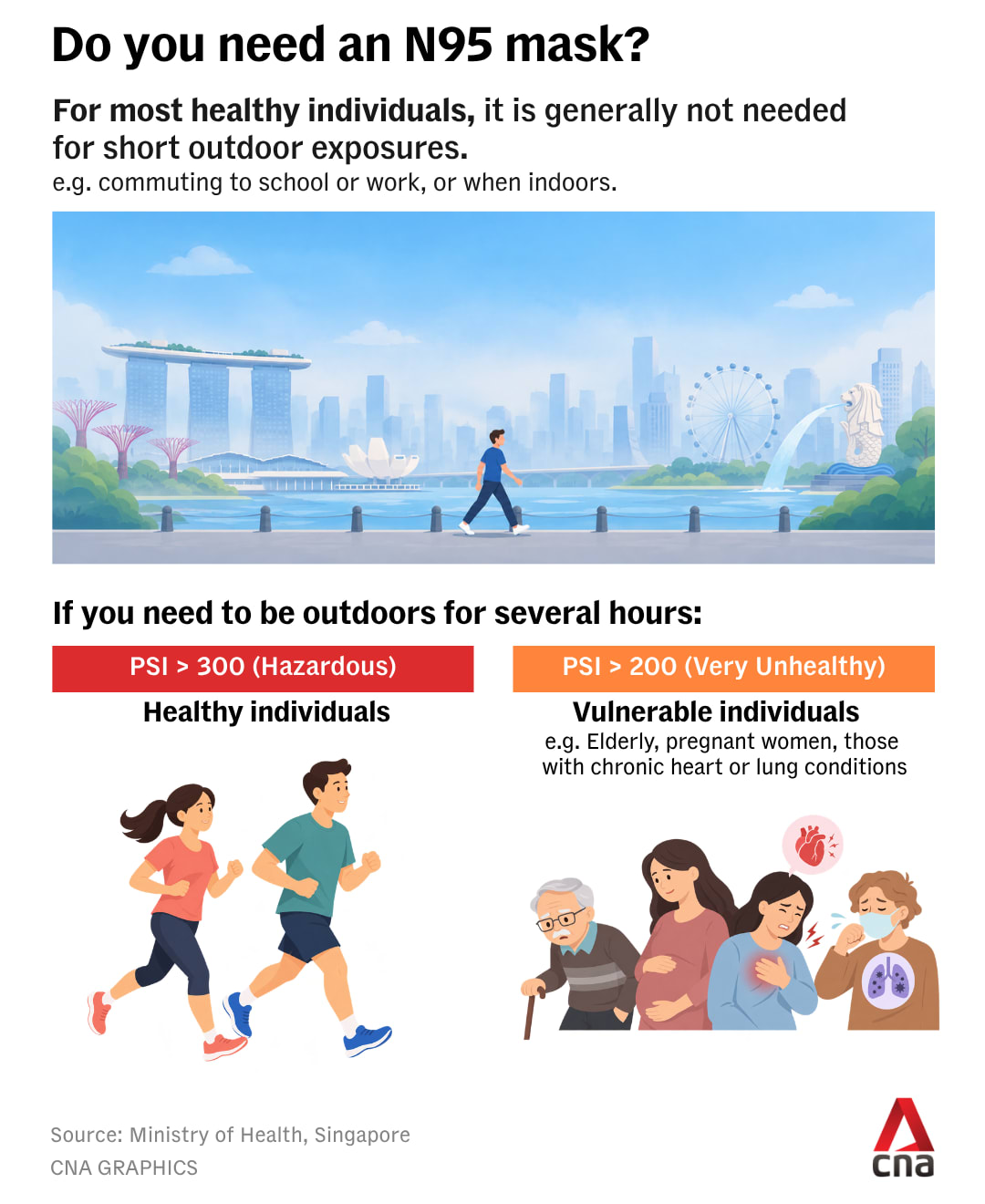
When the 1-hour PM2.5 readings are in the high band, vulnerable individuals, including the elderly, pregnant women and those with chronic heart or lung conditions, should avoid outdoor activities, according to the Ministry of Health (MOH).
Those who need to go outdoors for immediate activities may wear a well-fitting N95 mask or equivalent to reduce their exposure to haze particles.
When 1-hour PM2.5 readings reach the very high band of 251 and above, healthy individuals should also minimise all outdoor activities. Those who need to venture outdoors may similarly use an N95 mask for protection.
However, MOH said N95 masks are generally not needed for commuting between home and school or work, or in indoor environments.
The ministry has also advised the elderly, pregnant women and those with severe heart or lung conditions who experience breathing difficulties to consult their doctor before using an N95 mask.
Those who experience discomfort while wearing one should take a break from using it.

Besides N95 masks, KN95, FFP2 and KF94 masks are also effective in reducing exposure to haze particles, according to MOH.
Members of the public can visit the HazeMaskGoWhere website for more information on collection locations and live updates on mask availability at the vending machines.
MOH had also issued guidance on Oct 13 on the types of masks that can be used for protection against haze.
It said surgical masks can help reduce discomfort and the risk of infections by providing a barrier against larger irritant particles.
However, if PM2.5 readings are above 250 and people need to be outdoors for several hours, MOH recommends wearing an N95 or equivalent mask.
Cloth masks generally do not filter fine particles effectively, although they can reduce discomfort by blocking larger irritant particles in the air.




