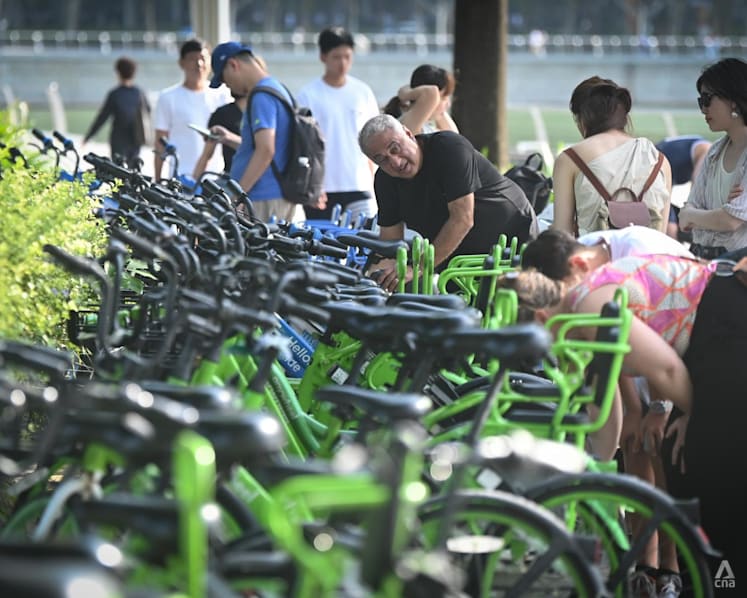
LTA ramps up efforts against indiscriminate bicycle parking, more spaces planned at transport nodes
More than 30,000 advisory notices have been issued since 2023 as authorities tackle the persistent issue of bicycles blocking walkways and station entrances.
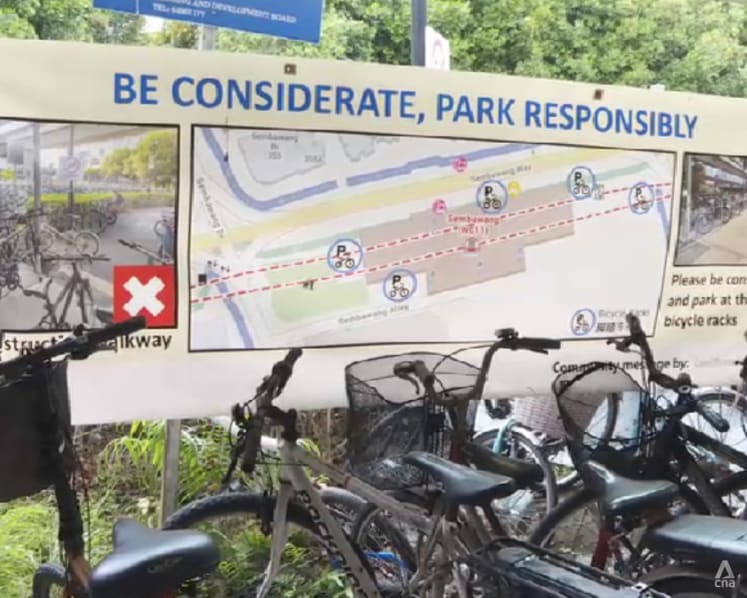
Bicycles line a walkway next to a sign urging cyclists to park responsibly near Sembawang MRT station.

This audio is generated by an AI tool.




SINGAPORE: Transport authorities are looking to create more bicycle parking spaces around MRT stations and bus interchanges, as part of efforts to address the persistent problem of bicycles blocking walkways and station entrances.
Since 2023, the Land Transport Authority (LTA) has issued more than 30,000 advisory notices and removed over 400 bicycles and other mobility devices causing obstruction.
The authority said indiscriminate bicycle parking is most commonly seen at busy transport nodes, where demand for space is highest.
LTA added that it is exploring ways to optimise existing areas for bicycle parking and will work with nearby building owners and developments to identify alternative locations where feasible.





Listen:
WALKWAYS BLOCKED DESPITE REMINDERS
Outside Sembawang MRT station, a large banner reminds cyclists to park considerately at designated bicycle racks.
But just beneath it, bicycles are still lined up along the walkway. Residents say the problem has become worse over time.
"Over the years, at the start, it was a bit clearer. But now it has gotten a bit more congested. And sometimes, during peak hours … around 6pm it gets a bit crowded and difficult to walk,” said one resident.
Another said the situation improved briefly after the authorities put up the banner, but it did not last.
"Sometimes, people even park larger devices here, blocking the entire walkway,” he added.
At the same location, CNA spotted a number of bicycles tagged for removal.
According to LTA, abandoned or derelict bicycles reduce the available lots for active cyclists, contributing to indiscriminate parking elsewhere.
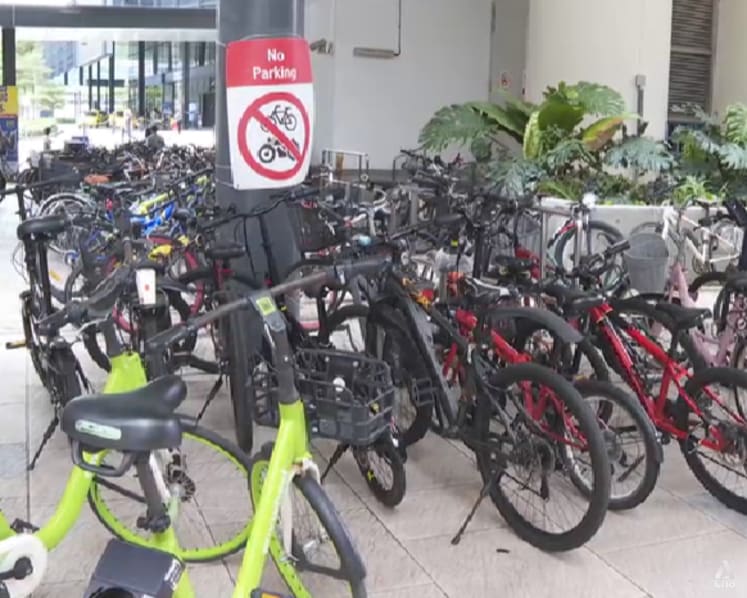
Similar scenes were observed at other MRT stations across Singapore.
Public transport operator SMRT said it has seen a growing number of bicycles being abandoned or parked improperly outside its more than 100 MRT stations.
Some bicycles block station entrances, while others obstruct ramps used by wheelchair users and commuters using personal mobility aids.
In the past year alone, SMRT removed more than 750 bicycles from stations along the North-South, East-West, Circle and Thomson-East Coast lines.
Over the same period, it also received around 10 feedback cases a month on improper bicycle parking.
SMRT said it has stepped up patrols and enforcement at locations where the problem is more common.
Additional signs and barricades have also been installed to guide commuters to designated bicycle parking areas, while notices are issued before improperly parked bicycles are removed.
ENFORCEMENT ALONE NOT ENOUGH
While enforcement is necessary, one transport expert said it cannot solve the problem on its own.
Associate Professor Zhou Yi from the Singapore Institute of Technology’s engineering cluster said the issue stems from both user behaviour and the availability of parking spaces.
He described one factor as "last metre behaviour", or people's preference to park as close as possible to their destination.
To address this, he said authorities should rely more on data to identify locations where parking is consistently full or where improper parking regularly occurs.
"We can use the data to understand where are the spaces that are always fully occupied, or where are the hotspots people may be illegally (parking) their bicycles. Then we are able to tackle the issue precisely."

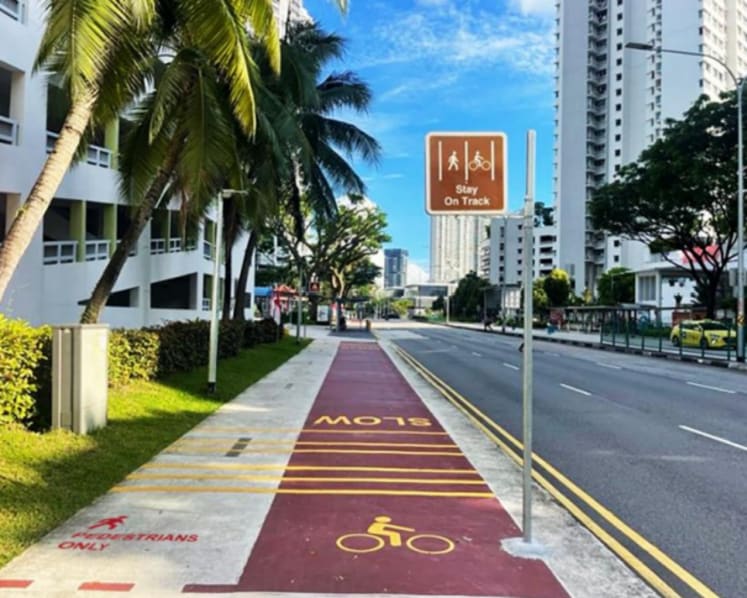
Beyond expanding parking capacity, Assoc Prof Zhou said technology could help cyclists locate available parking more easily, while better education could encourage more considerate parking behaviour.
This could be done via apps, which could inform cyclists where the nearest lots are, or be used to notify the authorities of indiscriminate parking, he suggested.
Assoc Prof Zhou added that education and public engagement should complement enforcement, so cyclists understand why keeping walkways clear is important.
LTA said it is stepping up efforts to clear abandoned bicycles and remove obstructions from covered walkways. It will also deploy more signs and banners and engage cyclists to encourage responsible parking.
As Singapore expands its cycling network towards a planned 1,300km by 2030, the authority said it will continue reviewing bicycle parking capacity at key transport nodes to ensure that facilities are sufficient and well designed to support cyclists' needs.