







Pasir Ris housing plans: Nature groups welcome coastal habitat conservation, but concerned over wildlife connectivity
HDB said the development is intended to meet housing demand in Pasir Ris, with recent Build-to-Order projects drawing strong interest.

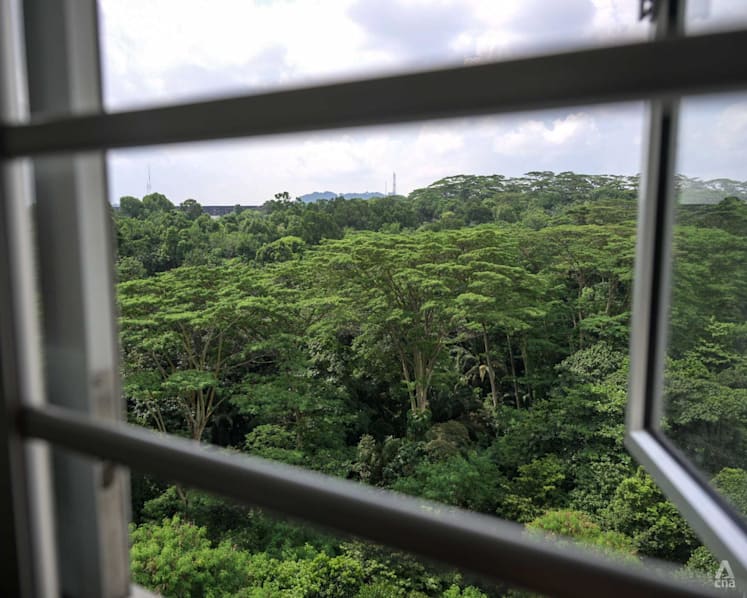
The plot of land along Pasir Ris Drive 3, next to Sungei Loyang, on Nov 23, 2026. (Photo: CNA/Raydza Rahman)

This audio is generated by an AI tool.


SINGAPORE: Some nature groups raised concerns on Monday (Nov 23) about the ecological impact of the Housing and Development Board’s (HDB) plans for a new Pasir Ris neighbourhood, although they welcomed the retention of the site’s most important coastal habitats.
Under HDB’s plans for the site, known as Pasir Ris Neighbourhood 3, about 5ha of terrestrial greenery and 8ha of coastal habitats comprising intertidal, seagrass and mangrove habitats would be retained.
About 20ha – the size of 28 football fields – is proposed to be developed for a mix of public and private housing as well as amenities.
HDB said it developed the plans after considering the findings of an Environmental Impact Assessment (EIA) and feedback from nature groups.





Nature groups told CNA that species such as the locally critically endangered greater mousedeer and globally critically endangered Sunda pangolin could be affected by habitat loss and reduced connectivity to and from other ecological sites such as Pulau Ubin.
While they appreciated the retention of the coastal habitat, they noted the importance of ensuring the area is safeguarded for wildlife in the longer term while the surrounding area is developed.
In response to CNA’s queries, HDB said the key parameters that remain under study include the precise development footprint and layout, housing yield and density, the extent and configuration of retained greenery, and the detailed mitigation measures.
The agency added that these will be further refined after the public feedback period, taking into account the EIA findings, housing needs, and broader planning considerations.
After the feedback period closes on Dec 20, HDB said it will review the submissions received and publish a feedback summary report to provide its responses to the key issues raised.

HABITAT LOSS, CONNECTIVITY CONCERNS
Mr Lester Tan, chairperson of the marine conservation group at the Nature Society Singapore (NSS), said it was a “pity” to develop this plot.
Apart from being a “nice biodiverse area”, the Pasir Ris site could be a landing point and stepping stone for the greater mousedeer, which is believed to have swum from Pulau Ubin.
The greater mousedeer was once thought to be extinct in Singapore, but was resighted at Pulau Ubin in 2008 after an absence of more than 80 years.
The locally endangered white-rumped shama, a bird species with a stronghold on Pulau Ubin, has also established a presence in that area of the mainland.
According to the EIA, the impact on habitat loss was assessed to be “moderate negative”, with about 81 per cent of the terrestrial forested area lost with mitigation.
“The biggest concern here is during development, there's always shepherding. So you shepherd the animals away from the development site, and then now you will squeeze them all into the conservation site that HDB choose to conserve, and that would be the holding ground or the habitat that is left for them,” Mr Tan said.
HDB said a proposed 15m-wide linear park along Sungei Loyang will support biodiversity, and tree-lined green buffers, including 10m-wide sections shown in the conceptual plan, will be provided along the northern, western and southern boundaries.
However, Mr Tan noted that the adjacent Pasir Ris Park is an urbanised coastal park that does not provide as much connectivity and would need “a lot of enhancements” to improve connectivity.
“Otherwise … the animals that cannot fly will have to then manoeuvre between urbanised areas or through the urbanised parks to connect to another side of Pasir Ris or in the eastern area,” he said.
Nature group LepakInSG’s co-founder Ho Xiang Tian said that in general, the connectivity to the Central Catchment Area from the east is already “weak”.
“Without proper connectivity, one single bad event can wipe out your whole population,” he said, adding that with a lack of diversity in the gene pool, species could also “inbreed to death”.
Mr Ho said retaining more areas of high ecological value than the original plan is “always a plus”.
“But we also hope the eastern side of Pasir Ris Park can be planted up to provide connectivity to the core Pasir Ris Park area (as the) existing greenery is quite sparse,” he added.
Dr Marcus Chua, a research fellow and curator of mammals at the Lee Kong Chian Natural History Museum, said whether the proposed retained area of 13ha is sufficient depends on the species.
The retained terrestrial greenery could still be a stepping-stone habitat to receive wildlife from Pulau Ubin or even Malaysia, and these species might be able to find suitable habitats elsewhere, he said.
He added that most of the plans have “adequately considered” the development's impact and come up with ways to mitigate it.
“What would make it even better is if, during development, that wildlife and human connectivity … to Pasir Ris Park to the north and west can be improved to enhance the site from a conservation perspective,” he said, noting that there is currently a large canal separating most of it.

COASTAL HABITAT CONSERVED
The nature experts welcomed the move to fully conserve one of the two areas identified to be of high ecological value – an 8ha area comprising intertidal, seagrass and mangrove habitats.
Ms Ng Lee Kiang, the co-founder of nature education provider Young Nautilus, which offers guided nature walks at Pasir Ris Park, said some impact on the existing ecology is inevitable with a development of this scale.
“But we were also glad to see that the most ecologically significant coastal habitats will be retained, and it was heartening that the concerns stakeholders raised seem to have been heard and have shaped parts of the plan,” she added.
One positive aspect of the proposal is that it retains a continuous habitat gradient from the terrestrial forested areas to the coast, together with buffers and additional green spaces that can help support wildlife movement, said Ms Ng.
She added that long-term monitoring will be important to understand how species respond over time and whether the intended ecological functions are maintained.
“I feel the focus now shifts towards how these retained habitats will function in the long run,” she said.
“The goal is not just to keep green and blue spaces on a map, but to ensure they continue to support wildlife movement, ecological connectivity and nature-learning opportunities for future generations.”
NSS’ Mr Tan said it would also be important to strengthen the coastline and monitor sediment runoff to minimise the impact on the mangrove and surrounding habitats, such as the intertidal zones.
“If those are properly managed, then I think that 8ha at the waterfront conserved will be worth it,” he said, adding that it would be important to look at how to conserve the area even with coastal protection against sea-level rise.
HDB said about 1ha in the southeastern corner of the 5ha area may eventually be required for coastal protection measures, subject to further study. It will remain undeveloped in the medium term.
HOUSING POTENTIAL
HDB said the site has been earmarked for residential use since Master Plan 1980, with this planning intention reaffirmed at each subsequent Master Plan review.
The development would provide more opportunities for Singaporeans to live in the east, HDB said.
Mr Eugene Lim, key executive officer at ERA, said recent BTO launches in Pasir Ris point to keen buyer appetite in the area.
For example, Costa Riviera I and II’s larger flat types had application rates among first-timer families reaching 2.4 for three-room, 3.6 for four-room and 6.7 for five-room/three-generation flats, he noted. The projects were launched for sale in October 2024.
Most nearby flats within a 1km to 2km radius were completed in the 1990s, he added.
“An injection of new homes and amenities would therefore provide a timely refresh for the area and could make it more appealing to younger households,” Mr Lim said.
Huttons’ senior director of data analytics Lee Sze Teck estimated that the area could have up to 3,000 HDB flats or up to 4,000 private homes. The neighbourhood is about 900m from both Pasir Ris and Loyang MRT stations on the upcoming Cross Island Line, he noted.
While the area is further from the town centre and amenities, it is close to the sea and greenery, and would appeal to those who prefer a “tranquil living environment”, he said.
Ms Christine Sun, chief researcher and strategist of Realion (OrangeTee & ETC) Group, said the location also offers convenience for those working in Changi and Tampines, and proximity to Changi Airport adds to its appeal.
“If they were to build flats, these flats could be Standard flats and they could launch the BTO exercise next year or the year after, depending on how fast they can approve the proposed plans,” she said.




