







New Skills and Workforce Development Agency to be set up later this year
The new statutory body will consolidate the functions of SkillsFuture Singapore and Workforce Singapore, while taking on expanded responsibilities in career, employment and training matters.
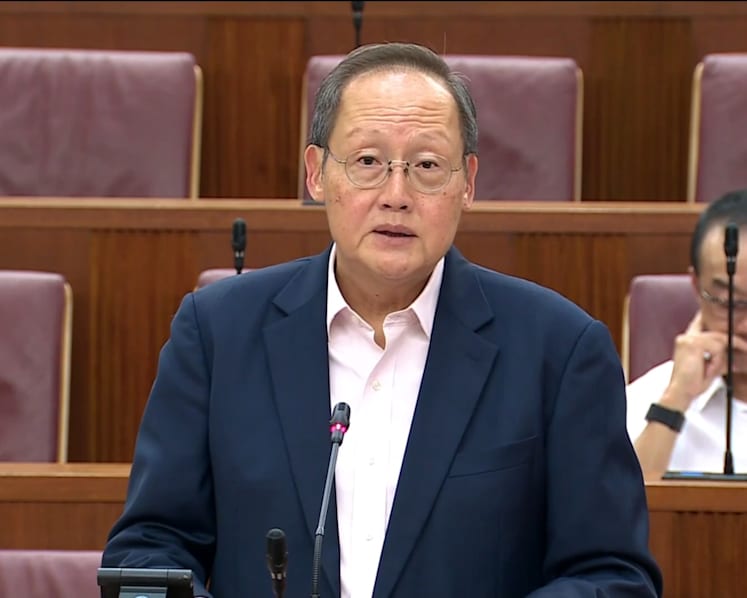
Manpower Minister Tan See Leng speaking in Parliament on May 5, 2026.

This audio is generated by an AI tool.




SINGAPORE: A new statutory body aimed at strengthening Singapore’s workforce and skills ecosystem will be set up in the third quarter of this year, after parliament passed the Skills and Workforce Development Agency Bill on Tuesday (May 5).
The newly formed Skills and Workforce Development Agency will consolidate the functions of SkillsFuture Singapore (SSG) and Workforce Singapore (WSG), while taking on expanded responsibilities in career, employment and training matters.
The move builds on Prime Minister Lawrence Wong's Budget 2026 speech, where he announced that the two agencies would be merged into a single statutory board to create a more integrated “one-stop shop” for workers and employers.
Speaking in parliament on Tuesday, Manpower Minister Tan See Leng said the merger comes as Singapore faces a rapidly changing global environment.
“We live in a different world from 10 years ago,” he said, pointing to accelerating technological change, geopolitical disruptions and an ageing population.
“What worked in the past decade will need significant transformation, to be more predictive, to be more anticipatory as well as be more responsive and targeted moving forward.”
WHAT THE AGENCY WILL DO
The agency will serve as a central body overseeing a broad range of functions previously split between SSG and WSG, while introducing enhanced capabilities in career and employment services.
It will be jointly overseen by the Ministry of Manpower (MOM) and the Ministry of Education (MOE), with Ms Dilys Boey - the current WSG chief - to be appointed as the chief executive of SWDA.
It aims to provide more seamless and integrated support for both workers and employers.





For workers, Dr Tan said the SWDA will help Singaporeans stay adaptable in a fast-changing economy by supporting career planning, skills upgrading and job transitions.
For employers, it will also strengthen hiring and workforce transformation by integrating skills and labour market data.
The agency will be governed by a board comprising between seven and 15 members, appointed by the minister. These members will be selected based on their expertise and experience.
Dr Tan said the SWDA is expected to be established in the third quarter of this year.
CALLS FOR STRONGER SUPPORT
More than 20 Members of Parliament (MPs) rose to speak on the Bill, raising concerns about how the new agency will work in practice and whether it would truly translate into a better experience for workers and businesses.
Pointing out that companies today still have to navigate multiple schemes, portals and processes, Nominated MP Mark Lee asked how the new agency would deliver a “genuinely simpler and more intuitive experience”.
MP Gerald Giam (WP-Aljunied) called for clear key performance indicators to measure real outcomes such as whether workers are actively applying their newly acquired competencies in their roles six months after they complete the course, and the percentage of subsidised-training enrolments in courses mapped to occupations facing a shortage.
There were also calls for stronger support for different worker groups, with MP Jessica Tan (PAP-East Coast) asking how the agency would better support mid-career and older workers, as well as those in disrupted sectors, and ensure uninterrupted services during the transition.
Others pointed to gaps faced by younger workers and students entering the workforce. MP Wan Rizal (PAP-Jalan Besar) highlighted a “first-job gap”, where graduates struggle to translate their qualifications into employment, and called for clearer pathways from education to jobs.
MINISTER'S RESPONSE
Dr Tan addressed Mr Giam’s characterisation of the merger as a reversal from the position in 2016, when the two agencies were restructured.
“I disagree with this characterisation. It is more important to ask if the restructuring in 2016 was the right call then, and whether the merger moving forward is the right call now and for the future,” he added.
“Now, the answer to both questions is yes.”
The 2016 restructuring allowed SSG and WSG to develop specialised capabilities in adult training and employment facilitation, said Dr Tan, adding that both agencies have substantially achieved the objectives of the restructuring.
The future of Singapore’s workforce strategy needs an end-to-end system that connects skills to jobs more quickly and accurately than before, he said.
Beyond delivering better services and programmes, SWDA has an expanded mandate to develop the broader career, employment and training ecosystem in Singapore, supporting innovative solutions and improving access to quality services, said the manpower minister.
“This is what will make SWDA more than the sum of its parts.”
Dr Tan acknowledged the two gaps identified by Dr Wan Rizal – the “first-job gab” for fresh graduates and the “career-transition gap” for mid-career Singaporeans.
He agreed that Singapore cannot wait until students graduate before intervening, adding that SWDA will work with institutions of higher learning and the education ministry to bring industry exposure upstream.
This will give students a clearer picture of the labour market “well before” they graduate.
SWDA will support mid-careerists by empowering them to take charge of and strengthen their career health amid a fast-evolving world, said Dr Tan.
“We will make good quality career guidance services more accessible to the broad middle of workers and equip them with data-driven insights on jobs and skills so that they can undertake the right training that connects them to the opportunities that they are seeking,” he added.
“We will look at tying cost funding more closely to demand signals so that the training translates into better career prospects.”
To cater to different worker segments, the agency will partner with community organisations to reach more vulnerable segments, said the manpower minister.
The government is also studying ways to provide stronger support for more flexible work models, such as fractional work, that may better cater to their needs, he added.
To prepare workers and businesses ahead of disruptions, data will be the “critical enabler”, said Dr Tan, adding that the new agency plans to tap various data sources to distil fresh jobs and provide insights on skills.
These insights can be applied to personalised services to deliver more targeted support proactively, he added.
Addressing questions about how the agency’s effectiveness will be measured, Dr Tan said the government will look at indicators such as time-to-placement and wage growth, on top of training and placement numbers.
“While not so easily measured, we also want to engender a culture of lifelong learning and career health to take root in the DNA of the Singapore workforce.”




