







Man who stabbed priest at St Joseph’s Church gets jail, caning
Basnayake Keith Spencer, 38, stabbed Father Christopher Lee Kwong Heng in the mouth with a foldable knife with a partially serrated 10cm blade during communion at a children’s mass in November 2024.

This audio is generated by an AI tool.


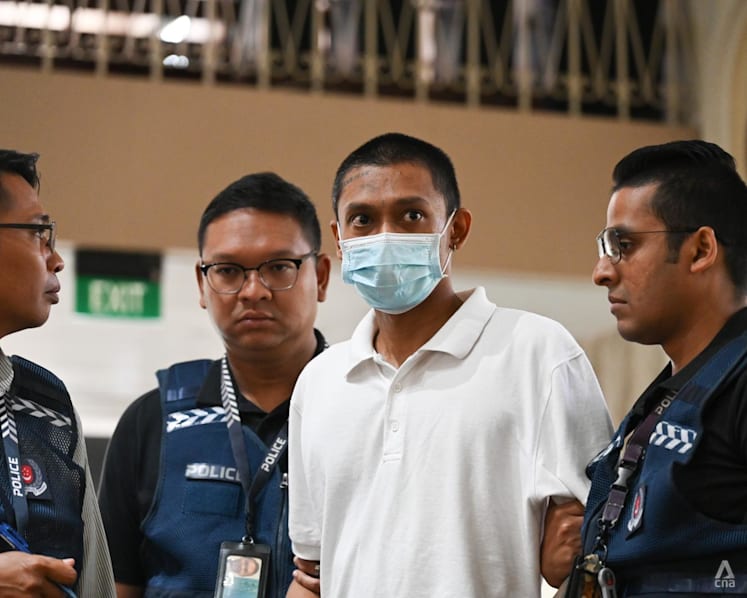
SINGAPORE: A man who stabbed a priest during communion at St Joseph’s Church in 2024 was sentenced to four years’ and three months’ jail on Friday (Aug 21).
Basnayake Keith Spencer, 38, also admitted to carrying multiple weapons in public without a lawful purpose. In addition to his jail term, he was sentenced to nine strokes of the cane.
Other than the foldable knife with a partially serrated 10cm blade that he used in the attack, a butterfly knife, a penknife, a fishing gaff and a mallet were found on him or in his bag, the court heard.
Basnayake queued up to receive communion at a children’s mass, and then stabbed Reverend Father Christopher Lee Kwong Heng in the mouth with the foldable knife at about 6.30pm on Nov 9, 2024, at the church in Upper Bukit Timah, the court heard.
Father Lee, who was giving out communion, suffered a stab wound to the floor of his mouth and cuts on his tongue, upper lip and mouth.
The 59-year-old parish priest received surgery to close his wounds and was discharged six days after the incident. The court heard that he received extensive post-surgery care, including speech therapy, and went on hospital leave for 40 days.
Deputy Public Prosecutor Xu Si Jia argued for four years and three months’ jail to four years and 11 months’ jail for Basnayake, as well as nine strokes of the cane.
Describing his actions as a “brazen and wholly unprovoked attack” on a defenceless victim, she stressed that the man stabbed the priest in front of hundreds of members of the public, during communion at a mass held for children.
This was a grave violation of public safety and peace that “struck at the heart of the sensibilities of the public”, she added.
Deterrence is needed to discourage any like-minded individuals and quell the public disquiet arising from the crime, said Ms Xu.
The foldable knife was also a dangerous weapon that could have potentially caused more serious harm if it had hit other parts of the body or vital organs, she added.
Basnayake was voluntarily intoxicated at the time, having taken five nitrazepam tablets before the attack, Ms Xu said, arguing that he was “clearly aware” of the drug’s effects. Nitrazepam is a prescription drug usually used to treat anxiety and insomnia.
He purportedly consumed the five tablets to stay focused and pay attention to the mass, and calm down before communion, the court heard.
A cocktail of various opiates and other controlled drugs was detected in his urine samples, Ms Xu added.
In a report by a doctor with the Institute of Mental Health (IMH), he said that after consuming the tablets on other occasions, he had lost consciousness and ended up in the hospital, and that the pills “caused him to lose his mind”, hear voices and have bizarre thoughts, the prosecution highlighted.
“He must bear full responsibility for the consequences that follow as a result of voluntary consumption of illicit substances,” Ms Xu argued.
Mr Ashwin Ganapathy and Mr Edwin Ho from the Public Defender’s Office argued for less than four years’ jail and nine strokes of the cane for Basnayake.
The defence disagreed that his intoxication was an aggravating factor.
While Basnayake told the IMH doctor that taking the tablets had led him to lose consciousness, lose his mind and hear voices in previous instances, Mr Ganapathy said he was not sure this was enough to say that the man had insight or awareness that the psychosis the drugs caused would lead him to turn violent.
This interview with the doctor also took place after the incident, he added, noting that court documents state that Basnayake purportedly took the drugs to help himself calm down and stay focused.
“It’s hard to see how this would also mean he’s sufficiently aware that this would trigger psychosis,” Mr Ganapathy argued.
Basnayake is also sorry for his actions, the defence said in mitigation.
“He is regretful, he is ashamed of what he has done. He asks for the sentence to be proportionate,” Mr Ganapathy added.
Delivering his sentencing decision, District Judge Shaiffudin Saruwan agreed that the punishment had to discourage similar offences and address public disquiet.
The attack was wholly unprovoked and caused harm to a defenceless man, and Basnayake’s punishment must reflect the full gravity of his offence, he said.
The judge noted several aggravating factors, including that the attack was “unprovoked and brazen”.
“The accused struck the victim at the precise moment he was administering a sacred ritual and would’ve been entirely defenceless and unsuspecting,” he added.
The potential harm was significant – given that the attack took place in a crowded church in front of hundreds of people, there was real potential for mass panic and further injuries, the judge said.
He also agreed that Basnayake’s drug-induced psychosis was “entirely self-induced”, noting that this was not his first violence-related offence while under the influence of drugs, which represents a clear escalation in the severity, warranting specific deterrence.
Basnayake has been in remand since he was charged on Nov 11, 2024, and was previously denied bail out of concerns for public safety.
Carrying weapons in public places without a lawful purpose is a non-bailable offence, punishable with up to three years in jail and at least six strokes of the cane.
For voluntarily causing grievous hurt, Basnayake could have been sentenced to life imprisonment or up to 15 years’ jail, a fine and caning.


WHAT HAPPENED
On Nov 9, 2024, St Joseph’s Church was scheduled to conduct a children’s mass at 5.30pm, with communion to begin at 6.15pm.
Basnayake entered the church hall at about 5.30pm as mass was about to begin. Nine hundred people were in attendance, and he sat on a bench in the hall. He consumed five tablets of nitrazepam purportedly to stay focused and pay attention to the mass, and calm down before the communion, the court heard.
As communion began, Father Lee and another priest stood at the front to give out communion, accompanied by another church volunteer. Basnayake joined the queue for the other priest at first, then left to join the queue for Father Lee.
The man was the last person in line to see Father Lee. At about 6.28pm, it was his turn to receive communion, and he stood about an arm’s length from the priest.
Before the priest could say anything to him, Basnayake suddenly took out a foldable knife from the left back pocket of his jeans and used his left hand to stab the priest in the mouth.
Father Lee stepped back while bleeding profusely from his mouth. He grabbed Basnayake’s back pocket to restrain him and stop him from causing further harm. Three church volunteers and an off-duty police officer also moved in to restrain him.
After calling the police for assistance, they tied his hands behind his back using a rope and searched his pockets to figure out his identity, which is when they found a butterfly knife and a fishing gaff in the pockets of his jeans.
Two volunteers brought Basnayake to a room and locked him inside while waiting for the police to arrive. Father Lee sat on the steps at the front of the church hall, and others attended to him.
Investigations revealed that Basnayake had brought a bag with him to the church containing more nitrazepam tablets, a penknife and a mallet. He had left the bag at the bench where he sat before joining the queue during communion.




