Dining alone isn't the same as eating alone. Here's why it can be more social than being with friends
CNA TODAY's Tang Jia Wen embarked on a solo dining experience to interrogate her lingering discomfort with visiting restaurants alone. Here's what she learnt from letting go of her fears of being perceived as a "loner".
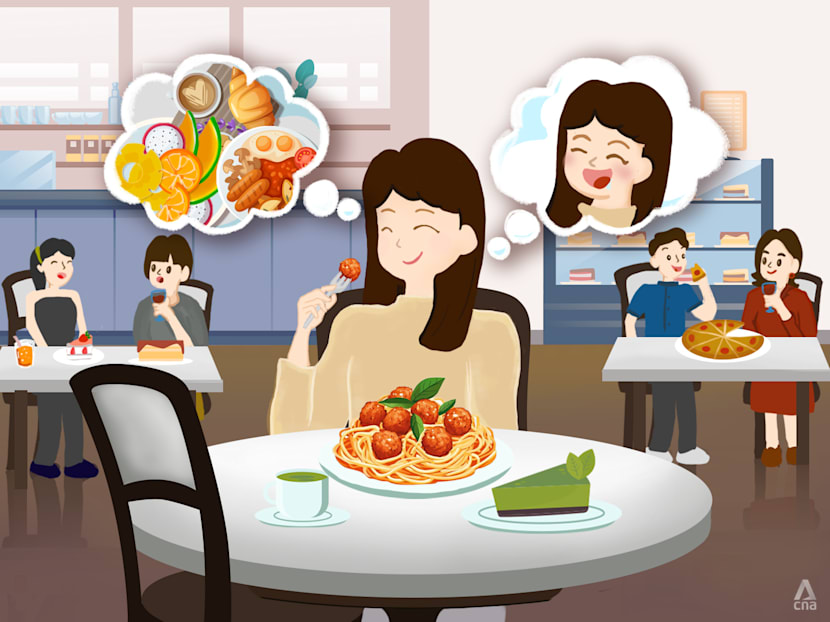
Solo dining has become increasingly common in recent years, with more people embracing the experience even if traces of discomfort or social stigma still linger. (Illustration: CNA/Chong Siew Lee)

This audio is generated by an AI tool.


During a summer I spent alone two years ago in Tokyo, I stayed in a quiet neighbourhood with a small izakaya run by an elderly widow.
Like many other traditional Japanese eateries, it was an intimate space with just five seats at the counter. All of these faced the open kitchen where she prepared seafood with a skilful hand.
The language barrier made conversation difficult. However, even with that obstruction – or rather, protection – on my first visit, I found myself unable to disappear into the background the way I usually do when I'm alone.
The chef-owner was warm and welcoming, but I was acutely aware of the silence, unsure of where to look or what to do with myself, and uneasy about how I might be perceived by the few other regulars seated down the counter.
I enjoyed my meal very much, but after that, it was surprisingly difficult to go back.
More than once, I found myself lingering outside the izakaya, listening to the low hum of chatter from diners as I tried to work up the courage to go in, before eventually defaulting to supermarket takeaways.





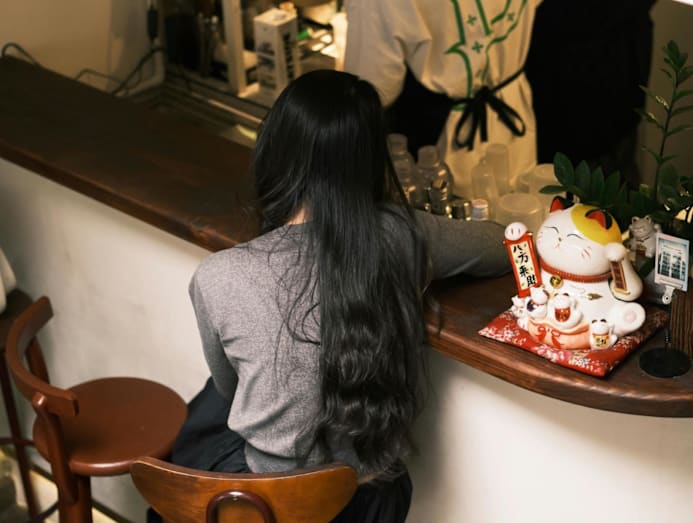
I was puzzled despite myself. Eating alone has never been a tall order for me. In fact, I regularly treat myself every now and then with a visit to my favourite conveyor belt sushi chain, settling in and ordering exactly what I want, at my own pace.
But somehow, that izakaya experience felt different.
Now, in hindsight, I'm able to make sense of it: Simply eating alone in public is one thing, but dining alone in a "real" restaurant is entirely another.
There's a difference between grabbing a quick meal at a coffee shop, food court or casual chain eatery, versus sitting down to a pricier meal at a nice restaurant that's just as much about style as it is sustenance.
The latter still carries a certain stigma, often associated with loneliness or social awkwardness, as if being by yourself must mean something is lacking.
But the tide appears to be turning.
Based on data from restaurant reservation platform OpenTable, bookings for individual diners worldwide surged 19 per cent year on year in 2025, the largest jump across all group sizes.
Mr Tan Whey Han, OpenTable's senior director for Asia and the Middle East, said that across Asia, solo dining also jumped 10 per cent in 2025 compared to the previous year.
While dining in Southeast Asia has traditionally been seen as a communal activity, Mr Tan called the increase "a clear sign that dining alone is becoming a more confident, intentional choice".
A few months ago, the Michelin Guide even published a piece on its inspectors' top tips for solo dining, suggesting this shift has been taking shape more visibly.
Clearly, more people are finding appeal in dining alone, whether for the flexibility, the quiet or simply the chance to spend time on their own terms.


Yet, even as solo dining becomes more popular, traces of lingering discomforts remain.
Chinese hot-pot chain Haidilao seats giant plush toys opposite solo diners, an endearing practice that nonetheless suggests the act of eating alone needs cushioning of sorts.
Some of my friends tell me they would never dine alone, out of fear of being recognised or judged.
It is easy to imagine others seeing you as a loner, or someone with no one to share a fancy meal. This can feel even more pronounced in more service-oriented settings where interaction feels expected or where you might run into familiar faces.
TABLE FOR ONE
Curious to see if my previous discomfort would hold, I decided to try it again, this time more deliberately.
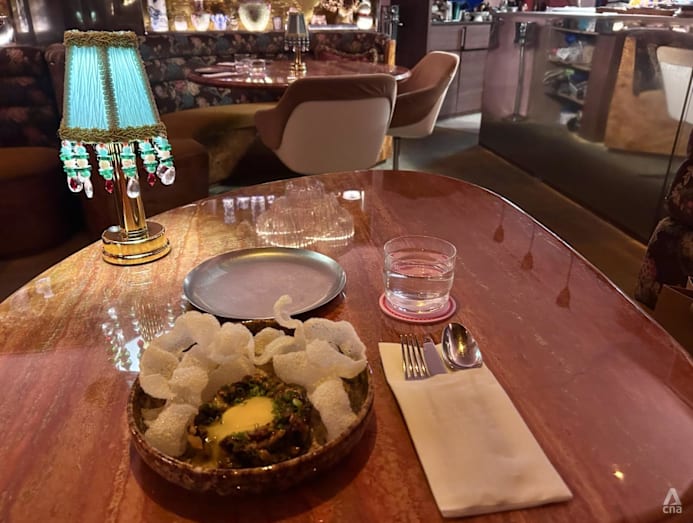
I made a reservation for one at a more upscale restaurant along Keong Saik Road with a tartare dish I'd been craving.
It's not somewhere I would usually go alone – out of the way, more of a social spot, with a level of service and attention I would not typically opt for when dining solo.
Initially, I was looking forward to it. However, on the morning of my reservation, I found myself hesitating. Part of me toyed with the idea of asking a friend along at the last minute.
I started casting around for ways to make the prospect of sitting alone in the restaurant less intimidating or awkward. What if I brought a book with me, or my tablet? Maybe that would make it feel like I was being productive, at least.
I resisted the urge, but only just barely.
When I arrived at the restaurant that evening, the host confirmed my reservation.
"Table for one?" he asked brightly – and much more loudly than I liked, even if the restaurant was sparsely occupied at the time. I said "yes" quickly, but my cheeks were already flushing hotly.

I had visited this restaurant before with friends, but being there alone immediately felt different.
As I was shown to my table and seated, I started noticing things I had missed entirely on previous visits: a retro fish tank lamp quietly rotating in one corner, the chubby baby illustrations dancing across the menu printed on cardstock that weighed heavily in my hands.
Ordering was straightforward, and as I waited for my food, I got more comfortable with observing my surroundings, meticulously decorated to mix modern charm with 1970s Shanghai glamour.
However, when my food arrived, my temporary ease gave way to a sharper self-consciousness.
I started fidgeting, unsure of where to rest my gaze or what to do with my hands.
I wondered, briefly, if my face – not wearing a permanent smile, not moving constantly with chatter – looked sad to others.
I reached for my phone instinctively, but having come all this way on my own, it felt a bit pointless to stay glued to a screen.
So I put it down.
I forced myself to stop looking for distractions and focus on being in the moment. I allowed myself to pay attention to not just the environment around me but also my own habits, like how quickly I ate.
As the dining room began to fill up with other patrons, streams of conversations and laughter picked up around me. Oddly enough, instead of making me feel more self-conscious, it started to make me feel less. I realised no one was really paying me any attention.
I wasn't sticking out like a sore thumb, nor was I unusual. I was simply another person in a restaurant filled with people.
THE GAINS OF BEING ALONE
There's a certain satisfaction in learning to sit in one's own discomfort. It's one thing to tell myself to have confidence in taking up space on my own, but it's quite another to put myself in a situation designed to trigger my fears and insecurities about how I might be seen by others.
Without the need to fill the moment or make it look like something else, these frictions soon melted away without me needing to push through them. I could fully enjoy the freedom of being in that situation on my own terms.
Upon finishing my meal, I wasn't in a hurry to get up from the table. But when I did, it felt slightly abrupt without the usual routine exchanges that come with wrapping up a long conversation with others – "Are you working tomorrow?" "Any weekend plans?" "Next time, let's try this other restaurant!"
Still, I left the restaurant feeling unexpectedly relaxed. A little invigorated, even.
Sitting down for that meal by choice made me realise how much of my waking hours I spend on autopilot, whether intentionally or otherwise.
What other opportunities have I missed out on to invite a bit of joy into my life, even if only in the form of some excellent wagyu tartare?
In a setting built and designed for social purposes, I had become more attuned to others simply by not participating in it myself.
At Ichiran, a Japanese ramen chain known for its solo dining booths, diners sit in individual cubicles and interact with staff only through a partition, catching glimpses of their hands as they pass food and drinks through.
It's greatly efficient and even comforting in its own way. However, I remember finding it isolating, too – a no-frills dining experience where the frills seemed to have been pared back a little too far.
During my solo meal at the Keong Saik restaurant, I happened to catch threads of a conversation between a couple seated nearby. The vibes were very first-date-y – from the way they asked each other's thoughts on reality show Single's Inferno, it was clear they were still feeling each other out. It was endearing to witness.
It struck me that I wouldn't have noticed any of it if I'd had company.
Without a conversation of my own to focus on or a screen to retreat into, my attention drifted outward instead – to the people around me, the space I shared with them, the small details that might otherwise have passed me by.
I couldn't help but notice the irony: In a setting built and designed for social purposes, I had become more attuned to others simply by not participating in it myself.
I'm now looking for an open spot on my calendar to fit in a visit to the chef's counter of that experimental whole-animal cooking restaurant that's been on my list for ages. Reservation for one, please.
Tang Jia Wen is a journalist at CNA TODAY.
If you have an experience to share or know someone who wishes to contribute to this series, write to voices [at] mediacorp.com.sg (voices[at]mediacorp[dot]com[dot]sg) with your full name, address and phone number.