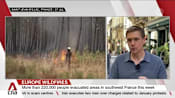
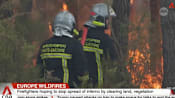
Spain lets wildfire evacuees return but France fears flames spreading
"It has been a horrendous fire, a brutal one - it's a monster that has run over us," said a Spanish mayor, describing the devastation left behind by the flames.
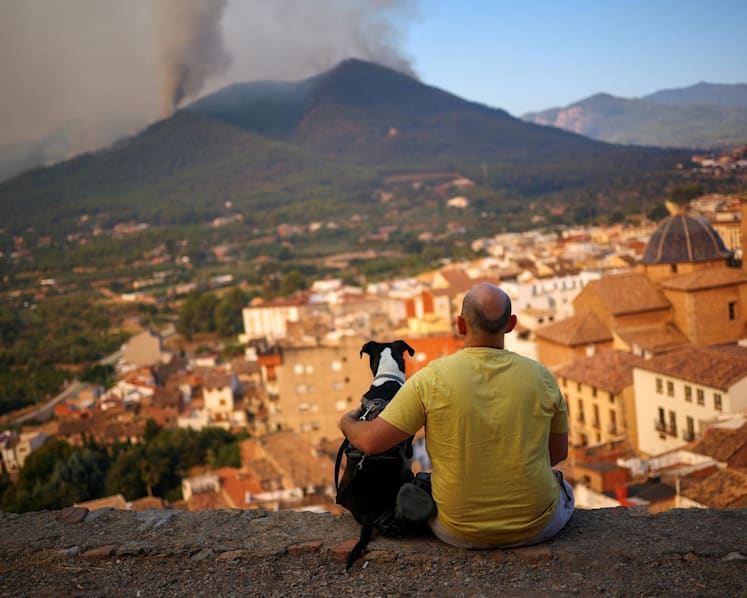
A man and his dog watch as clouds of smoke rise from a wildfire on a mountain in Onda, Spain, Jul 27, 2026. (Photo: Reuters/Pedro Nunes)
Swathes of tinder-dry forests, parched land and property have been destroyed west of the Spanish capital, Madrid, and in France's Gironde and Landes regions, forcing tens of thousands to head to safety.
Spain's interior ministry announced the end of evacuation orders for 15 municipalities on Tuesday afternoon in rare good news.
In the evacuated village of Navas del Rey, AFP reporters saw blackened debris, ash and burnt-out cars.
According to an initial estimate provided to AFP by municipal authorities, around 50 homes were destroyed by the flames and another 50 damaged.
Maria Paz Bolanos, 62, returned with her family to their home and garden in a housing development in the town - and found it only slightly scorched.
"We've been here 50 years," she said. "It must have been my grandfather, my father in heaven. He somehow made it so the fire just came in through and stopped right there.
"It's a miracle."
The mayor of nearby Pelayos de la Presa, Antonio Sin, described the scene as "a war zone".
"It has been a horrendous fire, a brutal one - it's a monster that has run over us," he told AFP.
In contrast, Marielle Mourgeon was among 4,000 people forced to cut short holidays in the French seaside village of Lacanau, in the Gironde area near Bordeaux, after camping sites were told to evacuate as a precaution.
"At first I thought my husband was joking, with the blue sky and the fires dying down," she said.
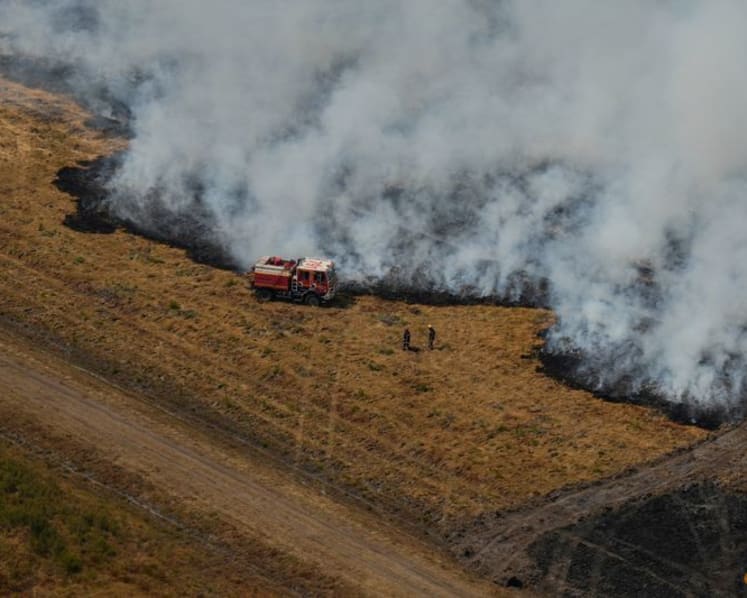
"TURNING THE TIDE"
Sophie Brocas, the government's top official in Gironde, told reporters the fire had "stabilised... meaning it is not advancing", and authorised nearly 60,000 people evacuated from three villages around the city to return.
But she said 14 blazes around it had reignited.
South of Lege Cap Ferret on the Atlantic coast, volunteers have been working round the clock to help firefighters restock with water to tackle a wave of fires.
"We pour 8,000 litres on an area and an hour later it starts up again," said one volunteer, Pierre Marie, after a 12-hour day.
"We fear every day that passes."
The French government will hold a meeting on Thursday to address businesses' "concerns," Industry Minister Sebastien Martin said. The ministry estimates that around 130,000 employees are unable to work due to the fires.
Fernando Casado, mayor of Robledo de Chavela, a village at the northern edge of the flames, was more cautious, calling the fire "a sleeping kitten" at night but "a mighty lion" during the day.
Some 60,000 people were forced to flee the Spanish fires, which have consumed 77,000 hectares (190,000 acres) - an area almost the size of New York City.
Experts warn health impacts persist long after the flames are extinguished, with communities hundreds of kilometres away also at risk from smoke drifting across regions.
“Wildfire smoke (is) estimated to be 10 times as toxic – particularly to children – as regular air pollution from burning fossil fuels,” Lisa Patel, executive director of George Mason University’s Medical Society Consortium on Climate and Health, told CNA’s Asia First programme.
“That's because when a wildfire happens … homes, cars, batteries, chemicals are also being burned in that process.”
The tiny particles can penetrate deep into the lungs and enter the bloodstream, triggering inflammation, said Patel, adding that exposure can worsen respiratory and cardiovascular conditions, increasing the risk of asthma attacks, pneumonia, bronchitis, heart attacks and strokes.
"EXTREME CONDITIONS"
Extreme heat has parched vegetation that had grown vigorously during wet weather earlier in the year, creating tinderbox conditions.
United Nations climate chief Simon Stiell said "the climate alarm is blaring from every direction" and called for a quick end to the use of fossil fuels.
The focus is currently on western Europe but the European Union's head of crisis management warned extreme heat could also trigger new fires in central Europe.
Spain's meteorological agency AEMET announced a new heatwave starting on Wednesday and lasting until at least the end of the week, with temperatures forecast to hit 42C in the northeast and 39C in the centre.
French weather agency MeteoFrance forecast more hot weather in France from Tuesday, with dry wind.
Near the southwestern French surfing hotspot of Le Grand Crohot, an AFP reporter saw violent gusts of wind whipping up flames as firefighting aircraft attempted to extinguish a rekindled fire.
Firefighting commander Matthieu Jomain warned that the conditions were similar to those when the fire started.
"We're not out of danger," added Michael Elicegui, who returned to his home in Biscarrosse in the Landes.