Great Barrier Reef at risk of 'collapse', scientists warn
The reef avoided being listed as endangered in July, despite the United Nations reporting "utmost concern" about mass coral bleaching and the impact of climate change.
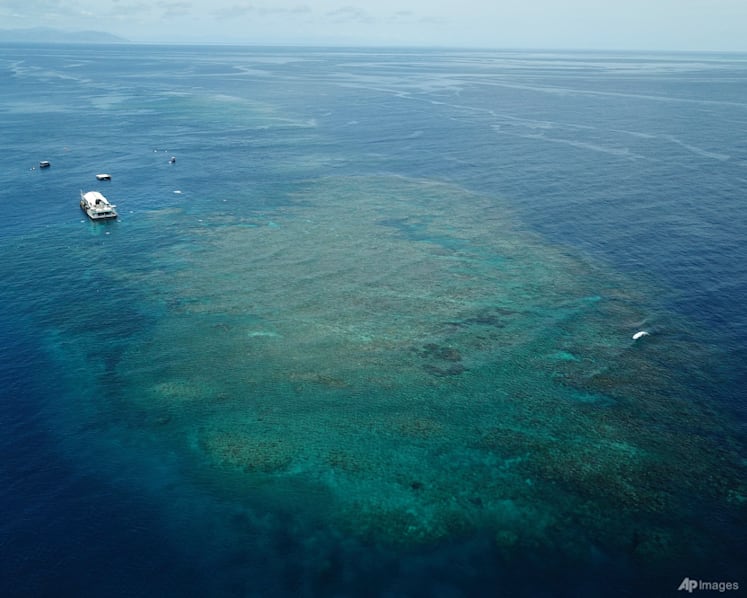
The Remoora pontoon sits above a section of the Great Barrier Reef off the coast of Queensland in eastern Australia on Nov 14, 2022. (File photo: AP/Sam McNeil)
AUCKLAND: Australia's Great Barrier Reef is at a very high risk of extreme and widespread bleaching and "ecosystem collapse" linked to this year's El Nino weather phenomenon, top scientists warned on Tuesday (Jul 21).
Often dubbed the world's largest living structure, the reef stretches 2,300km along the coast of Queensland state and is a major tourism draw for Australia.
This month it avoided being listed as endangered, despite the United Nations reporting "utmost concern" about mass coral bleaching and the impact of climate change.
Morgan Pratchett, a marine conservation ecologist at Queensland's James Cook University, told the International Coral Reef Symposium in Auckland, New Zealand, that the "extreme El Nino" posed a significant concern.





"It's not outside of the realm of possibility that the next major disturbance will lead to localised species extinctions ... and widespread ecosystem collapse," Pratchett said.
This year's El Nino is expected to break records for its overall strength as it warms surface temperatures in the central and eastern equatorial Pacific Ocean, bringing worldwide changes in winds, pressure and rainfall patterns.
"It's a very high likelihood that we'll see very high severity and large-scale mass bleaching on the Great Barrier Reef," Pratchett said.
UNESCO has been monitoring the reef annually since 2021, when it warned it was at risk of being placed on the list of World Heritage items "in danger".
Hard coral cover across the reef declined substantially in 2024-2025, with above-average water temperatures causing the reef's sixth mass coral bleaching event since 2016.
Extreme weather, land-based run-off, coastal development and predation by the Crown of Thorns starfish were also placing the reef under pressure.
Marine studies professor Ove Hoegh-Guldberg from the University of Queensland said a lack of government action had globally threatened the future of coral reefs around the world.
"This could be the precursor to the loss of humans," he said.
"If you were on a big boat, like the Titanic, and someone comes up to you and says the boat's going down, you bloody well get on those lifeboats and start acting and do stuff."
"We're not doing that. The ship is starting to sink in a really massive way, and we're not seeing it as what it is.
"It is so serious."