Iran buries Khamenei after new fighting with US erupts
The burial took place after both the US and Iran launched fresh attacks, raising fears the conflict could escalate further.
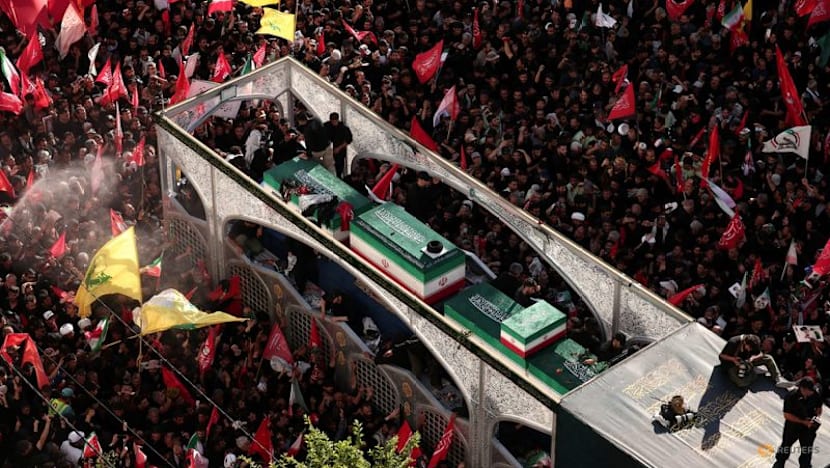
Vehicle transports the coffin of Iran's late Supreme Leader Ayatollah Ali Khamenei and coffins of his family members, on the day of his burial, in a culmination of a mass funeral, in Mashhad, Iran, Jul 9, 2026. (Photo: Reuters/Alkis Konstantinidis)
Khamenei's flag-covered coffin was carried aloft into the shrine of Imam Reza in his home city of Mashhad in eastern Iran as a sea of people waited outside and listened to prayers, with no sign of a public appearance by his son and successor Mojtaba Khamenei.
The "body of the martyred leader of the Islamic Revolution was buried in the memorial hall of the shrine of Imam Reza", state broadcaster IRIB reported.
The burial came after a second day of tit-for-tat attacks by Washington and Tehran's forces, with Iranian officials reporting that US strikes killed 17 people and state media saying one targeted a railway line between Tehran and Mashhad.
The Islamic Republic said it had resumed its attacks targeting US assets in Kuwait, Bahrain and Qatar, while sirens blared in Jordan - another US ally - where the military said it had intercepted eight missiles launched from Iran.
Khamenei was killed alongside close family members on the first day of the US-Israeli war against Iran on Feb 28.
The last of a marathon six days of funeral ceremonies, Khamenei's burial in his hometown of Mashhad was being closely watched for signs of his son Mojtaba Khamenei, who has yet to appear in public since being appointed.
Parliament speaker and chief negotiator in talks with the US, Mohammad Bagher Ghalibaf, powerful chief justice Gholamhossein Mohseni Ejei, and Khamenei's eldest son Mostafa Khamenei were all present at the shrine, with some senior figures weeping over Khamenei's coffin, state TV images showed.
But as on other days of the funeral process, there was no sign of Mojtaba Khamenei, who since being named has only communicated through written statements and is said to have been wounded in the Feb 28 strikes.
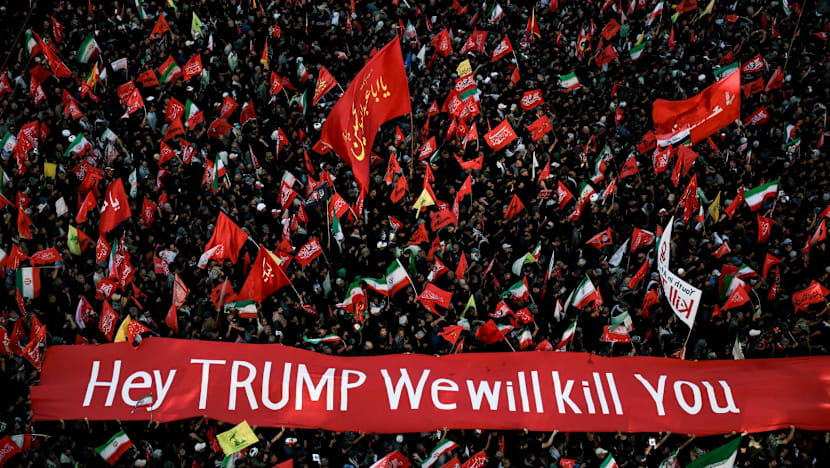
"WE WILL KILL YOU"
The Wall Street Journal meanwhile reported on Thursday, based on anonymous sources, that Israel told the US that their intelligence had detected a new Iranian plot to kill Trump.
The US on Thursday targeted the perimeter of Iran's only civilian nuclear plant with a strike, Iranian state media reported, citing the deputy governor of Bushehr province.
Iranian state media also reported on Thursday that a projectile hit a military headquarters on the outskirts of Bushehr, but a US defence official said that the US military was not currently carrying out any strikes on Iran.
State media said the US targeted a section of the Tehran-Mashhad railway 55km from Mashhad, forcing the closure of the line. Passengers were transferred to buses.
Iran's army said it had targeted a Patriot missile interceptor system in Kuwait, an early warning system in Qatar and fuel tanks in Bahrain with drones, as part of its attacks on US bases in the region.
But a US defence official said the dozens of missiles and drones fired by Iran were either intercepted or caused no significant damage, with no injuries to American personnel.
In a sign of the tense environment, at least one fighter jet escorted the plane carrying Khamenei's coffin to its final burial in Mashhad, footage from the supreme leader's website showed.


"THIRD" ATTACK ON IRAN?
"We are preparing for every scenario," added Prime Minister Benjamin Netanyahu, whose office said he spoke with Trump on Thursday, with the US president providing an update on "American moves in the Gulf".
The Strait of Hormuz, a vital oil and gas corridor, remains a key point of contention, with Tehran insisting on control of the waterway despite it being open to free passage before the war began.
The Iranian military hit at least three ships in recent days, prompting extensive US strikes against Iranian targets from Tuesday.
Traffic through the strait has fallen sharply since Wednesday, especially through the UN-backed Omani route, according to data from maritime tracking firm Kpler, after vessels were attacked earlier this week.