Middle East oil shipping costs surge to all-time high as Iran war intensifies
The cost of hiring a supertanker to ship oil from the Middle East to China surged to an all-time high of over US$400,000 a day.
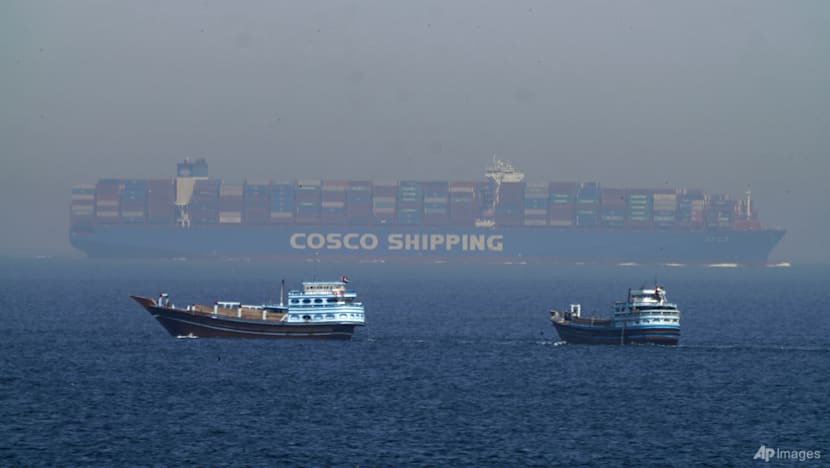
Two traditional dhows sail by a large container ship in the Strait of Hormuz on May 19, 2023. (File photo: AP/Jon Gambrell)
SINGAPORE: The cost of hiring a supertanker to ship oil from the Middle East to China surged to an all-time high of over US$400,000 a day as the United States-Israel conflict with Iran intensifies, with Tehran targeting ships passing through the Strait of Hormuz, LSEG data showed.
Shipping through the strait between Iran and Oman, which carries around one-fifth of global oil, as well as large quantities of gas, has ground to a near halt after vessels in the area were hit as Iran retaliated to US and Israeli strikes.
The benchmark freight rate for very large crude carriers on the route, also known as TD3, rose to W419 on the Worldscale industry measure used to calculate freight rates, as of Monday (Mar 2), or US$423,736 per day, LSEG data showed.
The rate doubled from Friday, extending gains from a six-year high last week, after the US and Israel attacked Iran and killed its Supreme Leader Ayatollah Khamenei on Saturday.
In retaliation, Iran has struck Gulf countries, prompting precautionary shutdowns of oil and gas facilities across the Middle East.
An Iranian Revolutionary Guards senior official said on Monday that the Strait of Hormuz is closed and Iran will fire on any ship trying to pass, Iranian media reported.
However, a shipbroker said it is very difficult to assess oil shipping rates in the Gulf as several shipowners have suspended operations.
Oil prices stabilised in early Asian trade on Tuesday. West Texas Intermediate oil was unchanged at US$71.23 per barrel following a 6.3 per cent rise on Monday.
Brent crude, having gained 7.3 per cent on Monday, rose 1.43 per cent in early trading to US$77.25 per barrel.
In natural gas markets, benchmark European and Asian LNG prices leapt by around 40 per cent on Monday after Qatar's state-run energy firm said it had halted liquefied natural gas production following Iranian attacks.