





GovTech and Google DeepMind developing real-time detection of scams on devices
Organisations will also receive funding through a new grant to protect against quantum threats.
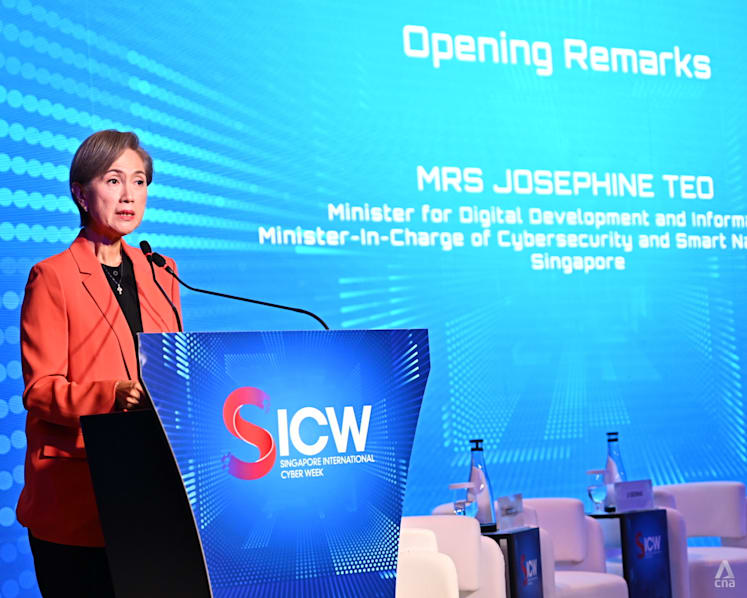
Mrs Josephine Teo, Minister for Digital Development and Information, delivering an opening address on quantum-safe migration at a Singapore International Cyber Week event at the Sands Expo and Convention Centre on Oct 14, 2026. (Photo: CNA/Raydza Rahman)

This audio is generated by an AI tool.


SINGAPORE: The Government Technology Agency of Singapore (GovTech) is collaborating with artificial intelligence research laboratory Google DeepMind to develop real-time detection of scams on devices, Mrs Josephine Teo said on Wednesday (Oct 14).
The Minister for Digital Development and Information, who is also leading the government's efforts in smart nation strategy and cybersecurity, said the collaboration could provide stronger protection while preserving privacy.
"If our devices can recognise signs of manipulation early, we can help potential victims avoid financial or credential loss, while keeping their personal messages on their devices."
Speaking at the Singapore International Cyber Week at the Sands Expo and Convention Centre, she noted that the fight against scams has become "harder to win" because of artificial intelligence.





"Our response should not be to turn away from AI because scammers misuse it. Instead, we must tune up our defences and make them better," she said, adding that Singapore must coordinate its responses more tightly as scammers deploy their tactics across multiple systems.
A victim may first encounter a scam on social media, move to a messaging platform, receive a phone call and transfer money through a financial institution. Each stage offers a chance to intervene, but no single defender sees the whole chain.
"It is therefore not enough to make every organisation better at stopping scams. We must also connect our defences so that a single signal detected on one part of the ecosystem can trigger action elsewhere."
At the same time, AI can be used to detect threats at scale, she said.
For example, the Scam Analytics and Tactical Intervention System by GovTech and the Singapore Police Force uses AI to scan and assess more than 600,000 websites every day, each in a matter of seconds.
It disrupts around 20,000 malicious websites every month, and has expanded to include mobile numbers and online platforms that are suspicious.
This allows Singapore to find and act on threats at a speed and scale that human effort alone cannot match, Mrs Teo said.
The on-device AI model is meant for Android devices, Google said in a press release.
Traditional threat detection relies on server-side scanning of messages in the cloud. But many modern messaging platforms use end-to-end encryption, which means private conversations cannot be inspected.
The AI model will analyse conversational patterns locally, without sending data to external servers. This allows faster analysis, so that users can be alerted to scams in real time.
When a scam is detected, a warning will appear on the user's screen, prompting them to pause before any financial loss or credential theft occurs.
Google said the model is fine-tuned on local scam narratives, including impersonations of public institutions, banks and public figures, as well as trending regional schemes.
It will undergo continuous training to adapt to evolving tactics and to distinguish everyday conversations from the high-pressure, structured manipulation common in social engineering scams.
More details on how users can install and use the model will be announced soon, Google added.
QUANTUM THREATS
Singapore should also pay close attention to quantum-related risks, Mrs Teo said.
Quantum computing uses the principles of quantum physics to solve complex problems. While it holds "enormous promise", sufficiently powerful quantum computers could eventually break some of the cryptography protecting financial transactions, sensitive communications and digital systems, she said.
"We do not know when this will happen. But we know we must prepare for it. Bad actors are already motivated to steal sensitive encrypted data while waiting for quantum computers to decrypt them in future," she said.
For larger organisations, migrating to quantum-safe solutions can take several years. They must assess risks, prioritise systems and data, and identify where current encryption can be broken.
They also need to work with technology suppliers, test alternative encryption methods and progressively migrate their systems, she said.
In June, the Cyber Security Agency of Singapore (CSA) issued guidance on migration milestones for owners of critical information infrastructure, or computer systems that provide essential services. They are expected to complete migration by 2031.
The agency previously identified energy, water, banking and finance, healthcare, transport, infocomm, media, security and emergency services, and government as sectors with such systems.
Mrs Teo said Singapore will issue guidance for other organisations to work towards quantum-safe migration by 2035. These include organisations whose exposure to the quantum threat could have serious consequences, she said.
For example, organisations that hold sensitive information that must remain confidential for many years, and those that provide critical services such as communications or digital transactions where maintaining integrity and confidentiality of information are essential.
A new quantum-safe kickstarter grant will also fund organisations to move from planning to implementation. The time-bound seed funding will help them identify implementation challenges, test quantum-safe solutions in real operating environments and build the experience needed for migration at scale.
The grant is open to all organisations, with priority for owners of critical information infrastructure systems. It will run from Nov 1 to Oct 31, 2027, with each funded pilot lasting up to six months.
Organisations may undertake pilots in-house or work with suitable solution providers, CSA said.
Priority will go to use cases that address common migration challenges, including migrating an application or system from end to end and cryptographic discovery and inventory.
Mrs Teo said neither scams nor quantum threats can be solved by the government alone, or by any country on its own.
"Staying ahead depends not only on what we can build ourselves, but what we can pool together through mutual support," she added.
CYBERSECURITY EFFORTS IN ASEAN
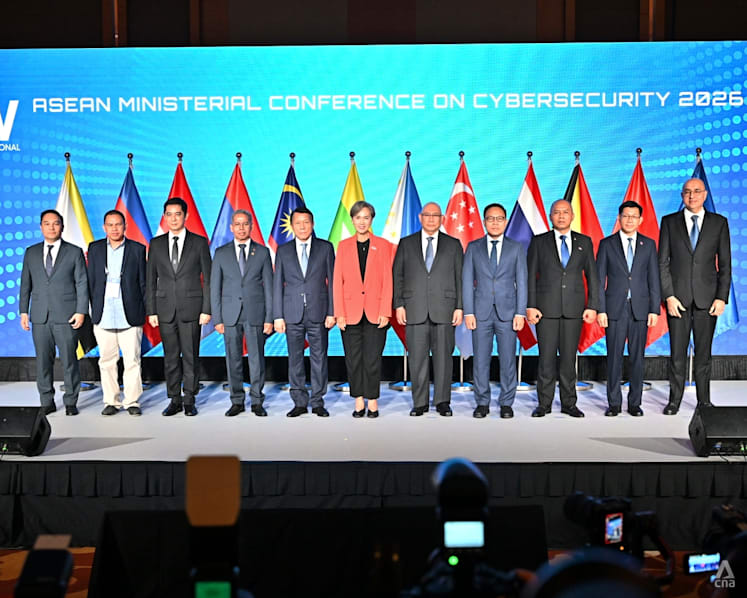
Singapore will invest a further S$30 million (US$23 million) to extend and enhance the ASEAN-Singapore Cybersecurity Centre of Excellence for another five years, Mrs Teo said at the 11th ASEAN Ministerial Conference on Cybersecurity on Wednesday afternoon.
Singapore previously committed S$30 million over five years when the centre was established in 2019 for member states to conduct research, share knowledge and train to respond to cyber threats. The centre has since delivered more than 80 programmes for over 2,200 participants.
Its next phase will go deeper in preparing participants for incident response, critical infrastructure protection, AI-related cyber risks and cyber diplomacy. It will also work with industry and academia to meet ASEAN's evolving needs.
Mrs Teo highlighted three trends amplifying the cyber risks the region faces.
The first is advanced persistent threats, which are sophisticated, targeted cyberattacks.
Singapore saw a fourfold increase in suspected attacks of this kind between 2021 and 2024, she said. One example is the UNC3886 cyberattack, which targeted four major telcos earlier this year.
The second is ransomware, which is now a transnational criminal industry.
Globally, more than 8,200 cases were observed in 2025, or one attack every 64 minutes, she said.
The third is emerging technologies such as AI, which lower the cost of attack.
She cited the hacking of Hugging Face by OpenAI's models as an example of AI's potential as an autonomous cyberattacker.
Together, these trends mean threats are becoming more persistent and prevalent, Mrs Teo said.
"If we do not raise our cyber defence capabilities now, our citizens will likely bear the consequences – through disrupted services, compromised data and lost confidence in the digital systems."
Editor's note: The article has been amended to reflect that the real-time detection applies to all scams and not only AI scams, following clarification from Google.