Hormuz closure, Gulf strikes: What we know about the latest Iran-US attacks
The latest round of attacks came after Iran declared the Strait of Hormuz closed on Sunday.
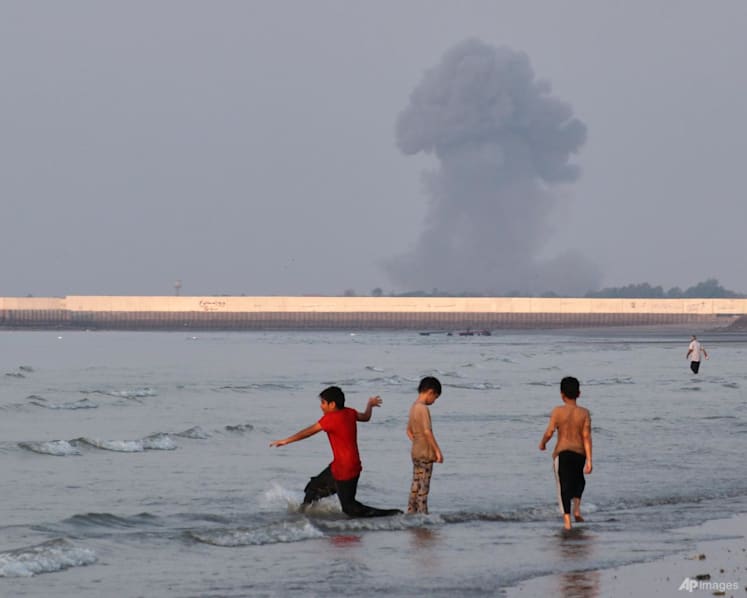
Three boys play in the shallow waters of the Strait of Hormuz, as a plume of smoke rises from an explosion in the background, off Bandar Abbas, Iran, on Jul 13, 2026. (Photo: ISNA via AP/Razieh Poudat)

This audio is generated by an AI tool.


SINGAPORE: Prospects of a lasting end to the Middle East conflict dimmed further over the weekend, as the United States and Iran exchanged another wave of strikes, catching several Gulf states and ships in the crossfire.
Tensions between the two sides have been escalating since last week, with the latest round of attacks coming after Iran declared the Strait of Hormuz closed on Sunday (Jul 12).
As oil prices rise and tit-for-tat strikes continue, here's what we know about how the latest escalation unfolded.
HORMUZ CLOSURE
While Iran’s nuclear programme initially underpinned US involvement in the conflict, control of the Strait of Hormuz has now emerged as the central flashpoint.





Under an interim deal signed in June, Iran had committed to allowing commercial vessels to pass through the strait safely and without charge for 60 days.
That arrangement began to unravel in early July, after Washington accused Tehran of hitting several tankers in the waterway - triggering an initial round of retaliatory strikes.
The latest escalation followed Iran’s declaration on Sunday that the strait was closed, after a vessel travelling on what it described as an unapproved route was struck.
According to Iran’s Islamic Revolutionary Guard Corps (IRGC), the ship had “jeopardised maritime security” by switching off its systems. It also warned that any retaliation over the incident would be met with a “severe response".
Iran did not provide details of the ship, but Oman said a Cyprus-flagged vessel carrying 24 crew members was hit off its eastern coast.
The US military responded on the same day with a new wave of strikes on Iran’s military sites, insisting that the strait remained open.
“The Strait of Hormuz is a vital maritime corridor for global trade. Iran does not control it,” the US Central Command said.
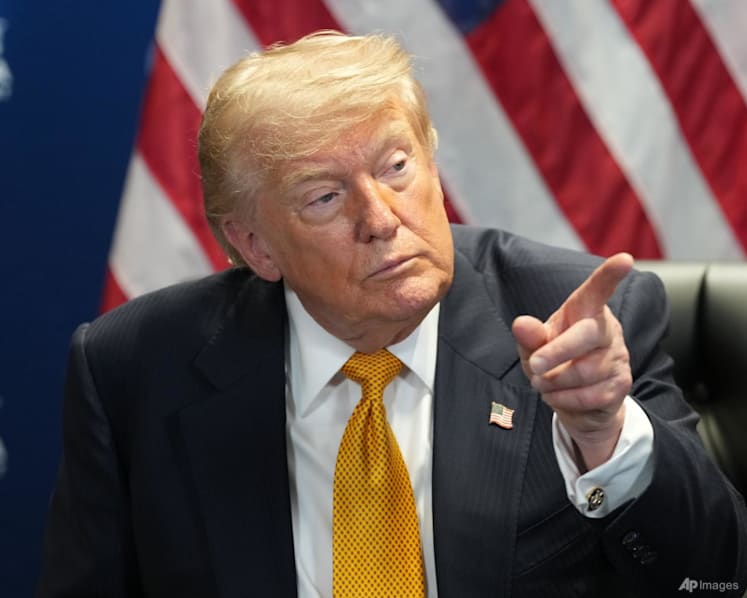
In retaliation, the US also reinstated its blockade of Iranian shipping in the Gulf on Tuesday. US President Donald Trump had proposed charging a 20 per cent fee on cargo passing through the strait as his country acts as its “guardian”.
However, he backtracked on the suggested levy on Tuesday, saying he was replacing it with trade deals with Gulf allies.
WHAT HAS BEEN HIT
As in previous exchanges, Iran’s strikes have targeted countries hosting US military facilities.
Qatar, the United Arab Emirates, Jordan, Bahrain and Kuwait have all been affected in the latest wave of strikes.
The IRGC said on Tuesday that it targeted several weapons support warehouses, a satellite communications centre and the residential building for US forces in Bahrain.
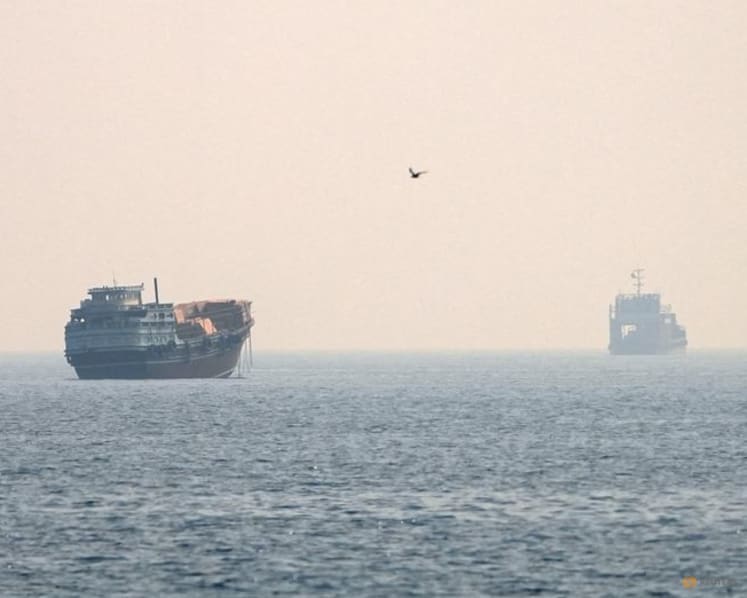
Jordan said the same day that it shot down four missiles from Iran, while the UAE said that Iran also attacked two ships in the Strait of Hormuz with missiles, killing one crew member and wounding eight others.
A Norwegian vessel, belonging to Stolt Tankers, was also attacked off Oman, the MTI Network crisis response company announced.
On the US side, its military has deployed fighter aircraft, naval vessels, one-way attack aerial drones and one-way attack sea drones.
It completed a five-hour mission on Tuesday that targeted military sites across Iran, including Chah Bahar, Jask, Konarak, Abu Musa, Bandar Abbas and Bushehr - the site of its only civilian nuclear plant.
Iran also reported US strikes on the Gulf island of Qeshm and its border area near Iraq and Kuwait.
Over four consecutive days of strikes, US forces said they hit a submarine, a ship maintenance facility, air defence systems, coastal radar sites, as well as missile and drone infrastructure and small boats.
Trump warned that the attacks would get "really bad" for Iran next week, threatening to hit its power plants and bridges.
"We're going to knock out all their power plants. We're going to knock out all their bridges unless they get to the table and negotiate," he told Fox News.
IMPACT ON OIL AND MARKETS
The latest escalation has unsettled global markets, particularly energy prices.
Oil prices rose to a one-month high on Tuesday and extended gains in early trade the next day.
Brent rose to US$86.19 a barrel by 12.29am GMT on Wednesday while West Texas Intermediate was at US$80.40 a barrel. These are still much lower than oil prices after the war broke out.
But investors are increasingly concerned about potential disruptions to supply, given that the Strait of Hormuz handles a significant share of global oil shipments.
Asian stocks were volatile on Tuesday.
A rebound for South Korean shares helped offset declines in Taiwan. Chinese stocks led the gains after stronger-than-expected trade data.
TRUCE UNDER STRAIN
The US and Iran were meant to hold another round of indirect negotiations after the burial of the late Supreme Leader Ayatollah Ali Khamenei.
However, the renewed fighting has cast doubt on the already fragile diplomatic efforts.
Trump said on Jul 8 that the interim peace deal with Iran was over, adding that he was uncertain any future agreement with the Islamic Republic would stick.
Iran has also signalled that the arrangement is faltering. Deputy Foreign Minister Kazem Gharibabadi said the US decision to renew the blockade "has, in a way, dismantled the Islamabad memorandum".
Foreign Ministry spokesman Esmaeil Baghaei said on Monday that Iran would ignore its obligations under the deal if Washington did the same.
Still, both sides have left the door open to diplomacy.
Trump has said a deal with Tehran was still possible, while Baghaei said Iran was continuing talks with mediators from Qatar, Pakistan and Oman to prevent further escalation.